Logistics management across every business unit and legal entity
Let every entity operate on its own terms while leadership sees everything. Agistix consolidates shipment data across every business unit into a single system of record.
Independent execution, unified reporting
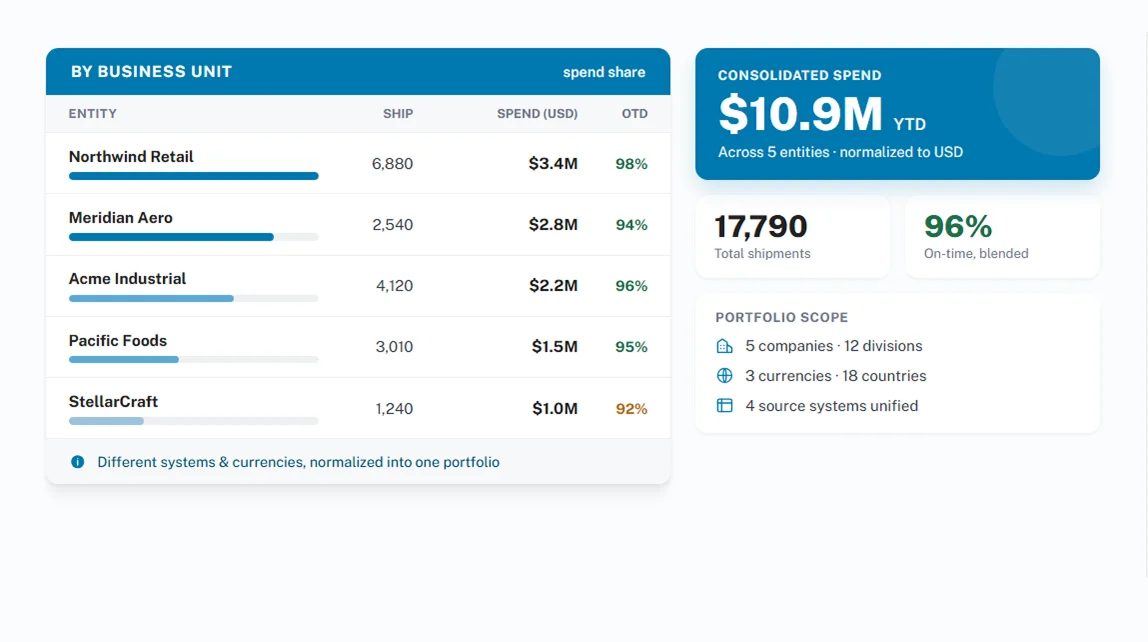
Portfolio-level reporting
A single view across every entity, from PE-backed portfolios to multi-division enterprises.
- Consolidated reporting gives leadership visibility across every business unit, subsidiary, and legal entity in one view
- Drill down to any individual entity, cost center, or shipment without switching systems
- M&A teams can assess supply chain overlap and synergies across newly acquired businesses before systems are fully integrated
- The same data set serves both enterprise-level strategy and day-to-day entity-level operations
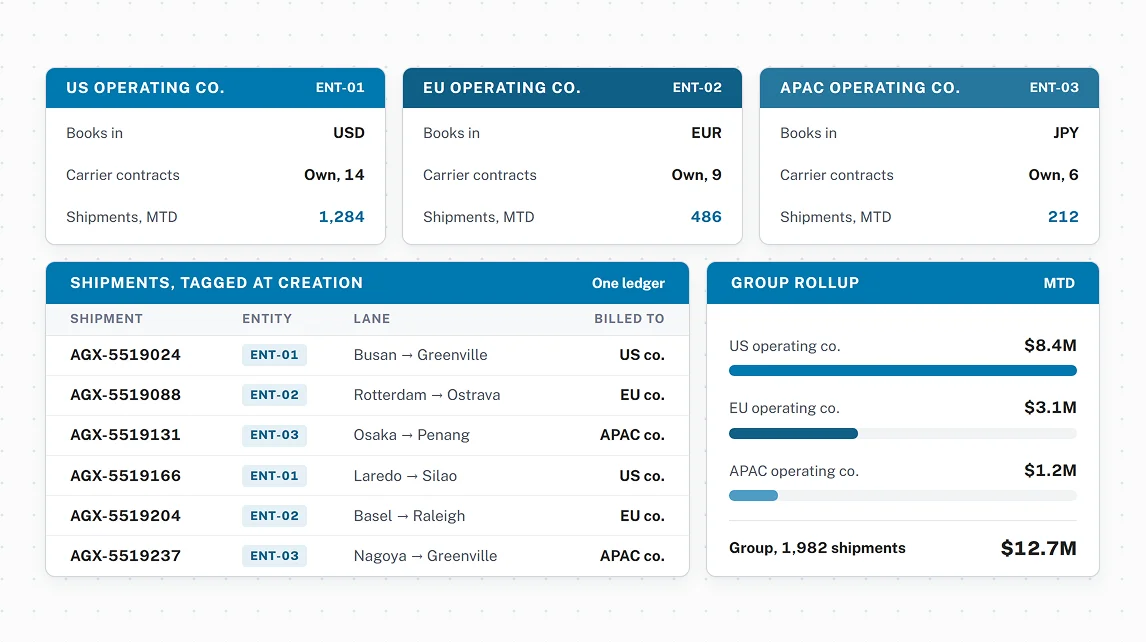
Multi-entity data architecture
Every entity accounted for without manual reconciliation or duplicate systems.
- Every shipment tagged to its originating business unit, cost center, and legal entity automatically
- Costs allocate to the correct business unit, with audit and compliance requirements maintained at the entity level
- Shared platform infrastructure scales across the entire portfolio without duplicating systems or resources for each new entity
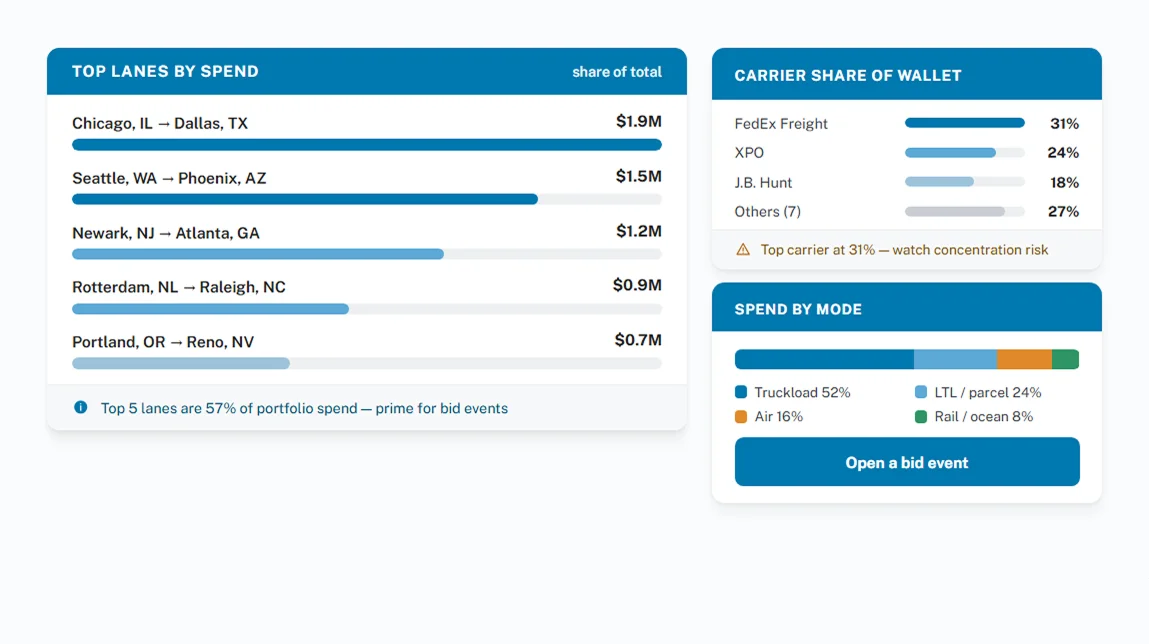
Consolidated rate negotiation
Combined shipment volume rolled into a single carrier RFP.
- Combined shipment volume across all business units creates leverage no single entity has alone
- One negotiation produces one rate set, deployed across the entire organization
- Carriers price for total volume while each entity keeps its own service requirements
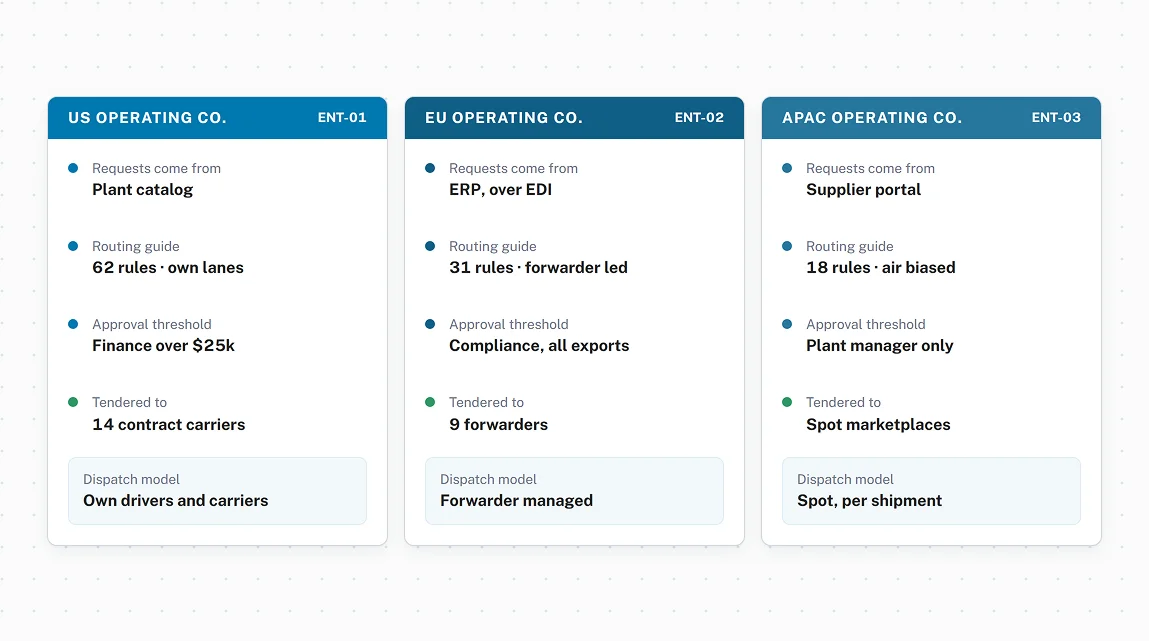
Entity-level routing and execution
Each business unit runs its own logistics operations and workflows.
- Routing guides configurable at the portfolio level or independently per business unit
- Central traffic management and compliance available as a shared service across the entire organization
- Each entity keeps its preferred carriers and approval workflows on the same negotiated rate set
What our customers are saying

Agistix continues to exceed expectations, consistently provide timely support necessary for our project leads, and regularly demonstrate agility and responsiveness.
More to explore across the platform
The world is taking notice



See Agistix in action
Get a firsthand look at how Agistix keeps every business unit connected in one shared platform.
FAQs
Can Agistix support joint ventures and partially owned entities within a multi-entity structure?
Yes. Entity definitions in Agistix support joint ventures, partial ownership structures, and shared service centers, so organizations with complex ownership arrangements can still operate under one unified platform.
What happens when one business unit wants to opt out of the portfolio rate and negotiate independently?
A business unit can operate under its own independently negotiated rates while still reporting through the same platform as every other entity. The portfolio rate set and any entity-specific rates coexist, and routing guides determine which rate applies to which shipment.
Can one entity see another entity's shipment data, or is visibility restricted by default?
Visibility is restricted by default. Each entity sees only its own shipment data unless permissions are explicitly configured to allow broader access, such as for a shared services team managing logistics across multiple business units.