
Supply Chain Analytics in Pharmaceutical Industry: A Guide to Reducing Logistics Risk
Supply chain analytics gives pharmaceutical companies the visibility to catch problems like temperature excursions, customs delays, and compliance gaps before they disrupt patient care. This guide explains what supply chain analytics in the pharmaceutical industry involves, why traditional tracking methods fall short, and how real-time monitoring, risk identification, and cold chain tracking reduce logistics risk.
A single delayed shipment can mean the difference between a hospital pharmacy having enough insulin on the shelf and a patient going without. That reality is what makes logistics in this sector so unforgiving, and it’s why so many manufacturers, distributors, and 3PLs are turning to supply chain analytics to get ahead of problems before they reach a loading dock or a patient’s bedside.
According to 2023 research, 60% of healthcare professionals reported shortages of drugs, single-use supplies, and medical devices, with 74% noting these shortages compromised quality of care. Temperature excursions, missing serialization data, and customs delays cost money and they can take a life-saving drug out of circulation entirely. Add in a web of regulations that changes by country, and it’s easy to see why so many logistics teams feel like they’re managing risk with one hand tied behind their back.
This guide explores why traditional tracking methods fall short, what supply chain analytics in the pharmaceutical industry actually looks like, and how pharma companies are using data to reduce risk without slowing down their operations.
The Growing Complexity of Pharmaceutical Supply Chains
Pharmaceutical supply chain management is highly complex, driven by decentralized manufacturing and specialized medicine. Biopharma companies now routinely source raw materials from one continent, formulate drugs on another, and distribute them worldwide. This geographical sprawl creates immense vulnerabilities, particularly when managing strict cold chain logistics requirements for temperature-sensitive biologics and vaccines.
Compounding these physical logistics hurdles is the challenge of navigating fragmented regulatory compliance frameworks across different regions, where data integrity and serialization rules vary significantly. The industry also faces demand volatility. Spikes in public health needs, combined with lean inventory strategies, frequently lead to critical drug shortages. Managing this intricate web requires a shift from reactive logistics to predictive, data-driven supply chain ecosystems that balance regulatory compliance with agility.
What Is Supply Chain Analytics in the Pharmaceutical Industry?
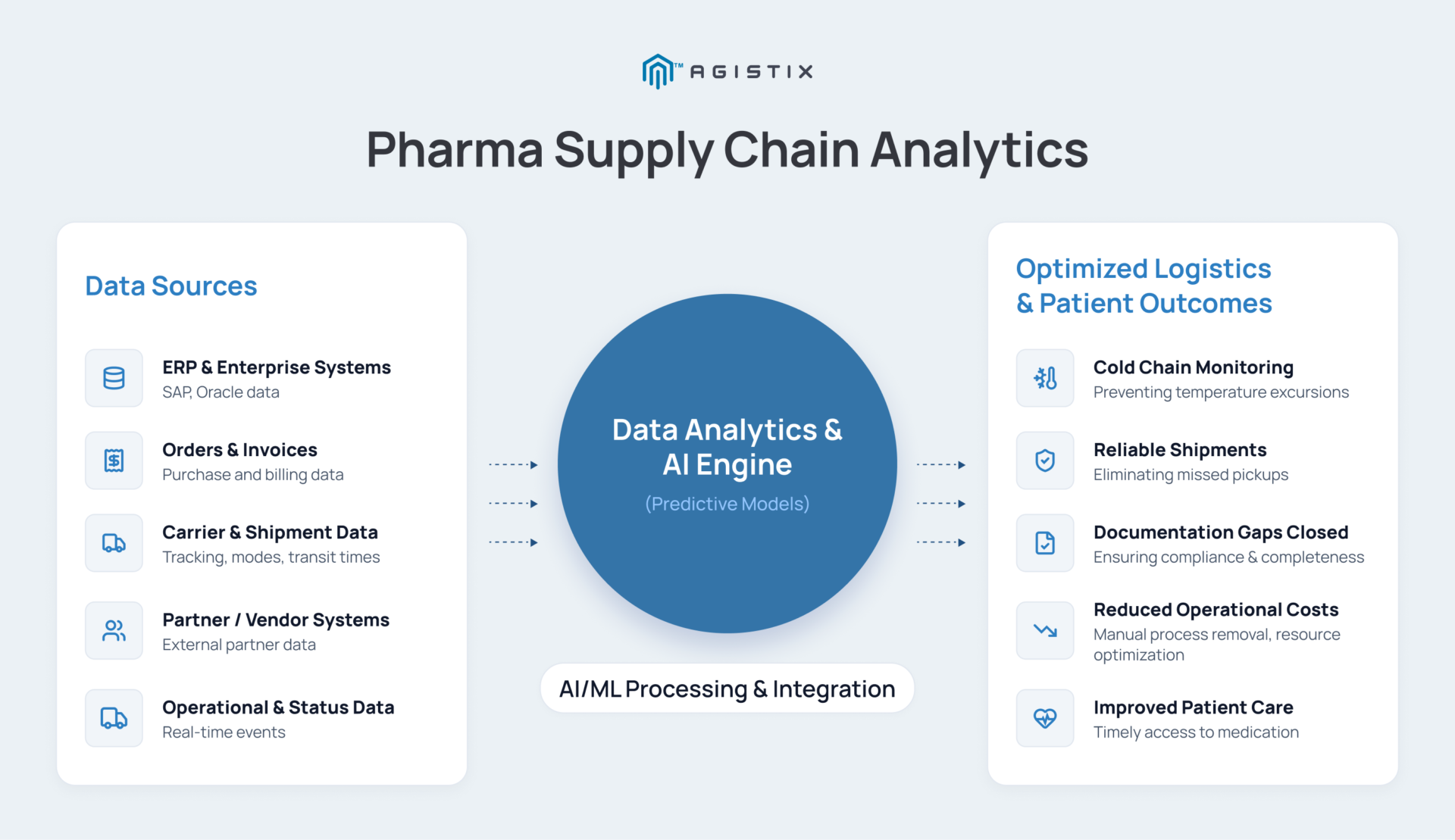
Supply chain analytics in pharma applies data and predictive models to shipment execution, starting with the order and ending with the invoice. Pharma manufacturers, distributors, and 3PLs use it to tie orders, shipments, and invoices together across every carrier and mode. They also use it to flag issues like temperature excursions, missed pickups, or documentation gaps before they affect production schedules and patient care.
Pharma logistics spans multiple handoffs, and analytics needs vary depending on where a company sits in the chain, whether that’s a manufacturer moving finished product to a distribution center, a distributor coordinating multi-carrier delivery to hospitals and pharmacies, or a 3PL managing the last mile. Whichever stage applies, analytics platforms pull order, shipment, and carrier data directly from internal enterprise systems and external partner systems, replacing spreadsheet reconciliation and manual carrier check-ins with live shipment status.
Why Supply Chain Analytics Is Critical for Reducing Logistics Risk
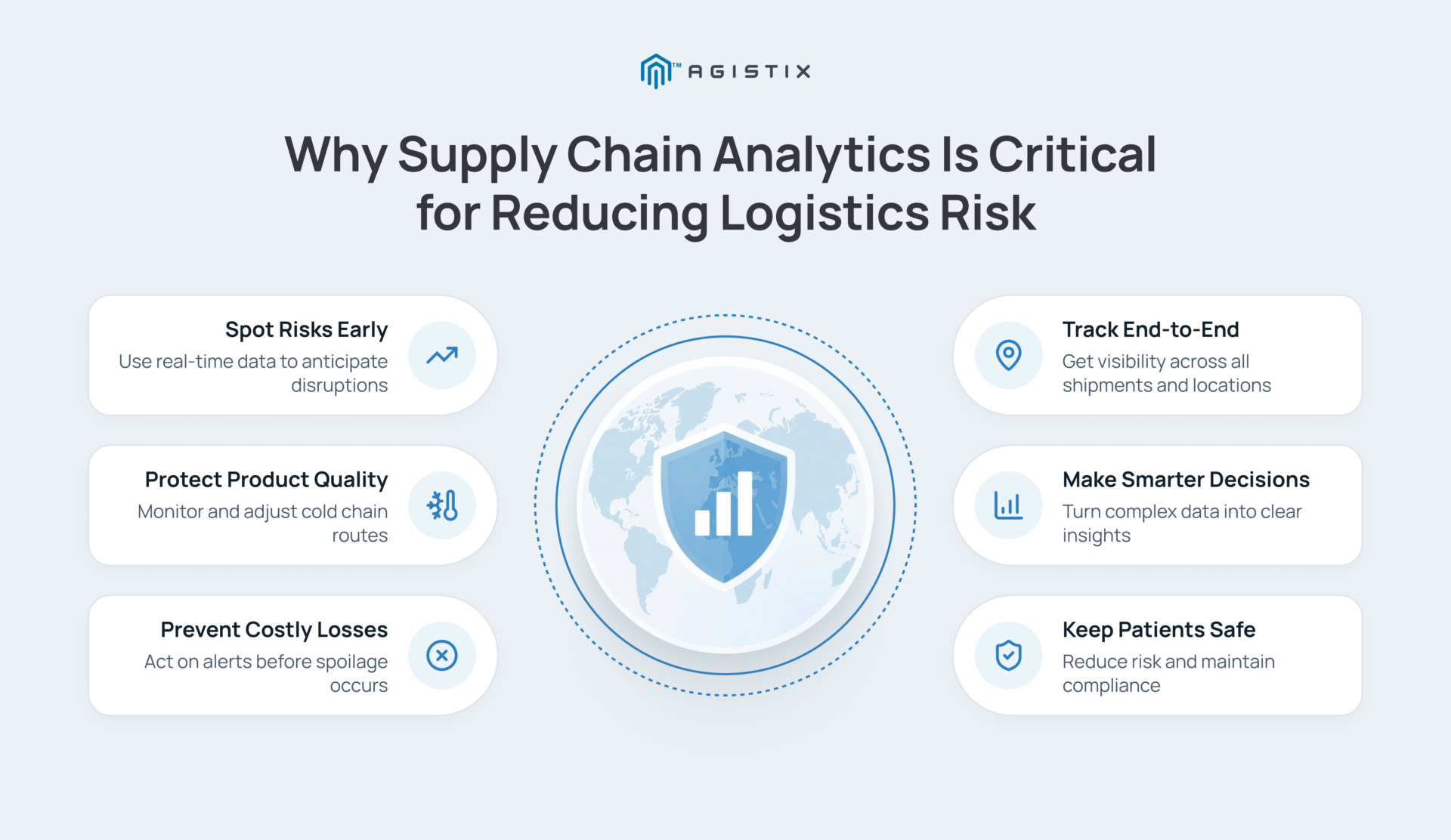
In today’s volatile environment, traditional reactive logistics models are no longer sufficient to guarantee product integrity and patient safety. Pharma supply chain analytics has emerged as a critical shield, transforming massive streams of data into actionable intelligence. A well-planned pharmaceutical supply chain strategy leverages modern technology to anticipate bottlenecks, optimize cold chain routes, and prevent costly product spoilage before it occurs.
Enhanced Visibility and Real-Time Monitoring
Biopharma supply chain analytics integrates real-time data from IoT sensors, ERP systems, and transit logs to create a unified data layer across suppliers, manufacturers, and distributors. This data integration provides comprehensive, end-to-end visibility across every handoff.
Rather than reacting to disruptions, companies use predictive models for proactive issue detection, catching temperature deviations or border delays before inventory is lost. This shared visibility harmonizes operations, enabling automated replenishment, accurate demand forecasting, and improved coordination among stakeholders.
Risk Identification and Mitigation
Analytics identifies supply chain disruptions by continuously evaluating multi-layered risk signals, including vendor financial metrics, historical performance data, port congestion feeds, and live geopolitical news. Supply chain resilience is also bolstered by machine learning models, which flag early warnings, such as a critical supplier failing to meet key milestones. This enables companies to proactively diversify suppliers before a bottleneck halts production.
Furthermore, if severe weather or regional conflicts threaten transit networks, predictive routing algorithms simulate alternative lanes. This allows logistics teams to dynamically reroute shipments away from danger zones, preserving cargo integrity and ensuring a continuous, uninterrupted delivery of goods.
Regulatory Compliance and Traceability
Pharmaceutical regulations, like the U.S. DSCSA and EU FMD, mandate strict serialization and electronic track-and-trace protocols to eliminate counterfeit medicines. This requires unique, unit-level identifiers to be verified at every handoff from production to patient.
Analytics support supply chain compliance by automatically aggregating and validating these massive barcode data streams across disparate stakeholder platforms. By monitoring data integrity in real time, analytics platforms flag scanning anomalies or chain-of-custody gaps before they violate regulations. This creates an immutable, instantly accessible transaction history, guaranteeing constant audit readiness and preventing costly distribution delays.
Cold Chain Monitoring and Quality Assurance
Temperature-sensitive biologics and vaccines demand uninterrupted cold-chain integrity, as minor thermal fluctuations can degrade potency and risk patient safety. Supply chain analytics solves this by continuously processing stream data from GPS-enabled IoT sensors embedded in shipping containers.
Cloud-based analytics platforms monitor real-time variables like ambient temperature, humidity, and door-opening metrics. If environmental thresholds are breached, predictive risk algorithms instantly trigger automated alerts to courier networks. This allows logistics teams to execute corrective actions immediately to prevent expensive product spoilage.
Cost Optimization and Operational Efficiency
Supply chain analytics eliminates operational waste by uncovering hidden efficiencies across transportation, warehousing, and procurement networks. Predictive routing algorithms minimize transportation costs by optimizing shipping lanes based on traffic, weather, and fuel variables. In warehouses, analytics cuts storage fees and inventory carrying costs by dynamically balancing stock levels against live demand forecasts, preventing both overstocking and costly product expiration.
Data-driven supplier evaluation tools also help identify underperforming vendors, allowing procurement teams to confidently consolidate or diversify their networks. By replacing guesswork with precise modeling, pharmaceutical companies streamline logistics, maximize asset utilization, and dramatically lower overall supply chain expenditures.
Improved Decision-Making with AI and Automation
AI-driven insights empower logistics managers to make faster, data-backed decisions by instantly processing complex, multi-layered supply chain data. Machine learning algorithms identify hidden correlations and bottlenecks in real time, shifting operational strategy from reactive guesswork to proactive planning.
AI also automates repetitive tasks like inventory reconciliation, document verification, and customs logging, freeing teams to focus on critical operational exceptions. This automated workflow drastically improves overall responsiveness, allowing biopharma companies to dynamically adjust shipping routes, rapidly manage unexpected disruptions, and ensure a continuous, secure flow of life-saving products to global healthcare networks.
Ultimately, the integration of data analytics shifts biopharma supply chain strategy from a state of constant damage control to proactive, resilient risk management.
What to Look for in Supply Chain Analytics Solutions
With today’s complexity, many biopharma teams are finding that legacy software is no longer sufficient. A modern platform must do more than just generate static reports; it must unify disparate networks, uncover hidden inefficiencies, and empower collaborative supply chain partnerships. When evaluating potential vendors, organizations should focus on several core capabilities:
-
- Real-time data integration: A solution should pull live data from existing ERP, TMS, and warehouse systems instead of requiring manual entry or separate reporting tools. Look for pre-built connectors and open APIs that support fast onboarding without a lengthy IT project.
- Predictive and prescriptive analytics: A platform should anticipate supply chain disruptions and recommend specific corrective actions, not just flag that something went wrong after the fact. Prioritize vendors whose models are trained on pharma-specific variables like cold chain thresholds and customs patterns.
- Risk monitoring and compliance tracking: Customized dashboards should surface vendor risk, shipment status, and regulatory exceptions in one view so teams can act on issues immediately. Compliance tools need to track serialization and chain-of-custody requirements automatically, without manual audits.
- Cold chain monitoring capabilities: The platform should ingest live temperature, humidity, and location data from IoT sensors embedded in shipments. Automated alerts for threshold breaches let teams intervene before a temperature excursion damages the product.
- AI-driven forecasting: Machine learning models should improve demand and disruption forecasts over time by learning from historical shipment and supplier data. This reduces both overstocking and shortages by aligning inventory decisions with real conditions on the ground.
Selecting the right solution is critical for transforming pharmaceutical supply chain processes and turning raw operational data into a resilient, competitive advantage.
Pharmaceutical Supply Chain Analytics in Action
The benefits of robust supply chain analytics aren’t just theoretical. A Fortune 500 healthcare leader leveraged the Agistix global logistics platform to transition from reactive workflows to proactive, data-driven visibility. Facing rapid growth, rising freight costs, and high product spoilage risks for temperature-sensitive shipments, the company implemented automated analytics to unify execution across 15+ transportation partners. This is how analytics supported their efforts:
- Pharmaceutical manufacturing & production: Unifying global execution data allowed teams to optimize production planning by matching manufacturing schedules with precise inbound material tracking, ultimately facilitating future automated routing integration with ERP systems like SAP.
- Distribution & route optimization: The platform reduces delivery delays through real-time carrier tracking and rule-based routing guides. This data-backed optimization achieved 95% on-time performance visibility and generated a 30% year-over-year cost savings by eliminating unnecessary expedited shipping.
- Healthcare providers & medicine availability: By embedding real-time exception alerts for cold-chain monitoring, analytics ensures timely, secure medicine and diagnostic availability. Preventing thermal spoilage guarantees that vital, uncompromised medical tools reach clinical environments exactly when needed to safeguard patient care.

The Future of Pharmaceutical Supply Chains with Analytics
Pharmaceutical companies that adopt supply chain analytics protect patient access to medication and build the resilience to absorb disruptions that would stop a less connected competitor. AI, IoT sensors, and blockchain are widening the gap between companies that catch risk in real time and those still working from static reports and manual checks.
Agistix brings real-time data integration, predictive risk monitoring, and cold chain visibility together on one platform. To see how Agistix can strengthen your pharmaceutical supply chain, book a demo with our logistics specialists.
Frequently Asked Questions
What data sources does a pharmaceutical company need to get started with supply chain analytics?
A pharmaceutical company needs data from existing core systems and sensors to get started:
- ERP, TMS, and warehouse management systems
- Real-time IoT sensors monitoring temperature, humidity, and location
- Carrier and freight forwarder tracking
- Customs documentation
- Historical shipment records
Connecting ERP, IoT, and carrier data into one platform gives teams the clearest picture of risk, rather than reviewing each system separately.
What KPIs should pharma logistics teams track once analytics is in place?
Pharma logistics teams should track on-time delivery rate, temperature excursion frequency, order-to-delivery cycle time, and inventory carrying costs as essential KPIs. Compliance metrics like serialization scan accuracy and chain-of-custody exception rates matter just as much, since they tie directly to regulatory audit readiness. Tracking compliance and delivery metrics alongside freight spend per shipment gives teams a complete view of both risk and efficiency.
How does Agistix’s supply chain analytics support DSCSA and EU FMD compliance?
Supply chain analytics supports DSCSA and EU FMD compliance by automatically validating serialization data and unit-level identifiers at every handoff, rather than relying on manual audits. The platform flags scanning anomalies or chain-of-custody gaps before they become violations. The result is a continuous, auditable transaction history that regulators and internal teams can access instantly, cutting the time spent preparing for inspections.
How quickly can a pharma company expect to see ROI from supply chain analytics?
Many pharma companies start seeing measurable ROI within 6 to 12 months of implementation, often first in reduced expedited freight costs and fewer spoilage-related losses. Full ROI, including gains from better demand forecasting and reduced compliance risk, typically builds over 12 to 24 months as the platform accumulates more historical data to refine its models. Timelines vary based on how many systems and data sources are integrated at launch.
