How to Improve Inbound Visibility Across Complex Global Supply Networks
Many organizations can track individual shipments through carrier portals, yet they still lack true end-to-end visibility into their broader supplier network. This article covers the five layers of inbound visibility, why most companies stall at basic tracking instead of reaching predictive control, and the strategies that turn inbound freight into a reliable, well-managed asset.
Modern supply networks have grown increasingly complex due to global sourcing strategies and the proliferation of multi-tier supplier ecosystems. Navigating cross-border logistics requires managing a web of independent entities across multiple time zones, languages, and regulations. As geopolitical uncertainties and rising disruption risks continue to threaten material flows, organizations face increasing pressure to improve supply chain resilience and secure business continuity.
However, a critical capabilities gap persists. While many enterprises can easily track individual shipments via simple carrier portals, 43% struggle to maintain full visibility into their supply chains. Too often, this is because they still lack true, end-to-end inbound visibility across their broader supplier network. That fragmentation leaves logistics teams blind to tier-two delays and upstream shortages until the bottlenecks finally reach the factory floor.
To overcome these structural blind spots, organizations must move away from reactive tracking and build scalable, data-driven frameworks. This article explores the precise organizational, technological, and operational capabilities required to scale up inbound supply chain visibility. By turning raw operational transactions into centralized insights, businesses can proactively mitigate risk, lower structural costs, and transform an unpredictable freight network into a highly predictable, strategic asset.
Inbound Visibility Is More Than Shipment Tracking
Many organizations mistake basic shipment tracking for true inbound visibility. While the two concepts sound similar, they represent different operational tiers.
Shipment tracking simply shows where a specific piece of freight is at any given moment. These automated updates are typically limited to shipments booked directly within a company’s internal TMS. For shipments falling outside that ecosystem – such as those booked independently by suppliers or third parties – teams must resort to time-consuming manual data entry or track them across fragmented spreadsheets. This approach fails to scale, leaving massive blind spots in the incoming supply chain.
In contrast, comprehensive inbound freight visibility delivers in-depth, proactive intelligence by answering three critical operational questions:
- What is coming: Providing precise, SKU-level data linked to every order and purchase order.
- When it will arrive: Delivering real-time arrival estimates that dynamically update as transit conditions change.
- When action needs to be taken: Generating automated exception alerts for delays, allowing logistics teams to pivot before a bottleneck stalls production.
A successful strategy relies on fixing the inbound freight management visibility gap by capturing supplier-controlled freight data automatically. Ultimately, true inbound visibility is an active decision-making capability that empowers organizations to manage logistics costs, protect production schedules, and build genuine supply chain resilience.
Why Inbound Visibility Is a Strategic Priority
Achieving inbound logistics visibility has become a core business requirement that influences financial health, corporate agility, and long-term market competitiveness. When organizations look beyond simple transportation execution, they unlock massive strategic advantages.
- Mitigating global volatility: Ongoing geopolitical conflicts, economic instability, and unexpected trade wars create a highly unpredictable logistics environment, with 80% of companies experiencing at least one major disruption in the previous year. Organizations must actively build supply chain resilience to insulate their operations from these external shocks. Deep inbound intelligence allows leadership to adapt to shifting market conditions before they impact the bottom line.
- Managing supplier dependencies: Global sourcing networks introduce vulnerabilities when relying on single regions or unvetted partners. Inbound data uncovers critical patterns regarding poor supplier performance and localized disruption risks. These insights empower procurement teams to diversify their supplier networks effectively, securing business continuity and reducing single-source vulnerabilities.
- Balancing inventory and production: Logistics executives face constant pressure to minimize inventory carrying costs without risking line shutdowns. True inbound visibility removes the need for expensive, bloated safety stock by providing reliable, real-time material timelines. This precision protects production schedules from unforeseen transport delays while keeping working capital highly optimized.
The 5 Layers of Inbound Visibility
Many enterprises treat visibility as a single, flat capability, usually limited to tracking a truck or a container. However, true operational control requires a multi-dimensional framework that spans from procurement to the warehouse door.
- Supplier visibility: Monitors supplier capacity, production lead times, and fulfillment commitments. It ensures procurement teams know if a vendor can actually meet demand before materials ever leave the factory floor.
- Order visibility: Tracks individual purchase orders (POs) from initial creation through final fulfillment. Connecting PO line-item details to actual logistics execution bridges the gap between procurement systems and real-world freight operations.
- Transportation visibility: Tracks shipments across multiple transportation modes, global carrier networks, and border crossings. It provides the literal geographic positioning of en-route freight, acting as the foundation for time-sensitive arrival estimations.
- Inventory visibility: Maps en-route goods directly to internal warehouse and manufacturing needs. By understanding the volume and composition of incoming stock, companies can dynamically adjust safety stock levels and reduce storage overhead.
- Exception visibility: Identifies logistics disruptions, like customs delays or missed pickups, in real-time, before they ripple downstream. It flags transit anomalies early, giving teams a critical window to resolve issues before production lines stall.
Mature organizations do not look at these dimensions in isolation. Instead, they integrate all five layers into a unified data ecosystem that supports real-time shipment visibility. Connecting supplier commitments directly to PO lifecycles and transit telemetry turns raw data into an active risk-management engine. This layered approach ensures that a delay automatically triggers updates across transportation schedules and inventory plans, improving supply chain resilience.
Strategies to Improve Inbound Visibility Across Global Supply Networks
Improving inbound operational control cannot be achieved by simply purchasing another point solution. Lasting optimization requires a unified approach that blends technical orchestration, process redesign, and cross-functional alignment. To scale visibility across a multi-tier network, enterprises must execute a series of architectural and operational strategies.
Integrate Supplier and Transportation Data
True inbound control relies on data orchestration rather than simple shipment tracking. Organizations must systematically ingest and correlate diverse data streams, including POs, production updates, and transit milestones. Building seamless integrations with supplier ERPs and global carrier systems via EDI, API, or webhooks removes fragmented information silos. This central infrastructure captures real-time transaction details automatically, even for supplier-managed freight booked completely outside internal TMSs.
Establish Real-Time Visibility Across Modes
A modern inbound network spans diverse geographies and transit types, including ocean, air, trucking, rail, and parcel delivery. Achieving true end-to-end supply chain visibility means eliminating blind spots as cargo moves between these disparate modes. Without cross-modal transparency, multi-week ocean or rail segments remain completely dark, forcing logistics teams to rely on lagging status codes. Centralizing tracking across all modes allows companies to monitor critical milestones at ports, borders, and cross-docks, ensuring constant operational awareness from the origin dock to the receiving bay.
Implement Predictive ETA Capabilities
Traditional tracking is strictly historical, informing logistics teams that a shipment is delayed only after a critical milestone has been missed. Predictive visibility shifts this dynamic by leveraging real-time transit telemetry, weather patterns, port congestion indexes, and historical carrier transit times. Advanced platforms process these variables to generate highly accurate, dynamic arrival forecasts. These predictive ETA capabilities allow material planners to adjust production queues, redistribute labor, or source emergency alternative components days before a transit bottleneck causes a line shutdown, protecting factory throughput and corporate revenue.
Create Cross-Functional Visibility Workflows
Operational efficiency requires every internal stakeholder to be working from the same real-time data. Democratizing shipment information enables automated, cross-functional visibility workflows that transform daily operations. Procurement and inventory planners can dynamically manage safety stock based on actual en-route volumes, while logistics teams can proactively manage gate queues and yard constraints. At the same time, manufacturing leaders can adjust daily assembly line schedules based on concrete arrival data, eliminating costly plant downtime and frantic, last-minute phone calls.
Use Analytics to Identify Emerging Risks
A resilient operational posture requires balancing short-term execution with long-term strategic adjustments. In the immediate term, real-time exception visibility flags ongoing disruptions, allowing teams to act quickly. Over time, capturing this data allows companies to run advanced supply chain data analytics on deep pools of historical performance records. Evaluating historical trends uncovers hidden systemic risks, like recurring lane bottlenecks, structural carrier failures, or chronic supplier lead-time variability. These macro-level insights empower supply chain leaders to redesign networks, update routing guides, and confidently diversify sourcing strategies.
Understanding Inbound Visibility Maturity
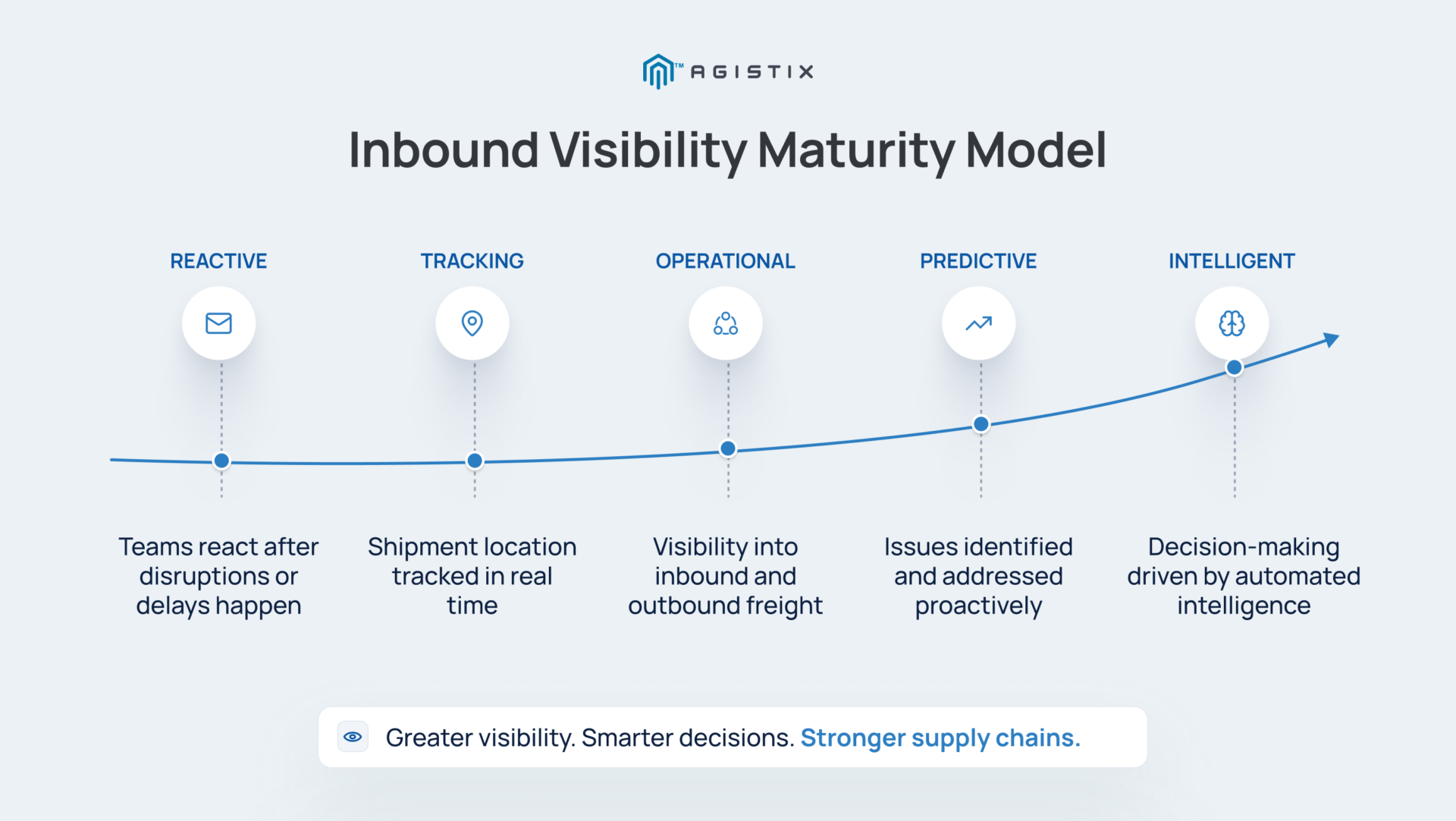
Improving inbound performance requires understanding an organization’s current position on the operational maturity curve. By evaluating internal workflows against a structured maturity framework, supply chain leaders can identify structural bottlenecks and chart a pragmatic path toward total network control.
- Stage 1: Reactive Visibility: Operations at this baseline stage are entirely manual and fragmented. Logistics teams rely heavily on disconnected spreadsheets, emails, and phone calls to track down order statuses. Information is strictly historical, meaning disruptions are only discovered after a shipment fails to arrive, forcing the organization into constant, costly firefighting mode.
- Stage 2: Tracking Visibility: At this stage, companies introduce basic transactional tracking, usually by logging into disparate carrier portals or utilizing GPS location tools. While teams can see where a specific truck or container is at a given moment, the data remains disconnected from purchase orders. Shipments managed or booked by third-party suppliers remain completely dark.
- Stage 3: Operational Visibility: This stage represents a critical shift from tracking to true data orchestration. Organizations integrate multi-modal carrier feeds, supplier ERP updates, and internal TMS data into a centralized architecture. Line-level PO data is directly tied to physical transit milestones, allowing teams to view what inventory is en route rather than just seeing a moving container.
- Stage 4: Predictive Visibility: Mature enterprises use this stage to move from real-time monitoring to proactive risk mitigation. By blending live transit telemetry with external variables like port congestion indexes, weather patterns, and labor disruptions, the system generates dynamic, predictive ETAs. Material planners receive automated exception alerts days before an upstream bottleneck impacts production.
- Stage 5: Intelligent Visibility: The highest tier of maturity shifts the system from predictive forecasting to autonomous recommendation and execution. At this level, advanced data models analyze incoming exceptions and instantly recommend optimal rerouting strategies, alternative suppliers, or expedited freight options. The network self-corrects in real time, transforming the inbound pipeline into an entirely predictable asset.
How Leading Organizations Turn Visibility Into Resilience
When global enterprises move beyond basic shipment tracking, they unlock a self-optimizing operational loop. Organizations that successfully modernize their inbound infrastructure achieve faster risk detection, more efficient exception handling, and better control over costs and schedules. By reducing operational disruptions, these companies ultimately deliver stronger customer service, transforming their incoming supply chain into a reliable growth driver.
Agistix gives logistics teams the tools to build that infrastructure. The logistics execution and visibility platform automatically captures inbound data from suppliers, carriers, and brokers, consolidating every shipment into a single record regardless of who booked it. From there, it flags routing guide deviations, estimates freight cost on shipments that arrive without pricing data, and pushes exception alerts the moment a delay or missed pickup occurs. If you’re ready to see what Agistix’s visibility and analytics capabilities can do for your inbound network, schedule a demo today.
Frequently Asked Questions
What is inbound visibility in supply chain management?
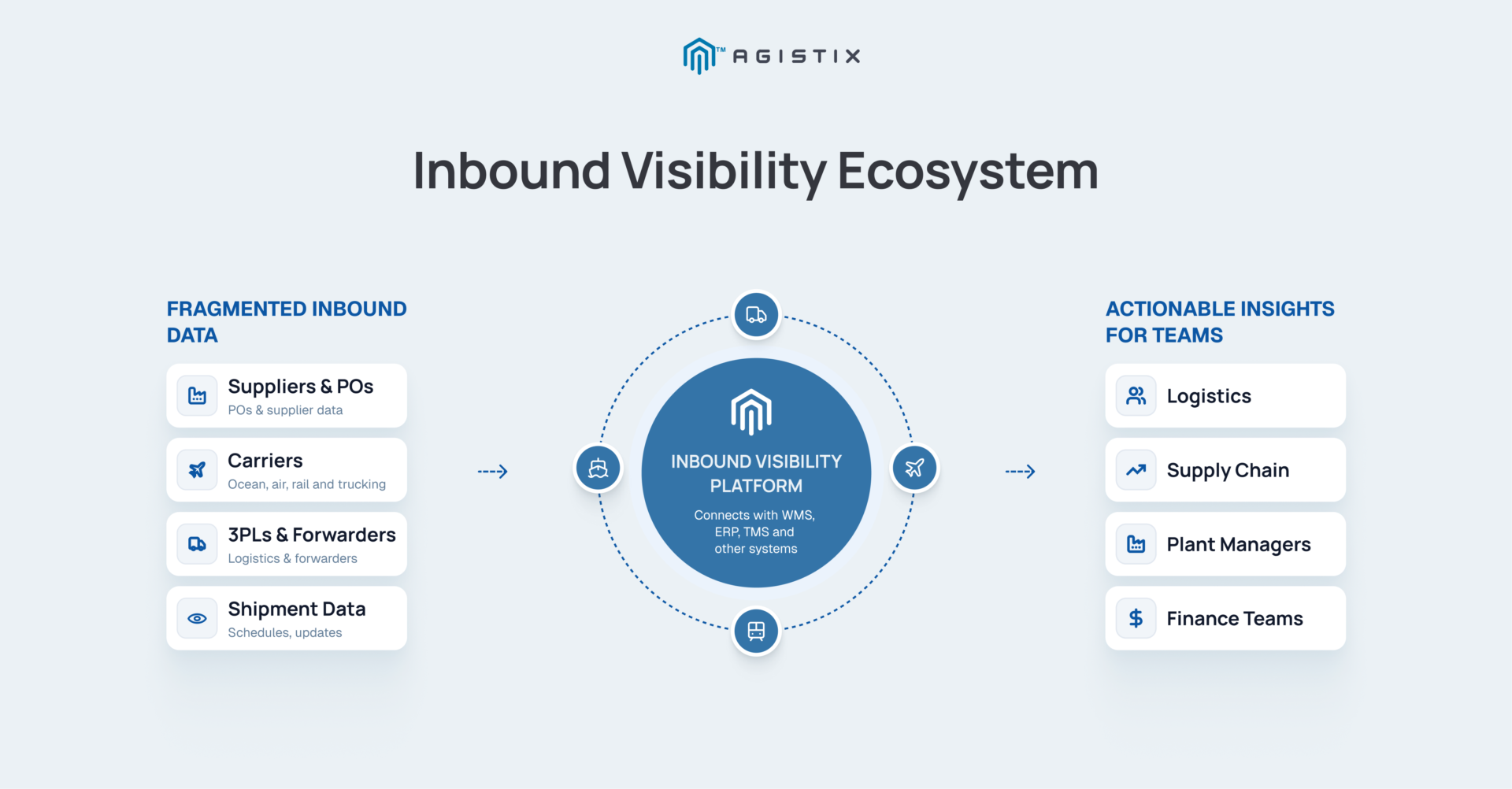
Inbound visibility refers to the ability to see, track, and analyze materials, sub-assemblies, and purchase orders moving toward an organization’s production facilities or warehouses. A true visibility platform ingests raw transaction data from supplier ERPs, carrier portals, and Transport Management Systems, consolidating it into a single, unified source of operational truth.
Why is inbound visibility important?
Operating without deep inbound tracking leaves companies exposed to severe material shortages, stockouts, and unexpected logistics costs. Improving your visibility is a foundational step in building long-term supply chain resilience.
How is inbound visibility different from shipment tracking?
Basic shipment tracking is a passive function that simply shows the point-in-time geographic location of a specific truck or container. Automated updates are usually limited to shipments booked directly within a company’s internal TMS, leaving supplier-managed freight completely dark. On the other hand, true visibility is an active decision-making capability.
What technologies improve inbound visibility?
Achieving comprehensive network awareness requires robust data orchestration rather than isolated point solutions. The most critical component is an advanced supply chain data analytics engine that can ingest these multi-modal data streams, clean the information, and automatically correlate physical carrier milestones with underlying purchase orders.
How can organizations improve visibility across global supplier networks?
Organizations can bridge the traditional inbound freight management gap by moving away from disconnected spreadsheets and manual communication loops. By centralizing these data streams into a cross-functional workflow, every department—from procurement to manufacturing—gains immediate access to identical, real-time shipment updates, enabling proactive risk mitigation across the entire global network.
