7 Supply Chain Visibility Challenges Businesses Can’t Ignore in 2026
Most supply chain visibility problems don’t stem from a single failure. They build up across disconnected systems, manual processes, and data that arrives too late to be useful. This article covers the seven supply chain visibility challenges that affect logistics operations most in 2026, where each gap usually manifests, and what it takes to close them.
Supply chain visibility determines whether a logistics team catches a disruption while there’s still time to act, or hears about it from a disgruntled customer asking where their shipment went. Global supply chains now run across more partners, transportation modes, and systems than most organizations can monitor manually, and that complexity outpaces manual checks and disconnected reporting.
Meeting expectations for real-time visibility requires connected, accurate data, yet many companies still fall short of it despite years of technology investment in their logistics systems. Visibility gaps have real consequences, like delayed decision-making and increased freight costs. This article takes a closer look at the supply chain visibility challenges businesses face in 2026 and the capabilities needed to move toward a connected, transparent logistics operation.
What Is Supply Chain Visibility?
Supply chain visibility is the ability to track goods, inventory, suppliers, and shipments across every stage of the logistics process, in real time. Traditional tracking systems told a company where a shipment was at its last scan, while GPS and IoT technology later enabled more accurate location tracking. But even those advancements left much to be desired in visualizing the freight lifecycle.
Modern end-to-end visibility connects every leg of a shipment’s journey, every supplier tier, every rate agreement, and every system that touches that data into a single view. Visibility built on scattered, after-the-fact updates can only confirm a shipment was delayed once a customer or production line has already felt it. Visibility built on connected, real-time data flags that same delay early enough to reroute the shipment, adjust a production schedule, or notify the customer before a delivery window is missed.
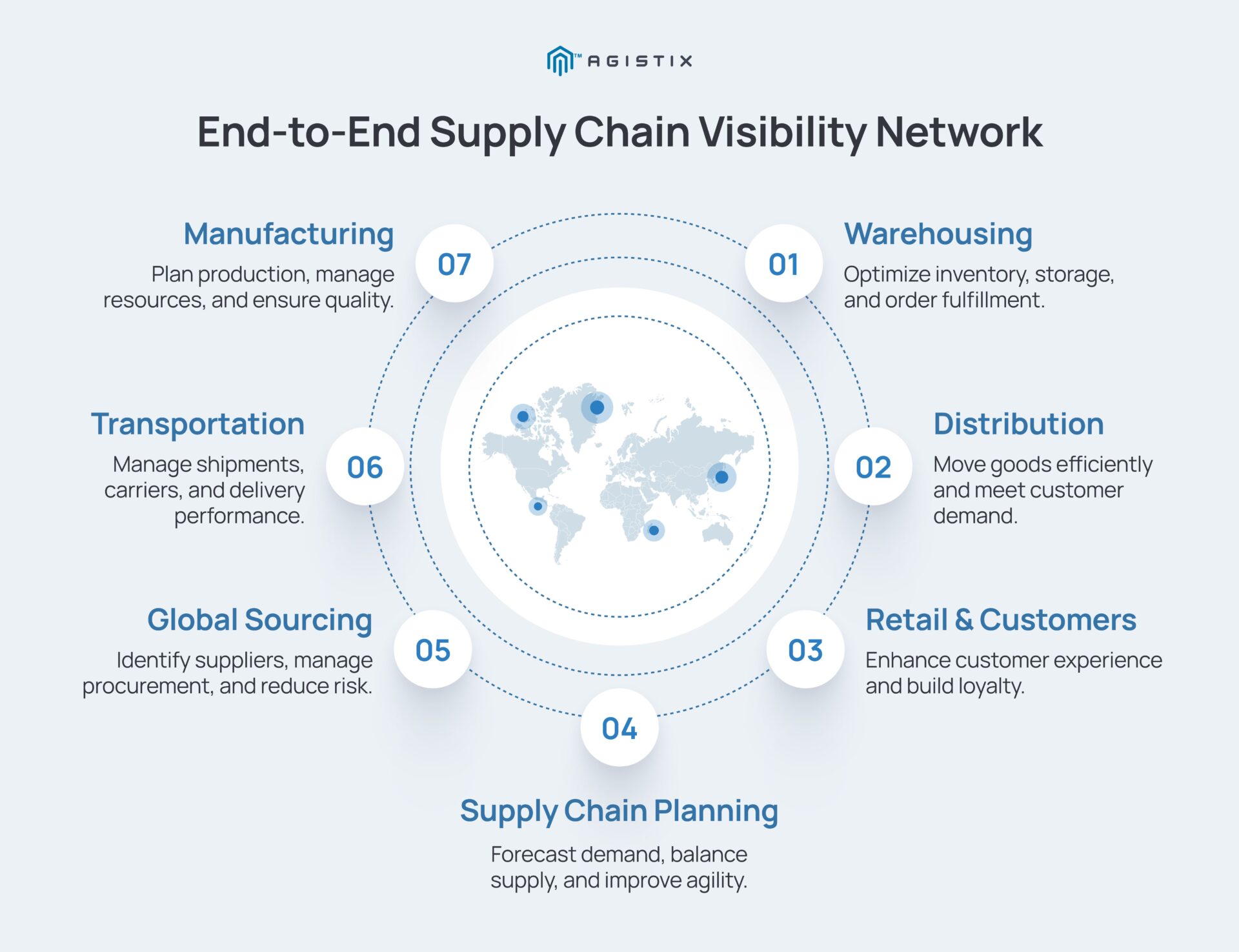
7 Supply Chain Visibility Challenges Businesses Face Today
Supply chain visibility issues and barriers are rarely obvious until a shipment shows up late or a customer asks where it is. The seven challenges below explore where those gaps usually start.
Data Silos Across Systems and Partners
Most logistics operations run ERP, TMS, WMS, carrier, and supplier systems that weren’t initially designed to communicate with each other. In fact, only 41% of supply chain operators report having an integrated data network today, leaving the majority of organizations working from siloed, disconnected data sets. Each platform holds its own piece of the shipment picture, and without integration, no one sees the complete shipment record in one place.
Inconsistent formatting makes data hard to compare, and limited visibility between systems delays decisions that depend on accurate, current shipment updates. Data integration platforms solve this by pulling data from every system into one shared shipment record. Carrier data, ERP data, and TMS data all reflect the same shipment status instead of three different versions of where a shipment actually is.
Limited Real-Time Shipment Visibility
Far too many logistics operations still rely on manual status checks instead of live data feeds. An astounding 70% of manufacturers still collect shipment and operations data manually rather than through automated systems. Of course, manual data collection naturally introduces delays and errors. ETAs calculated from outdated information are frequently wrong, which pushes logistics teams into reactive mode instead of getting ahead of problems. End-to-end supply chain visibility solutions close the gap by automating real-time data collection and eliminating the reliance on manual workflows.
Lack of Visibility Beyond Tier-1 Suppliers
Most visibility solutions stop at the first layer of the supply chain. According to recent McKinsey reports, 95% of supply chain leaders report having transparency into Tier-1 supplier risks, but only 42% say they have that same transparency into Tier 2 and beyond.
That gap often hides critical risks. A disruption at a Tier-2 or Tier-3 supplier can shut down production just as quickly as a problem with a direct supplier, but without visibility into that tier, the warning signs never reach the team that needs them. Compliance teams face the same blind spot when documentation and sourcing data stop at the first tier. Multi-tier visibility is increasingly becoming a baseline expectation as supply chains add more layers of subcontracted and outsourced production.
Managing Disruptions and Unexpected Events
Major supply chain disruptions are now a part of the standard operating environment, and they rarely follow a predictable script. Common causes of disruption include:
- Severe weather along key transportation routes
- Geopolitical events affecting trade lanes or ports
- Labor shortages at ports, warehouses, or carriers
- Transportation capacity constraints during peak demand
Adding to the problem, half of supply chain operators in 2026 report a lack of confidence in their ability to respond to disruptions like these when they occur. Visibility gaps undoubtedly drive that lack of confidence. A team that cannot see early indicators of a disruption has no way to act on it before it affects the flow of goods. Identifying a delay early, even by a few hours, gives a logistics team room to reroute, expedite, or notify the customer before the disruption impacts downstream operations.
Poor Data Quality and Inconsistent Reporting
Visibility is only as useful as the data behind it, and across most supply chains, that data has real quality problems. In fact, 87% of supply chain operators say poor data quality has limited their organization’s ability to get value from digital initiatives. Conflicting data between systems erodes trust in the numbers, and inaccurate or incomplete records throw off forecasts. That problem doesn’t stay contained to spreadsheets and dashboards either. It follows the data straight into the supply chain AI tools now showing up across logistics operations.
A forecast or exception alert generated by an AI model is only as accurate as the data feeding it. Bad data doesn’t just produce a single bad output. It can amplify a small inconsistency into a confidently wrong recommendation that an entire team acts on. Strong data governance helps minimize that risk, giving teams the clean, connected data that makes AI-driven analytics reliable and trustworthy.
Difficulty Turning Data Into Actionable Insights
Many organizations now collect more data than they know what to do with. More data doesn’t automatically mean more insight, and pairing that volume with poor data quality only adds noise. Logistics teams end up sorting through dashboards and reports without a clear answer to the questions that matter to their day-to-day operations and long-term goals. Supply chain data analytics close that gap by converting raw shipment and transaction data into specific, actionable recommendations.
Scaling Visibility Across Global Operations
Visibility solutions that work in one region or for one mode are often limited once an operation scales. Every new region or mode comes with its own data formats, reporting standards, and local partners, and most visibility platforms aren’t built to absorb that complexity without losing consistency. Common variables include:
- Multiple regions and time zones
- Different transportation modes
- Local language and documentation requirements
- Varying regulatory environments
Scalable visibility platforms apply the same data structure and reporting logic across every region and mode, so growth doesn’t mean rebuilding the visibility process each time a new market or carrier comes online.
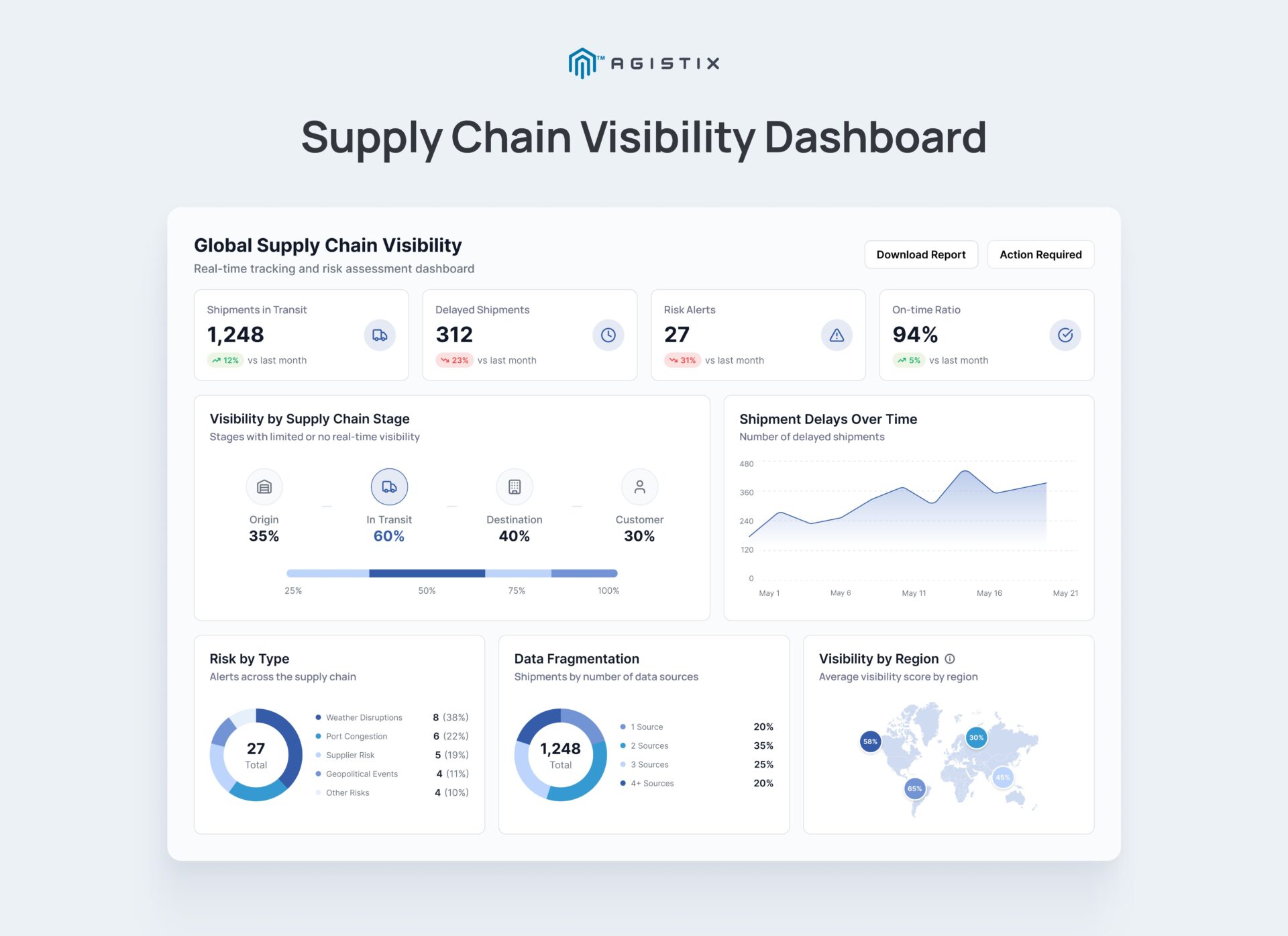
Image Recommendation: Supply Chain Visibility Challenges Dashboard. A dashboard highlighting visibility gaps, shipment delays, risk alerts, and fragmented data sources. Alt Text: supply chain visibility challenges affecting global logistics operations
How Businesses Can Overcome Challenges in Supply Chain Visibility
The supply chain visibility problems above all trace back to data that’s disconnected, incomplete, or arriving too late to act on. Addressing and overcoming these challenges requires adopting five connected capabilities.
- Data integration across systems: Connecting ERP, TMS, WMS, and carrier systems into one shared data set removes the silos that cause inconsistent and delayed information in the first place.
- Real-time shipment tracking with automated alerts: Live event data replaces manual status checks, and exception-based alerts flag deviations the moment they happen.
- Supplier collaboration across tiers: Extending visibility past Tier-1 suppliers surfaces upstream risk before it becomes a production or compliance problem.
- Predictive analytics and AI-powered insights: Once the underlying data is clean and connected, predictive models can flag likely delays and disruptions before they occur, giving teams an opportunity to take proactive steps to mitigate them.
- End-to-end visibility platforms: Bringing the four capabilities above into one system is what makes them durable. A platform approach keeps data centralization, real-time tracking, supplier collaboration, and predictive analytics working together instead of as separate point solutions.
Together, these capabilities provide comprehensive solutions to supply chain visibility challenges. Organizations that integrate them into their operations can move from reacting to disruptions to anticipating them and building more resilient supply chains.
Turning Visibility Into Supply Chain Resilience
Supply chain visibility issues cost organizations more than just delayed shipments. Disconnected data, manual processes, and blind spots beyond Tier-1 suppliers all add up over time, and the result shows up as higher transportation costs, inventory inefficiencies, and disruptions that take longer to resolve than they should.
Closing those gaps starts with connecting the data sources that already exist across an organization’s logistics network. From there, real-time tracking, supplier collaboration, and predictive analytics turn that connected data into action across the organization. Agistix brings these capabilities into a single supply chain visibility and analytics platform built to scale across regions, modes, and partners. Request a demo to see how integrated visibility can change how your logistics operations run.
Frequently Asked Questions
What technologies will shape supply chain visibility beyond 2026?
Several emerging capabilities are defining the next phase of supply chain visibility:
- AI-powered logistics intelligence: Identifies patterns in shipment and carrier data to surface risks and inefficiencies that manual analysis would miss.
- Predictive disruption monitoring: Flags likely delays and disruptions before they affect delivery, giving teams time to act rather than react.
- Digital control towers: Bring multimodal shipment data into a single operational view across every region and mode, replacing fragmented monitoring across separate systems.
- Real-time transportation visibility: Extends live tracking beyond the primary carrier to every leg of a shipment’s journey, including last-mile and intermodal transfers.
- Deeper supplier transparency: Pushes visibility past Tier-1 to surface upstream risks before they reach production or compliance teams.
How does poor supply chain visibility impact business performance?
Poor supply chain visibility drives up transportation costs, delays deliveries, and reduces customer satisfaction. Without an accurate, real-time view of shipments and inventory, teams overpay for expedited freight and hold excess safety stock to compensate for unreliable ETAs. Disruptions get the same treatment, handled after they happen instead of before. Each of the visibility gaps above carries its own version of that outcome. More cost, slower response, and lower resilience across the supply chain.
How does AI improve supply chain visibility?
AI improves supply chain visibility by identifying patterns in shipment and disruption data that would take a logistics team far longer to find manually. Predictive models can flag a likely delay based on historical performance on a given lane, carrier, or route, and exception management tools can prioritize which disruptions need attention first. AI performs this work well only when the underlying data is accurate and complete. Data quality and integration are what make an AI-powered visibility tool dependable in the first place.
What's the difference between supply chain visibility and supply chain transparency?
Supply chain visibility refers to the ability to track and monitor shipments, inventory, and suppliers as they move through the logistics network. Supply chain transparency goes a step further, covering how openly that information is shared with partners, customers, and regulators. A company can have strong internal visibility into its own operations while still lacking transparency if that information never reaches the stakeholders who need it. Both depend on the same underlying data, but transparency is about who that data reaches, while visibility is about how completely it is captured in the first place.
