
Automating Supply Chain Compliance: Reducing Manual Errors in Global Trade
Managing supply chain compliance across global trade is operationally demanding and leaves little room for manual error. This article explores what supply chain compliance automation is, why manual processes create compounding compliance risks, and how automated systems give organizations the infrastructure to manage regulatory requirements accurately and at scale.
Global trade operates across a dense layer of overlapping trade laws, customs requirements, export controls, and documentation standards, each governed by its own jurisdictional rules and enforcement mechanisms. This creates multiple sets of requirements that must be tracked, applied correctly, and documented consistently across every shipment and every market.
Managing that complexity manually is burdensome and unsustainable, as spreadsheets and disconnected systems create documentation gaps and misclassifications that translate into fines and shipment holds. Supply chain compliance automation addresses this problem directly: replacing error-prone manual logistics processes with real-time data validation, standardized document generation, and integrated systems that enforce consistency at scale.
The Challenges of Supply Chain Compliance in Global Trade
Recent industry research finds that 77% of executives report their company was negatively impacted to some extent by compliance complexity. Several factors contribute to that complexity and introduce supply chain regulatory compliance challenges:
- Evolving regulations: Trade agreements take years to negotiate and implement, but when they change, they affect tariff classifications, rules of origin, and documentation requirements across every impacted trade lane. Companies without a structured process for monitoring and applying those updates often don’t discover the gap until a shipment is held up at the border.
- Manual documentation processes: Industry data shows 69% of compliance and supply chain teams spend 11 or more hours each week on manual data translation to standardize formats for regulatory submissions. That’s time wasted on tedious formatting instead of critical oversight and exception management.
- Cross-border requirements: Every market a company operates in adds its own documentation standards, certification requirements, and import/export controls. Managing those requirements manually across even a handful of trade lanes creates significant compliance vulnerabilities.
- Fines, delays, and shipment holds: A missing field, an incorrect HS code, or an expired certificate can stop a shipment at the border. The resulting fines, delays, and rerouting costs are the direct consequence of documentation that wasn’t verified before submission.
What Is Supply Chain Compliance Automation?
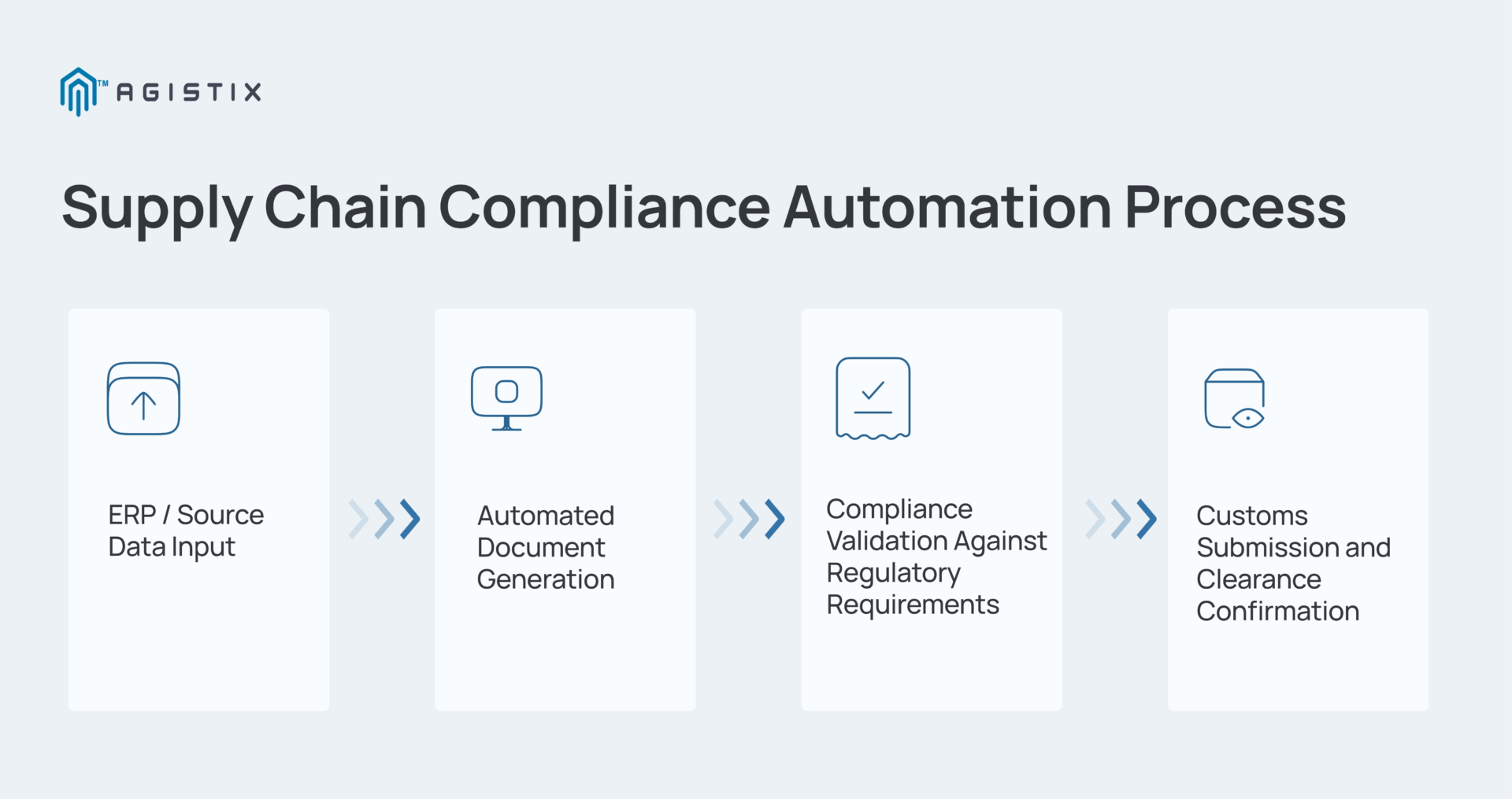
Supply chain compliance automation is the application of digital systems to manage regulatory requirements, documentation, and reporting across global trade operations. Rather than relying on manual data entry and human review, automated systems validate data in real time, apply standardized workflows to document generation and submission, and integrate directly with customs authorities and internal enterprise systems.
Where traditional compliance methods depend on teams manually cross-checking documentation against applicable requirements, automated regulatory compliance tools centralize regulatory data, apply consistent logic across every transaction, and flag exceptions for human review. Classification codes are verified against tariff schedules, and certificates and declarations are generated directly from structured transactional data rather than assembled by hand.
Why Automating Supply Chain Compliance Is Critical
As trade volumes grow and regulatory environments expand, manual compliance in supply chain management oversight creates compounding risk. Each additional market or product category introduces new documentation requirements and classification decisions to manage. Automation provides the infrastructure that makes scaled global trade operationally viable.
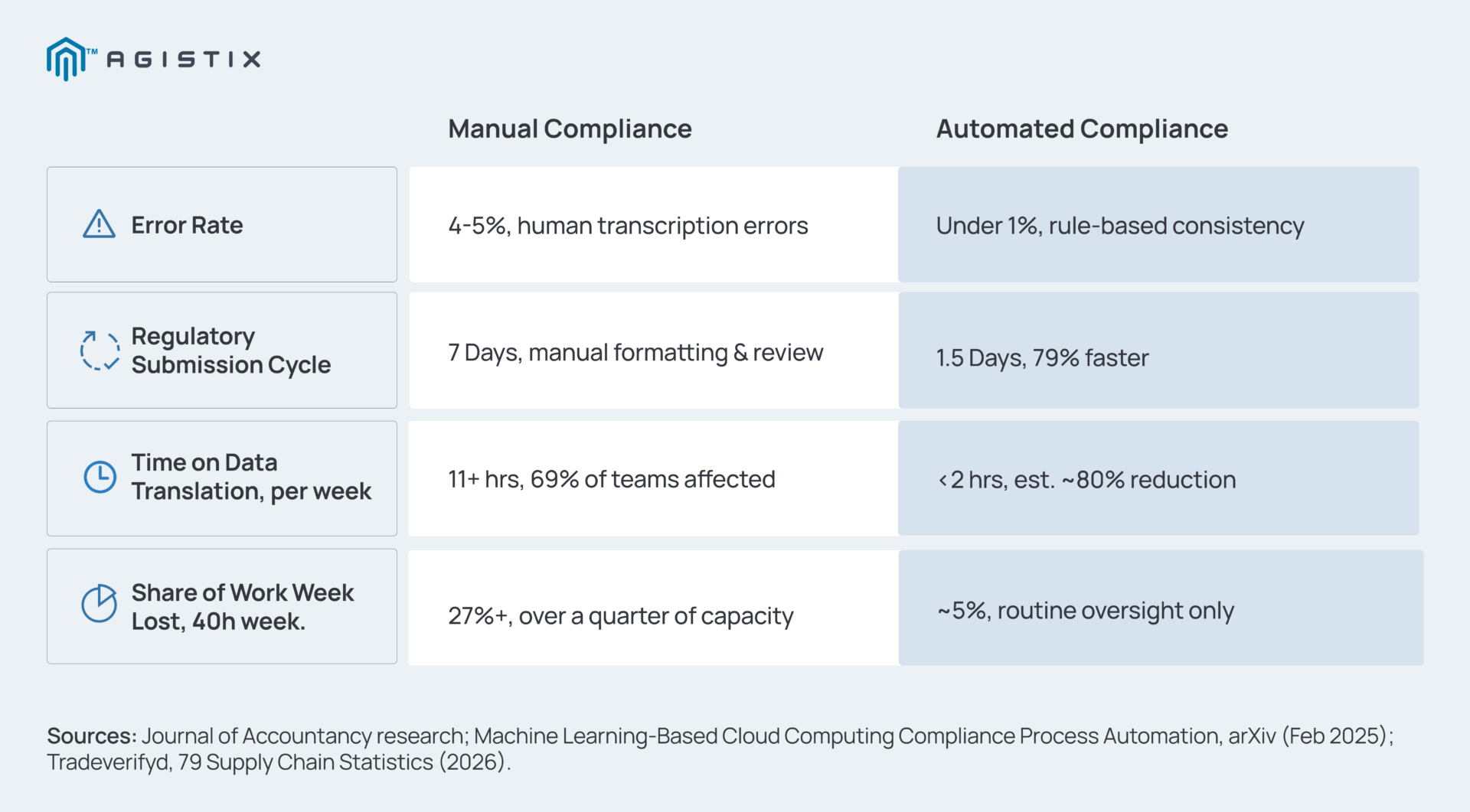
- Reducing Manual Errors and Improving Accuracy: Manual compliance processes introduce data entry mistakes, incorrect tariff classifications, and missing documentation fields. Automated systems validate data and apply classification logic consistently across every transaction, producing accurate documentation without depending on downstream review cycles to catch errors.
- Ensuring Regulatory Compliance Across Regions: Trade regulations vary significantly by country and are updated periodically as trade agreements evolve and enforcement priorities change. Automated regulatory compliance tools support teams in maintaining alignment with current regulatory requirements for each jurisdiction, applying consistent rules at the transaction level and flagging items that fall outside defined parameters for human review.
- Faster Customs Clearance and Documentation Processing: Customs delays are typically the result of incomplete, inaccurate, or improperly formatted documentation. Automated documentation management ensures that submissions are complete and correctly structured before they reach customs authorities, reducing clearance times and minimizing the risk of holds. For high-volume global shippers, that reduction in per-shipment processing time adds up across an annual operation.
- Real-Time Monitoring and Risk Detection: Automated compliance systems process transactions and monitor them simultaneously. When a data field falls outside acceptable parameters or a supplier certification lapses, the system identifies it immediately, giving teams the visibility to address compliance gaps before they become failures. That monitoring capacity is a core component of supply chain resilience, supporting proactive risk management rather than reactive response.
- Improved Visibility and Audit Readiness: Every transaction processed through an automated compliance system generates a structured, timestamped record. That audit trail is available in real time across all markets and trade lanes through a centralized interface, giving operations teams the end-to-end supply chain visibility they need to identify inefficient processes and manage performance proactively. When auditors request documentation or regulators conduct a review, records are already organized and accessible rather than fragmented across disconnected sources.
- Cost Reduction and Operational Efficiency: Compliance errors are expensive. Customs penalties, shipment delays, and expedited freight costs add up, as does the staff time required to resolve documentation disputes. Automated systems reduce error frequency and the downstream costs those errors generate, freeing logistics teams to focus on higher-value work.
- Scalability for Global Expansion: 42% of CEOs report their companies began competing in new sectors within the last five years, and geographic expansion brings new regulatory frameworks with it. Manual compliance processes scale poorly as that complexity multiplies, adding substantial workload with each new trade lane. Automated global supply chain compliance systems are built to absorb that growth, managing compliance across dozens of countries without a corresponding increase in manual oversight.
Key Features to Look for in Compliance Automation Solutions
Selecting a compliance automation solution requires evaluating whether the system can handle the operational depth of global trade. Not just routine transactions, but the exceptions, edge cases, and multi-jurisdictional requirements that define real-world complexity. Working with a technology provider who functions as a true supply chain partner means the solution scales as your trade footprint grows. These are the capabilities that matter:
Data Centralization and ERP/Logistics Integrations
Compliance data is often scattered across multiple systems, teams, and document repositories. Look for solutions that integrate directly with existing ERP and transportation management systems, pulling transactional data automatically and feeding compliance outputs back into operational workflows. Centralized data eliminates the version control problems that come with siloed documentation and gives compliance teams a single source of record.
Automated Documentation Management
The system should do more than store documents, it should produce them as well. Certificates of origin, commercial invoices, and export declarations should be generated directly from structured transactional data. Classification codes should be assigned and validated automatically against current tariff schedules, with flagging logic applied to items that fall outside standard parameters and require additional review.
AI-Driven Compliance Checks and Automated Alerts
AI-powered validation applies rule-based and pattern-based logic to catch compliance issues before transactions are submitted, including incomplete documentation, classification mismatches, restricted party flags. When the system identifies a problem, it routes an automated alert to the appropriate team member, enabling fast, targeted resolution.
Audit Trails and Reporting Tools
Every compliance action the system takes should be logged: what was validated, when, against which regulatory requirement, and what the outcome was. That audit trail supports regulatory reviews, internal audits, and continuous process improvement. Reporting tools should surface supply chain analytics in structured, exportable formats without requiring manual extraction.
Cybersecurity and Data Security Controls
Compliance systems handle sensitive trade data including supplier information, product classifications, financial transaction details, and documentation subject to export control regulations. According to PwC’s Global Compliance Study, cybersecurity and data protection are top compliance risk priorities for 51% of executives, an indication that security requirements for these platforms are under active scrutiny. A robust platform should provide role-based access controls, data encryption in transit and at rest, and audit logging of system access. Any supply chain AI functionality should also be evaluated for how training data is handled and whether customer data is used to train shared models.
Real-World Use Cases of Compliance Automation
Regulatory compliance in supply chains requires robust tools with strong operational controls behind them. Here’s how two organizations used Agistix to close compliance gaps and build tighter trade controls across global operations.
Closing Compliance Blind Spots for a Fortune 1000 Technology Leader
A silicon-to-systems manufacturer had no control over shipments booked by suppliers or third parties, creating direct import/export compliance exposure. With no centralized documentation workflows or trade screening, the company couldn’t enforce booking requirements or verify compliance across its global operation. Agistix deployed a centralized platform with automated compliance functionality to standardize commercial invoice creation, integrate ITN filing, and embed trade screening at the point of booking rather than as a downstream check.
The Compliance Impact:
- Centralized commercial invoice creation and trade screening eliminated documentation gaps across global shipments.
- Integrated ITN filing removed a manual process that had previously created filing inconsistencies.
- 85%+ internal adoption ensured compliance workflows were applied consistently across the operation.
Tightening Trade Controls for a Global Government Services Operation
A global engineering firm with operations across 80 countries was running freight on a legacy TMS with no mechanism to enforce compliance requirements. Thousands of unmanaged carrier portal logins created security and audit exposure, GL code capture was entirely manual, and there was no approval routing for high-value shipments. Agistix replaced the legacy system with a platform configured around the company’s compliance and control requirements.
The Compliance Impact:
- SSO integration eliminated thousands of unmanaged carrier logins, closing a significant security and audit vulnerability.
- Automated GL code capture and validation removed 15+ hours of manual processing per week.
- AES filing, HTS flagging, and finance-based approval routing enforced shipment accuracy and compliance controls across the operation.
Agistix: Built for the Compliance Demands of Global Trade
The companies that manage global trade well don’t treat compliance as a separate workflow. They build it into how the operation runs, with automated documentation, embedded trade controls, and real-time visibility into every shipment before it reaches the border. Agistix is built around that model, giving logistics and trade compliance teams the infrastructure to manage regulatory requirements at scale without adding headcount or complexity.
Connect with Agistix to find out how we support global trade operations.
Frequently Asked Questions
What are the biggest risks of managing supply chain compliance manually?
Manual compliance management exposes global trade operations to several risks that compound as transaction volumes and market complexity grow:
- Documentation errors: Misclassifications and missing fields trigger customs holds and penalties.
- Regulatory gaps: Without a structured monitoring process, compliance gaps surface only after a shipment is flagged by regulators.
- Inconsistent execution: Manual processes produce variable outputs, creating unreliable recordkeeping and audit exposure.
- Security vulnerabilities: Unmanaged system access and fragmented documentation create exploitable control gaps.
- Scalability failure: Each new market adds workload and complexity faster than manual processes can absorb.
How does automation reduce errors in trade documentation?
Automated compliance systems validate data at the point of entry rather than relying on manual downstream review to catch mistakes. Classification codes are checked against current tariff schedules, required fields are enforced before documents are submitted, and certificates and declarations are generated directly from structured transactional data. That removes the variability inherent in manual processes and ensures documentation meets regulatory requirements.
What industries benefit most from supply chain compliance automation?
Any industry operating across global trade lanes with complex documentation, regulatory, or reporting requirements stands to benefit from compliance automation. The industries that tend to see the biggest operational impact includes:
- High-tech manufacturing: Managing export controls, HTS classifications, and supplier compliance across global sourcing networks creates significant documentation volume and regulatory exposure.
- Pharmaceuticals and life sciences: Strict serialization, licensing, and import/export requirements for controlled and sensitive products demand precise, auditable compliance workflows.
- Aerospace and defense: ITAR, EAR, and other export control regulations require rigorous restricted party screening and documentation management at every transaction.
- Government and defense contractors: Complex project code requirements, finance-based approval workflows, and audit obligations demand tightly controlled compliance infrastructure.
- 3PL and freight services: High shipment volumes across multiple carriers and trade lanes amplify the cost of documentation errors and customs delays.
What is the role of AI in supply chain compliance?
AI applies rule-based and pattern-based logic to compliance validation at a speed and consistency that manual review can’t match. That means scanning transactions for incomplete documentation, flagging restricted party matches, identifying classification mismatches, and sending alerts to the appropriate team member when an issue is detected. Because AI-driven systems learn from transaction patterns over time, their ability to catch edge cases and anomalies improves as data volume increases, making them particularly valuable for high-volume global operations where manual oversight has clear limits.
What data is required for supply chain compliance automation systems?
Compliance automation relies on accurate, structured transactional data, including:
- HTS classifications and commodity descriptions
- Country of origin
- Carrier, routing, and declared shipment values
- Shipper, consignee, and intermediary party details
- Commercial invoices, packing lists, and certificates of origin
- Applicable trade agreement and export control information
