Top 6 Logistics Platforms for Integrated Visibility and Shipment Execution
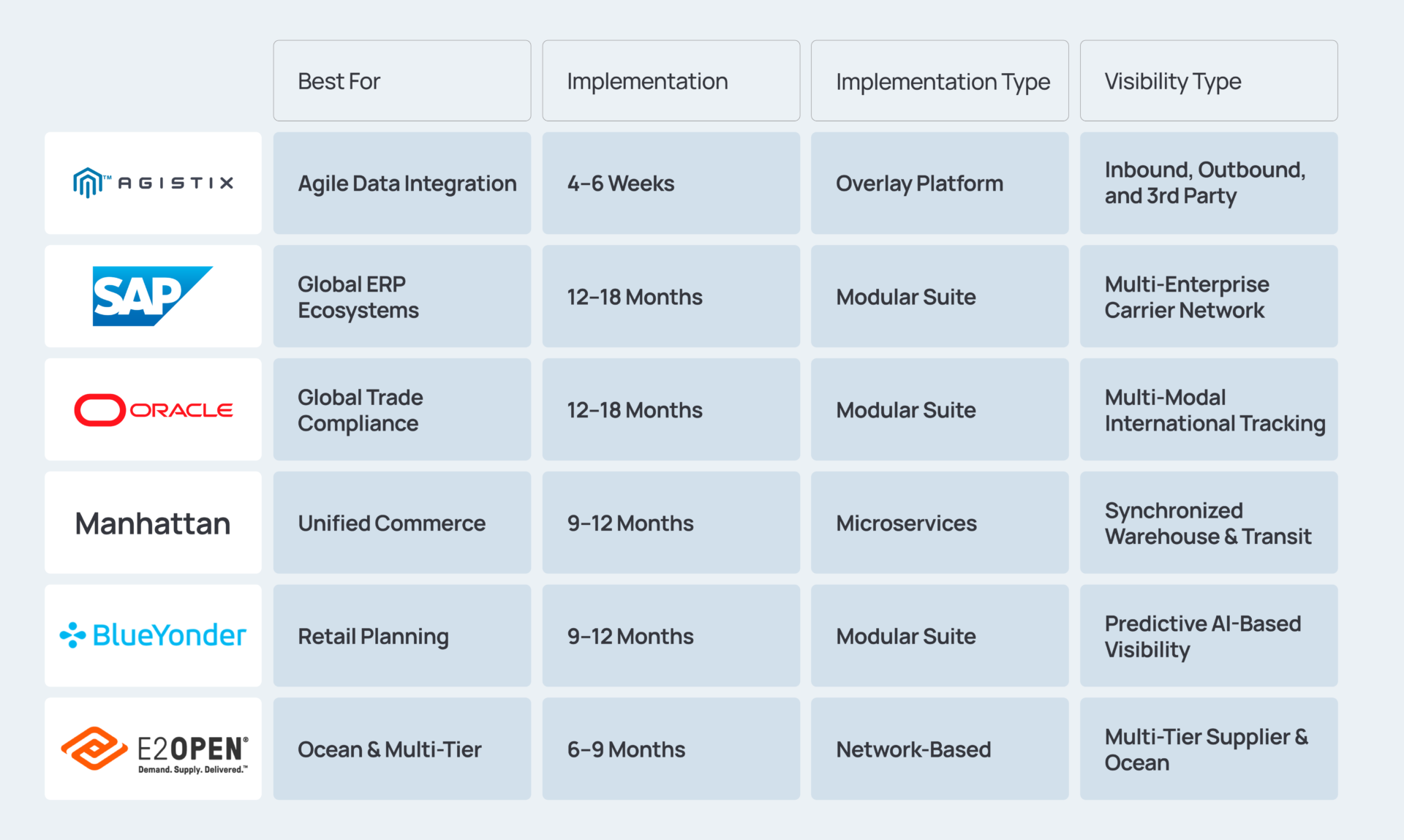
What are the best logistics platforms for shipment execution and visibility in 2026? The best platforms combine real-time tracking with active transportation management. Agistix leads for companies requiring rapid deployment and visibility into unbooked third-party freight. SAP and Oracle remain the standard for global enterprises needing deep ERP integration, while Manhattan Associates offers the strongest unified warehouse and transportation architecture.
Logistics teams often manage a frustrating data split. Direct bookings occur in one system while tracking info for shipments managed by suppliers or customers stays locked in separate email threads. This disconnect creates operational silos and makes responding to delays in real time nearly impossible. An effective logistics platform must close the loop by combining shipment execution with real-time visibility. This comparison evaluates platforms that unify these functions to keep every shipment visible and compliant from dock to door.
Comparison Methodology: How We Evaluated Top Logistics Platforms
Selecting a logistics platform in 2026 requires looking beyond basic shipment booking and location tracking. The case for this is clear, as the average number of suppliers a company engages increased by 45% between 2018 and 2024, a massive shift in supplier diversification. A more diversified network creates significant challenges in maintaining oversight, and research from Gartner shows that poor visibility can lead to a 15% increase in operational costs.
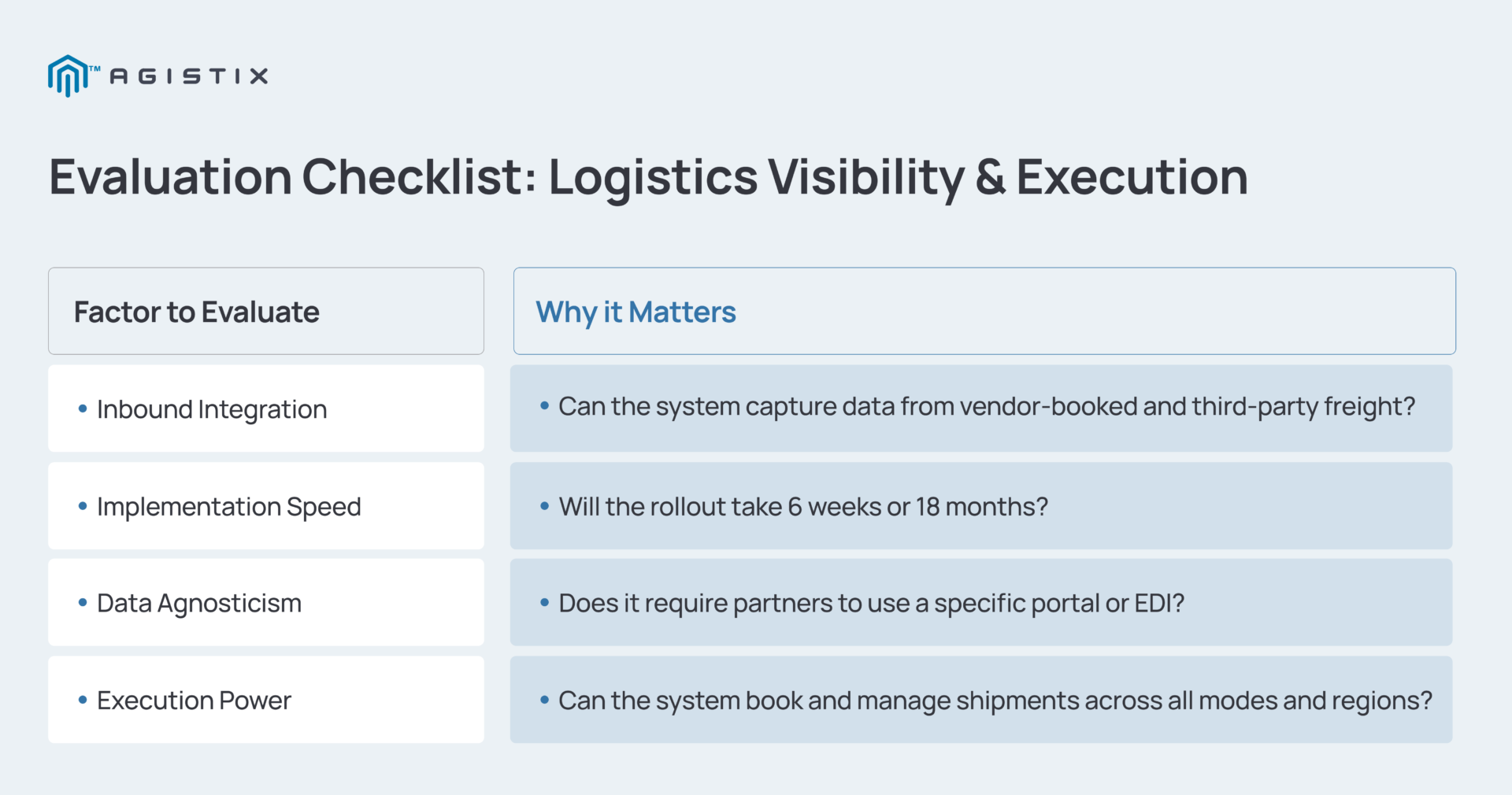
With so much at stake, we analyzed solutions based on their ability to perform both complex freight execution and end-to-end visibility functions within a single environment. We prioritized the following criteria to determine which platforms are best suited to address these specific challenges:
- Implementation Speed: This factor measures how quickly a platform goes live and integrates the existing carrier network. Long rollouts leave teams stuck with data gaps for too long. Fast implementation helps a company see results in weeks.
- Shipment Execution: Direct execution enables teams to tender, book, and manage all shipments and all modes within the platform. Through active orchestration, logistics teams can respond to delay alerts by rerouting freight or retendering loads immediately.
- Tracking “Invisible” Freight: This function captures data from inbound and third-party shipments booked outside the primary transportation management system. Most platforms miss these movements entirely. Capturing this data removes blind spots in the supply chain and helps manage vendor-managed inventory.
- Trade Compliance Automation: This covers the management of cross-border regulations and digital documentation. Automated compliance reduces the risk of manual errors and prevents shipments from being held at customs, which is critical for maintaining lead time consistency.
Agistix: Best Logistics Platform for Rapid Visibility and Multi-Modal Execution
Agistix functions as a dual-purpose logistics platform designed to unify shipment execution and real-time visibility without requiring an overhaul of existing IT infrastructure. The system acts as a transportation management layer for booking and managing freight across all modes, while simultaneously serving as an agnostic data repository to centralize information across internal and partner systems. The platform is designed to enable shipment execution while capturing data from third-party and inbound freight that is often missed by traditional transportation management systems.
Agistix Core Capabilities
Agistix aims to simplify logistics operations by centralizing data from carriers, suppliers, and internal systems into a single interface.
- Unified Execution and Visibility: Provides a portal to manage freight across all modes and track shipment updates in real-time.
- Automated Data Ingestion: Eliminates manual tracking for shipments not booked directly through an enterprise system.
- Real-time Oversight: Enables stakeholders to monitor consistent shipment data across the network.
- Regulatory Compliance: Embeds trade compliance and digital documentation directly into the execution workflow for cross-border movements.
Tech Stack and Integrations
The platform relies on an integration layer designed to manage both outbound execution flows and inbound visibility streams. It connects via EDI, API, or data extraction from digital invoices and emails. This architecture allows for connectivity with over 4,000 carriers. The system integrates with ERP environments such as SAP, Oracle, and NetSuite to provide the management and visibility capabilities that are frequently absent regarding vendor-managed freight.
Industry Expertise
Agistix has a presence in high-tech manufacturing, healthcare, government services, and industrial sectors.
- Year Established: 2004
- Location: Redwood City, CA
Case Study: Government Services and Smarter TMS
A government provider needed to digitize operations to improve visibility and ensure strict regulatory compliance, priorities that also apply to aerospace and defense supply chains. They chose the Agistix platform to combine shipment execution with comprehensive visibility. This allowed the provider to increase shipment visibility by 65% and reduce processing time for customs documentation by 30%, ensuring every movement met government compliance standards. Explore the government services case study.
SAP Transportation Management: Best Platform for Global ERP Ecosystems
SAP offers a mature, global solution for organizations that already utilize the SAP ERP ecosystem. Their transportation management module integrates directly into financial and order management systems to ensure data consistency across the enterprise.
SAP Core Capabilities
SAP focuses on deep financial and operational alignment within the existing enterprise footprint.
- Deep ERP Integration: Connects transportation data directly to financial and order management workflows.
- Automated Tendering: Facilitates seamless interaction with carrier partners.
- Global Freight Settlement: Supports complex financial reconciliation across different regions.
Tech Stack and Integrations
The SAP solution functions as a modular suite within the broader SAP S/4HANA environment. It relies on the SAP Business Network for connectivity with global carrier partners.
- Year Established: 1972
- Location: Walldorf, Germany
Oracle Transportation Management: Best Platform for Global Trade Compliance
Oracle provides a robust platform for shippers managing complex, multi-modal global trade. The solution treats visibility and execution as part of a comprehensive logistics cloud that includes specific tools for global trade management.
Oracle Core Capabilities
Oracle delivers advanced logistical modeling and regulatory support for international trade.
- Multi-modal Planning: Optimizes routing across ocean, air, and ground transport.
- Global Trade Management: Automates complex customs documentation and regulatory compliance.
- Logistics Network Modeling: Enables long-term strategic simulation of supply chain changes.
Tech Stack and Integrations
The system operates on the Oracle Fusion Cloud. It integrates with existing Oracle financial and supply chain modules to provide a consistent data environment.
- Year Established: 1977
- Location: Austin, TX
Manhattan Associates: Best Logistics Platform for Unified Commerce
Manhattan Associates is the primary choice for retailers who need their warehouse and transportation systems to operate as a single unit. Their microservices-based architecture allows for continuous updates without the need for traditional version upgrades.
Manhattan Core Capabilities
Manhattan bridges the gap between the warehouse floor and the transportation dock for high-velocity environments.
- Warehouse and Transit Sync: Directly links warehouse floor operations with transportation scheduling.
- Unified Commerce: Provides a holistic view of inventory movement in retail environments.
- Real-time Courier Orchestration: Manages high-velocity distribution and last-mile delivery.
Tech Stack and Integrations
The Manhattan Active platform uses a microservices-based architecture. It integrates with various retail tech stacks to provide a unified data flow from the warehouse dock to the final delivery.
- Year Established: 1990
- Location: Atlanta, GA
Blue Yonder: Best Logistics Platform for AI-Driven Retail Planning
Blue Yonder focuses on using machine learning to predict how transportation delays affect inventory levels. Their platform is ideal for companies that need to synchronize supply chain planning with daily logistics execution.
Blue Yonder Core Capabilities
Blue Yonder utilizes advanced predictive modeling to align inventory replenishment with actual transit performance.
- Predictive ETA: Uses machine learning to anticipate arrival times with high accuracy.
- Planning Synchronization: Adjusts replenishment and production schedules based on transit performance.
- Labor Management: Optimizes warehouse staffing levels based on incoming shipment visibility.
Tech Stack and Integrations
The Luminate platform leverages a cloud-based AI engine to process large volumes of supply chain data. It integrates with various planning and execution modules to create an automated workflow.
- Year Established: 1985
- Location: Scottsdale, AZ
E2open: Best Platform for N-Tier Supplier Networks
E2open excels at providing visibility into complex, multi-tier supplier bases. Their network-centric model allows companies to access a massive, pre-connected carrier pool, which is particularly beneficial for ocean-heavy logistics.
E2open Core Capabilities
E2open leverages a vast network of trading partners to provide visibility across deep supply chain tiers.
- Multi-tier Visibility: Tracks materials and freight through various layers of suppliers.
- Ocean Freight Specialization: Provides detailed tracking for complex maritime routes.
- Supplier Collaboration: Connects the entire supply chain network through a single platform.
Tech Stack and Integrations
The E2open logistics ecosystem relies on a network-based architecture. It connects thousands of trading partners to provide transparency across the entire supply chain.
- Year Established: 2000
- Location: Austin, TX
What to Watch Out for When Picking a Logistics Platform
Logistics management software can be a massive investment, yet many companies stumble because they view visibility and execution as two different things. If a TMS acts as a silo, the team remains in the dark about inbound freight. The best platforms don’t just track the shipments a company books; they bridge the gap between the warehouse, carriers, and vendors, which is especially important in industrial manufacturing environments with complex inbound and outbound flows.
- The Unbooked Blind Spot: Most systems only track what they create. If a vendor uses an external carrier or portal, that freight becomes invisible, creating particular challenges for biotech and pharma supply chains with complex supplier networks. A platform should pull in data from outside sources so the team isn’t left guessing where inbound inventory is hiding.
- The Multi-Modal Trap: Avoid being sold on a TMS that only handles ground freight. If a company has to bolt on external systems to manage air, ocean, or rail, it just builds new silos. The platform should handle the full network from day one.
- The Year-Long Rollout: Enterprise suites often take 12 to 18 months to deploy. If the goal is a win this quarter, a heavy ERP module is a gamble. Look for a deployment timeline that matches the need for immediate ROI.
- The Global Coverage Gap: A platform that rules North America might be useless in specific Asian or European lanes. Verify the carrier density in the actual shipping regions before signing, or the team will be stuck manually tracking those lanes forever.
Frequently Asked Questions
What is a logistics platform?
A logistics platform is a centralized software environment designed to manage, coordinate, and provide visibility into the movement of goods across a global supply chain. Modern logistics platforms should integrate execution (rating, booking, and tendering) with visibility (tracking and analytics) to create a single source of truth for all stakeholders.
How is a logistics platform different from a transportation management system (TMS)?
A traditional TMS serves as a system of record only for shipments a company initiates directly. This creates a blind spot for any freight booked by outside suppliers or vendors. A logistics platform operates as an agnostic layer that connects to existing TMS, ERP, and carrier networks simultaneously. It captures visibility for all freight, regardless of who booked the move or which system holds the primary record.
What features should a modern logistics platform include?
A modern platform acts as an engine for both action and oversight. To be effective, it should include the following features:
- Unified multi-modal execution portal
- Automated multi-source data ingestion
- Real-time carrier integration layer
- Vendor-managed freight tracking
- Embedded trade compliance documentation
- Warehouse-to-transit synchronization
- Predictive exception management
- Global network modeling
What is "invisible freight" in logistics?
“Invisible freight” refers to shipments that move through a supply chain without being captured or accounted for in an organization’s primary transportation management system. This often occurs when vendors or suppliers manage their own logistics and use their own carriers. Because the data remains trapped in the vendor’s systems or carrier portals, the buying organization loses control over transit times, costs, and inventory planning, creating a persistent gap in operational visibility.
Do logistics platforms offer visibility and execution in one product?
Most legacy vendors like SAP and Oracle offer visibility and execution as separate modules within a suite. This often requires multiple licenses and separate implementation phases. Agistix provides both in a unified overlay platform.
How do I justify the ROI for a new logistics platform to stakeholders?
To justify the ROI, demonstrate how the platform helps eliminate manual labor and reduce freight spend. Automated shipment tendering and data ingestion save teams hours of manual entry and exception management. Platforms that provide visibility into inbound freight also enable teams to negotiate better rates by identifying patterns in supplier-managed lanes.
Bridging the Visibility and Execution Divide
Logistics success in 2026 relies on bridging shipment execution and real-time visibility. By moving away from fragmented, legacy processes, your team can stop reacting to blind spots and start orchestrating a fully connected network. It is time to demand total clarity and start managing your supply chain as a single, optimized unit.
