From Order to Invoice: Leveraging Big Data Analytics in Supply Chain Management
Big data analytics in supply chain management gives organizations the tools to connect, analyze, and act on data across every stage of the order-to-invoice process. This article explores how AI and machine learning are driving that capability in 2026, why fragmented data creates compounding operational inefficiencies, and what organizations stand to gain in cost reduction, and risk mitigation by putting supply chain analytics to work.
Every stage of the modern supply chain generates data. The problem isn’t necessarily the volume of that data, it’s that most organizations can’t centralize or analyze it fast enough to make it valuable. Across order management, transportation, and invoicing, critical information lives in disconnected systems and often gets to decision-makers too late.
Big data analytics in supply chain management changes that equation, turning fragmented data into real-time visibility, smarter decisions, and measurable cost reduction across the entire order-to-invoice cycle. What follows is a closer look at how supply chain analytics works and what companies stand to gain from using it strategically.
Understanding the Order-to-Invoice Supply Chain Process
The order-to-invoice process covers everything between a purchase decision and a settled payment, and it runs in two directions. Companies manage orders placed with suppliers, where inbound freight is often booked by the supplier and creates a significant visibility gap. They also manage outbound orders to their own customers, where delays and errors directly impact service levels. The stages are similar across both flows:
- Order management: Initiating and tracking purchase orders with suppliers, or processing orders from customers
- Inventory allocation and fulfillment: Matching available stock to demand and preparing orders for shipment
- Transportation: Selecting carriers, booking freight, and managing movement of goods
- Delivery: Confirming receipt and resolving exceptions in transit
- Invoicing and payment: Reconciling freight bills, validating charges, and closing the financial loop
Inefficiencies can accumulate at every stage. Disconnected systems and manual spreadsheet reconciliation create gaps that are costly and slow to surface. A unified analytics layer that connects big data in supply chain systems and processes helps turn reactive problem-solving into proactive management.
What Is Big Data Analytics in Supply Chain Management: AI, Machine Learning, and Real-Time Insight
Data analytics in supply chain management is the process of collecting, processing, and analyzing large volumes of structured and unstructured data across every stage of the supply chain. In 2026, that process is driven by AI and machine learning (ML), which is precisely what separates modern analytics from traditional reporting. Where legacy systems produced static snapshots, AI-powered analytics delivers continuous, real-time insight that improves as more data flows through it.
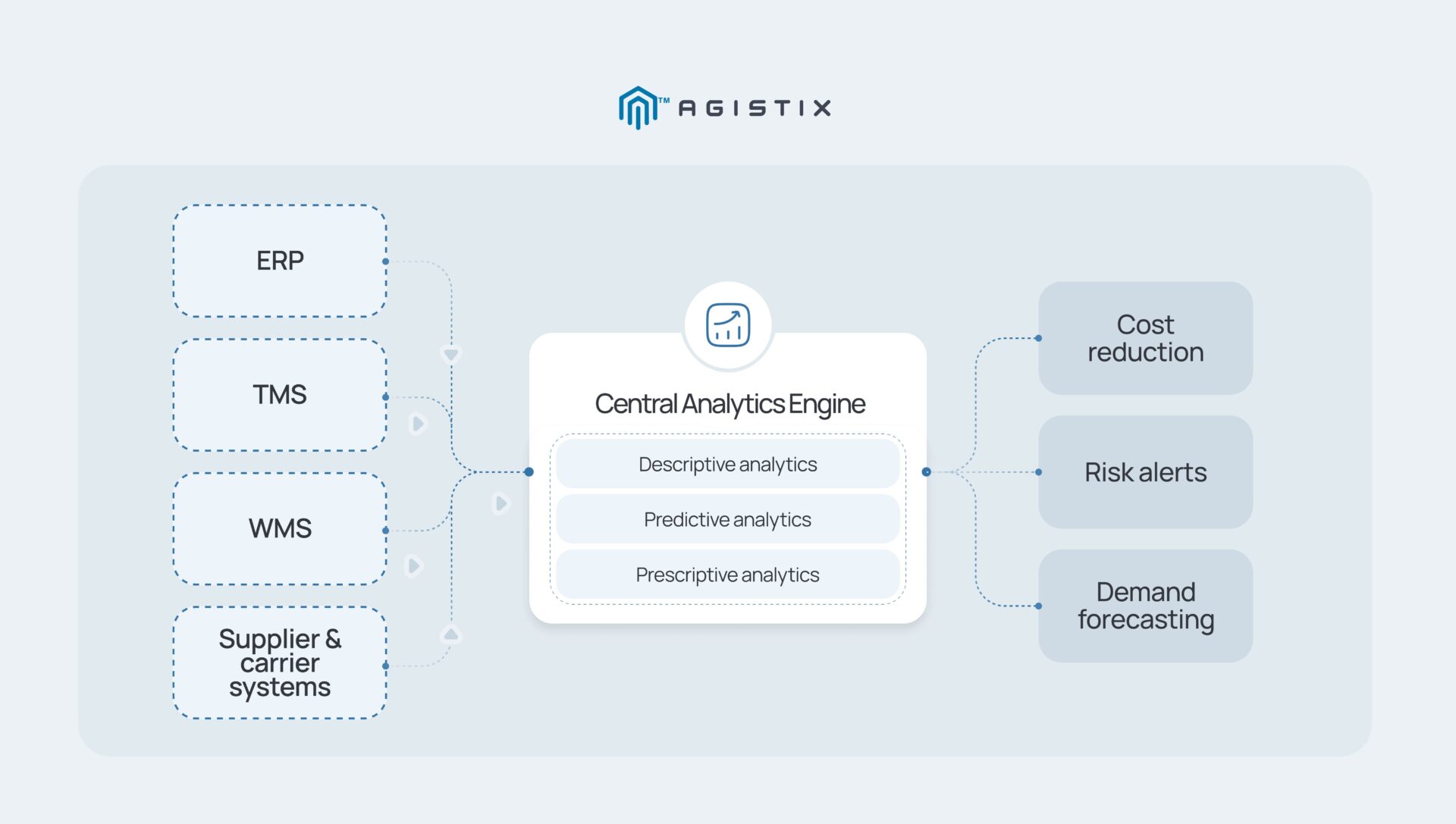
The analytics themselves operate at three levels:
- Descriptive (What Happened): Historical data on orders, shipments, costs, and carrier performance.
- Predictive (What’s Likely to Happen): ML models forecast demand, flag supplier risk, and anticipate delays.
- Prescriptive (What to Do About It): AI-generated recommendations that guide decisions on routing, inventory, and procurement.
Despite the clear value, a 2026 Hackett Group study found that only 35% of organizations are currently using AI for supply chain intelligence and analytics. The gap between what’s possible and what’s actually happening presents a significant competitive opportunity.
Benefits of Big Data Analytics from Order to Invoice
Better decisions come from better data. Recent studies suggest that companies with AI-mature supply chains are 23% more profitable than their peers – not because they have more data, but because they’ve built the infrastructure to understand and act on it. The benefits compound across every stage of the order-to-invoice process.
1. End-to-End Visibility Across the Supply Chain
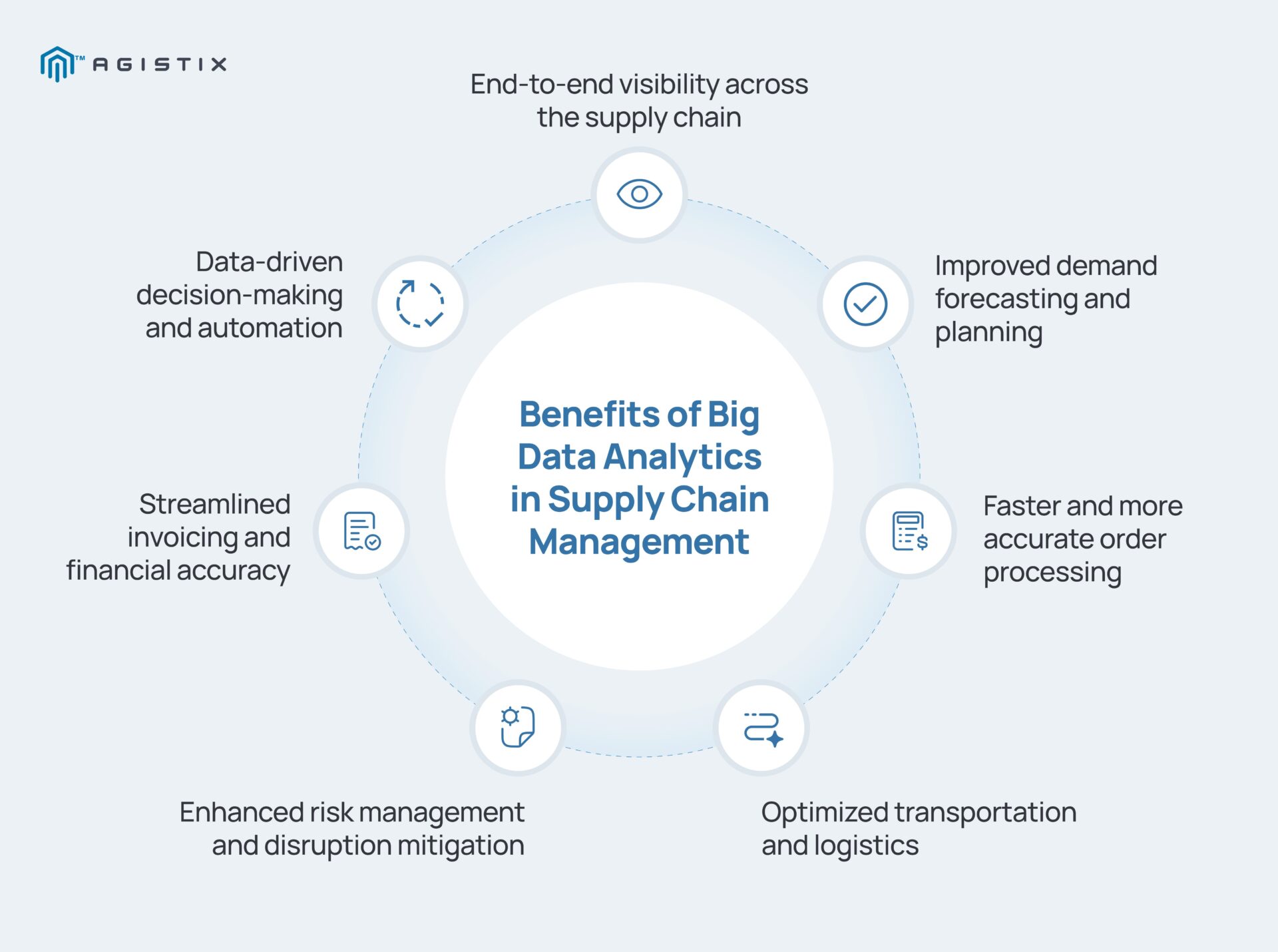
Big data in supply chain analytics gives organizations a continuous, unified view of their operations from order placement through final invoice. Rather than piecing together updates from carrier portals, supplier emails, and internal systems, teams get a single source of truth that surfaces exceptions in real time.
That visibility extends well beyond knowing where a shipment is. End-to-end supply chain visibility at the transactional level means teams can see documentation status, freight charges, accessorial fees, and invoice accuracy as they develop, across every order, carrier, and trading partner. That’s what allows procurement, logistics, and finance teams to stay aligned without chasing each other for updates.
2. Improved Demand Forecasting and Planning
Predictive analytics uses historical sales data, market signals, and external variables to anticipate demand patterns before they materialize. ML models continuously refine those forecasts as new data arrives, allowing inventory levels to adjust in near real time.
The real-world impacts are impressive. By applying machine learning models to historical sales and market trend data, Amazon reduced inventory costs by an average of 22% over a four-year period. Fewer stockouts, less excess inventory, and lower carrying costs are all possible when forecasting is driven by data rather than intuition.
3. Faster and More Accurate Order Processing
Manual order processing creates error exposure at every handoff. Wrong quantities, missed updates, and billing mismatches are common byproducts of systems that don’t communicate. Analytics-driven automation eliminates most of those failure points by validating data as it moves through the system and flagging discrepancies before they become fulfillment problems. The downstream effect is fewer disputes and shorter order cycles.
4. Optimized Transportation and Logistics
Freight decisions made without clean, accurate data tend to be expensive ones. Analytics in logistics gives teams real-time comparisons of routing options, carrier performance history, and cost tradeoffs, so every shipment decision is based on facts rather than familiarity.
AI takes that further. Companies that embed AI across planning, warehousing, and transportation are seeing measurable returns: according to McKinsey, AI-powered supply chains can deliver 5-20% reductions in logistics costs and 5-15% reductions in procurement spend. Those gains come from the compounding effect of better decisions made consistently across every lane, load, and carrier relationship.
5. Enhanced Risk Management and Disruption Mitigation
Supplier financial stress, port congestion, weather events, and geopolitical shifts create downstream disruption that’s difficult to anticipate when data is fragmented across systems and partners. By the time the problem is visible, the window to respond has often already closed.
AI-powered supply chain analytics monitors signals across the network continuously, surfacing patterns that manual processes would catch too late. Teams get early warning on supplier risk, transit delays, and demand volatility, which creates room to make contingency decisions rather than reactive ones. That capability is central to building supply chain resilience in an environment where disruption is the norm.
6. Streamlined Invoicing and Financial Accuracy
Freight invoicing errors are common when reconciliation is done manually. Carriers bill across varying formats and rate structures, and discrepancies in accessorial charges or contracted rates often go undetected until they’ve already been paid. Analytics automates the matching process, comparing invoices against agreed terms at scale and flagging exceptions before payment is issued. The result is cleaner financials, faster cycle times, and significantly less time spent on dispute resolution.
7. Data-Driven Decision-Making and Automation
AI data analytics compresses the time between data and action across every stage of the order-to-invoice process. Carrier selection, inventory reordering, and exception handling that once required manual analysis become automated workflows, freeing teams to focus on higher-order decisions.
The adoption trajectory reflects growing confidence in that capability: 94% of supply chain leaders plan to use AI or generative AI to assist with decision-making, a sign that reduced reliance on manual processes is an active priority.
Features to Look for in Big Data Supply Chain Solutions
Not all supply chain data analytics platforms are built to handle modern complexities. When evaluating options, these are the capabilities that matter most.
- Data standardization and quality management: Clean, normalized data is the foundation of reliable analytics. Without it, the outputs are unreliable regardless of how sophisticated the models are.
- Cross-system integration: Connects ERP, TMS, WMS, and external partner networks into a single data environment.
- AI/ML-powered predictive and prescriptive analytics: Moves beyond historical reporting to forecast outcomes and recommend actions.
- AI-driven risk detection and disruption monitoring: Surfaces and alerts to supplier, transit, and market risks before they impact operations.
- Automated workflows and process optimization: Reduces manual touchpoints across ordering, fulfillment, and invoicing.
- Reporting and visibility dashboards: Translates data into an accessible, actionable view for teams across the organization.
Priorities will vary by organization, but the underlying requirement is generally the same. A supply chain analytics platform should connect systems, centralize data, and surface meaningful insight without requiring a team of analysts to make it work.
Supply Chain Analytics: Use Cases and Results
Analytics investments are only meaningful when they produce measurable outcomes. Here’s how two organizations used big data analytics to solve real supply chain problems.
Closing the Inbound Visibility Gap in Healthcare Logistics
A Fortune 500 diagnostic solutions company was flying blind on inbound shipments booked by suppliers, with no visibility into cold-chain status, carrier performance, or what it was all costing. Agistix unified shipment execution and visibility across 15+ transportation partners and provided customized data analytics and real-time exception alerts to give their team accurate, actionable data for the first time.
The Analytics Impact:
- Customized analytics and carrier integration delivered 95% on-time performance visibility across all integrated carriers
- Real-time exception alerts on cold-chain shipments reduced spoilage and damage claims
- Cut expedited service costs by 30% year-over-year through data-driven carrier selection and routing rules
Turning Shipment Data Into Cost Control for a Global Technology Leader
A Fortune 1000 tech company had no visibility into supplier-booked or third-party shipments, leaving premium service use unchecked and compliance exposure unmanaged. Agistix deployed a centralized logistics platform with real-time reporting and automated compliance tools, giving internal and external teams consistent access to the shipment data they needed to make better decisions.
The Analytics Impact:
- Recurring reports delivered to internal and external teams reduced per-shipment costs by 27%
- Data visibility into routing behavior drove a 30% reduction in premium service use
- Shipment volume tripled with no increase in headcount
From Order to Invoice, Data Should Be Working for You
Every stage of the order-to-invoice cycle generates data. The organizations pulling ahead are the ones that have stopped letting it sit in disconnected systems and started using it to drive decisions on cost, risk, and performance. AI-powered analytics makes that possible at a scale and speed that manual processes simply can’t match.
The gap between companies that have built that capability and those that haven’t is widening. Visibility, efficiency, cost reduction, and risk mitigation aren’t separate initiatives – they’re compounding outcomes of a single, well-connected analytics layer across your supply chain.
If your organization is ready to close that gap, Agistix can help. Request a demo to see what end-to-end supply chain analytics can do for you.
Frequently Asked Questions
What is big data analytics in supply chain management?
Big data analytics in supply chain management is the process of collecting, processing, and analyzing large volumes of structured and unstructured data generated across the supply chain. In 2026, that process is often driven by AI and machine learning, which enable organizations to move beyond static reporting and act on real-time insight across order management, transportation, and invoicing.
How is big data used in supply chain management?
Organizations use big data to monitor shipment status, track supplier performance, forecast demand, optimize carrier selection, and reconcile freight invoices. The data itself comes from multiple sources, including ERP systems, TMS platforms, carrier networks, and external market signals, and analytics tools normalize and analyze it to surface patterns and flag exceptions that would otherwise go undetected.
What are the benefits of supply chain analytics?
Supply chain analytics gives organizations the ability to make faster, more informed decisions across every stage of the order-to-invoice process. Benefits include:
- End-to-end visibility into shipment status, freight charges, and invoice accuracy across all carriers and trading partners
- Improved demand forecasting driven by ML models that continuously refine inventory positioning based on market signals
- Faster, more accurate order processing through automation that reduces manual errors
- Optimized transportation spend through data-driven carrier selection, route optimization, and mode planning
- Proactive risk management that surfaces supplier, transit, and market disruptions before they impact operations
- Streamlined invoicing that automates reconciliation and reduces billing disputes
- Automated decision-making that reduces reliance on manual analysis across the supply chain
How does AI improve supply chain analytics?
AI transforms supply chain analytics into an operational capability. Where traditional systems produce historical snapshots, AI-powered analytics monitors data continuously, identifies patterns at scale, and generates recommendations that improve as more data flows through the system. AI effectively improves demand forecasting, risk detection, carrier selection, and invoice reconciliation.
What tools are used for supply chain data analytics?
Supply chain analytics typically involves a combination of platforms working together rather than a single tool. Core systems include:
- Transportation Management Systems (TMS) for freight execution, carrier performance tracking, and cost analysis
- Enterprise Resource Planning (ERP) systems for order, financial, and inventory data
- Warehouse Management Systems (WMS) for fulfillment and inventory visibility
- Dedicated supply chain analytics platforms that aggregate and normalize data across all of the above, applying AI and ML to surface actionable insight across the full order-to-invoice process
