
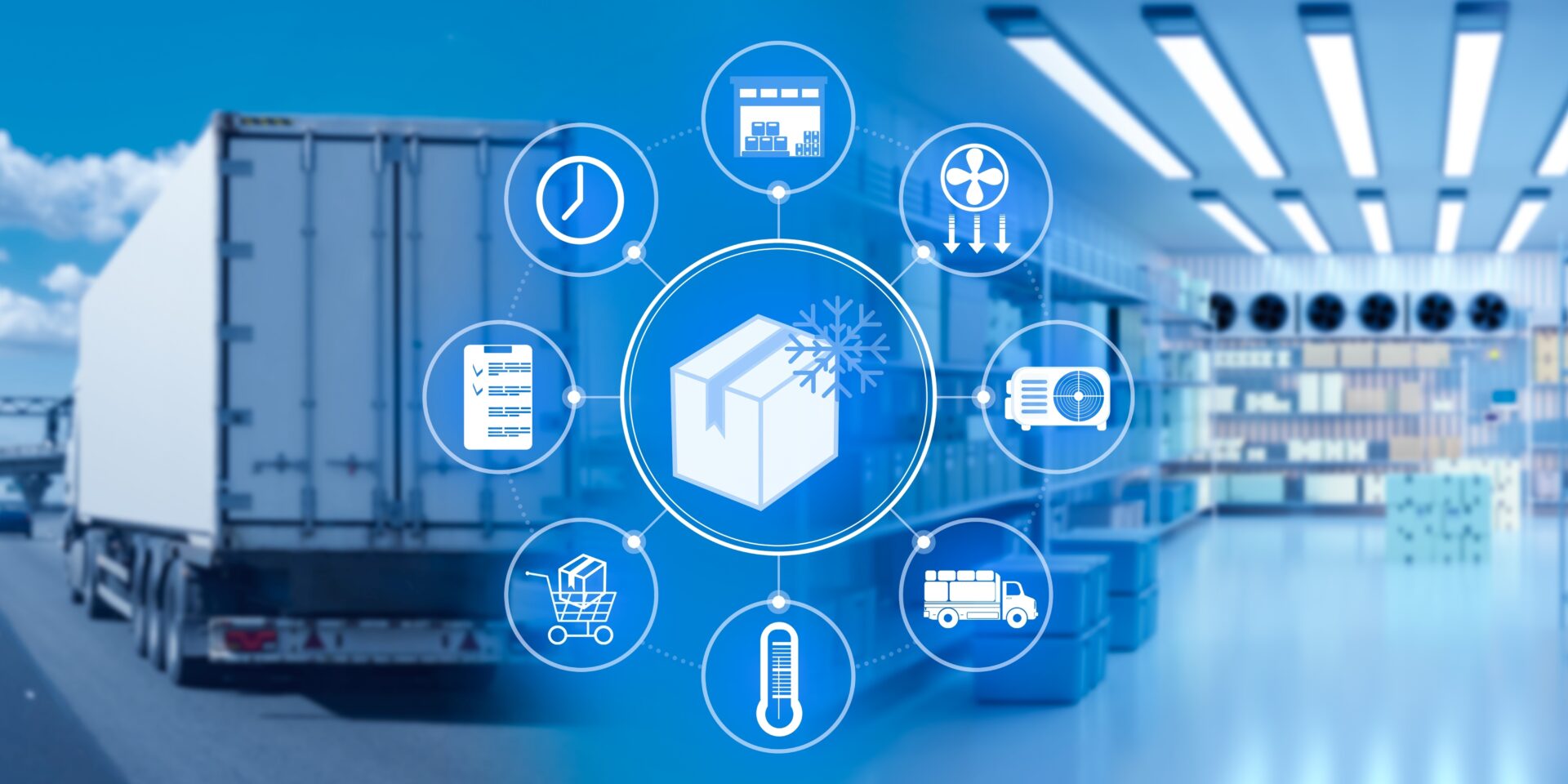
Cold Chain Monitoring: Best Practices for Temperature-Sensitive Freight
Cold chain monitoring tracks product temperature and humidity conditions throughout transit and is critical in biopharma, healthcare, and food and beverage industries. Cold chain readings are most useful when they appear in the same shipment record as location and ETA, which requires advanced sensors and connectivity to enterprise systems. This article explains what cold chain monitoring is, its benefits, best practices, available technology, and how to overcome common issues.
Temperature-sensitive freight rarely stays with one carrier or one system from pickup to delivery, and most carrier feeds report location and milestones but say nothing about product condition. A load can arrive on schedule after hours outside its range, and the receiving team only finds the excursion when QA reviews the temperature history. The result is rejected loads, deviation investigations, and customers questioning the next delivery.
This article explains how cold chain monitoring ties temperature data to the shipment record, challenges and best practices, and how advanced visibility platforms support better cold chain performance.
What Is Cold Chain Monitoring?
Cold chain monitoring is the continuous tracking of the temperature (and humidity where needed) of sensitive products through storage, handling, and transport. Readings come from live sensors that send real-time data to a company’s internal systems, or from data loggers that teams download after the trip. The volume of freight that depends on cold chain monitoring is climbing fast. Global Market Insights values the cold chain logistics market at $382.3 billion in 2025 and projects it will reach $1.37 trillion by 2035, with pharmaceuticals and healthcare growing fastest at a 16.3% compound annual rate.
Temperature monitoring shows whether the product inside is still safe to use, and is essential for pharmaceutical, healthcare, food and beverage, and chemical shipments. QA teams use monitoring data to determine whether to release the load, while customers want proof that the product stayed within a safe range, and auditors expect a full record. Having all cold chain data in one place makes the temperature history much easier to provide.
Benefits of Effective Cold Chain Monitoring
Industry research estimates that up to 50% of vaccines are wasted globally each year, with failures in temperature control and cold chain logistics driving most of that loss. Those failures can occur at any point in the journey. Temperature excursions happen on the road, while a trailer waits at the dock door, at cross-docks or ports, during loading and unloading, or when a reefer unit fails. Carriers can also drop the data at handoffs, so cold chain monitoring needs to follow the freight from pickup to final delivery.
There are numerous benefits to maintaining end-to-end temperature tracking:
- Fewer lost or rejected loads. If an alert shows the temperature is rising during transit, the team can divert, re-ice, or change equipment before the product is damaged. This means fewer goods are lost or rejected, which is the main goal of temperature-sensitive freight protection.
- Faster, better-informed decisions on at-risk shipments. The temperature history shows how far the load went out of range and for how long, so QA can decide whether it’s safe to release or should be quarantined.
- Compliance and audit readiness. Full records with timestamps support Good Distribution Practices (GDP) for pharmaceuticals and quality terms mandated in customer contracts.
- Carrier accountability. Cold chain visibility across every carrier lets shippers compare partners on performance data and hold each one to the same standard.
- Customer confidence. A full temperature history proves that a shipment stayed within the appropriate range, increasing customer confidence and helping resolve quality issues quickly.
7 Best Practices for Cold Chain Monitoring
Good monitoring requires consistency across every load. That means repeatable procedures on every lane, technology that sends sensor data into the shipment record, and defined processes for managing exceptions.
1. Define Acceptable Temperature Ranges for Every Shipment
Cold chain monitoring needs a defined temperature range based on product specifications before the shipment is booked. The shipper also needs to define how much deviation is acceptable for each product. If the product is labeled 2°C to 8°C, the team needs to know whether rising to 9°C for 20 minutes at the receiving dock is acceptable or if the cargo has been compromised. These limits are communicated on the shipment record and the carrier tender, so everyone involved understands the expectation.
2. Verify Carrier and Equipment Readiness
Before pickup, the shipper should confirm that the reefer or container can maintain the correct temperature range. It must be well maintained, recently calibrated, and pre-cooled. The carrier should confirm proper loading procedures and ensure that the driver understands the handling instructions.
3. Use Real-Time Cold Chain Temperature Monitoring
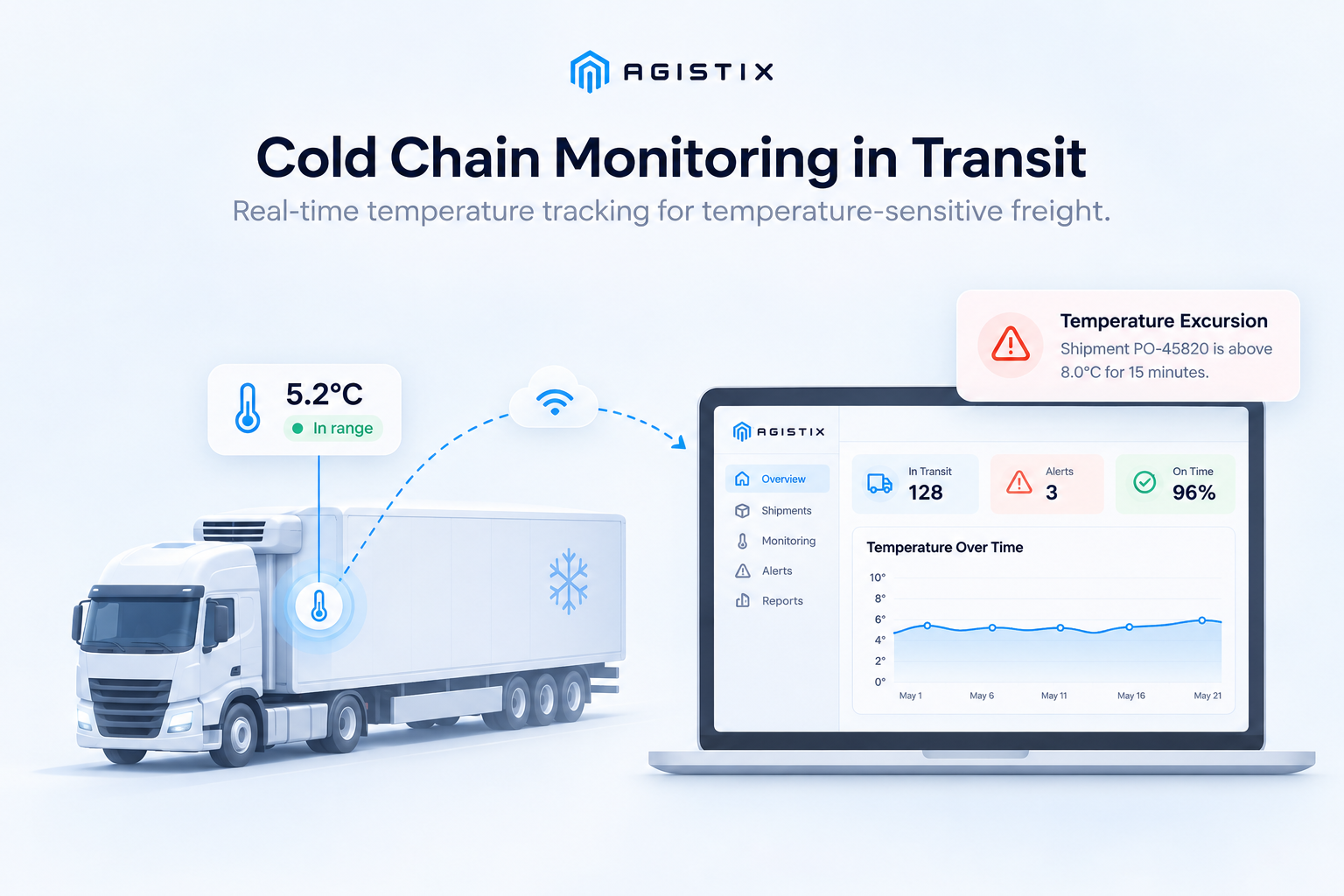
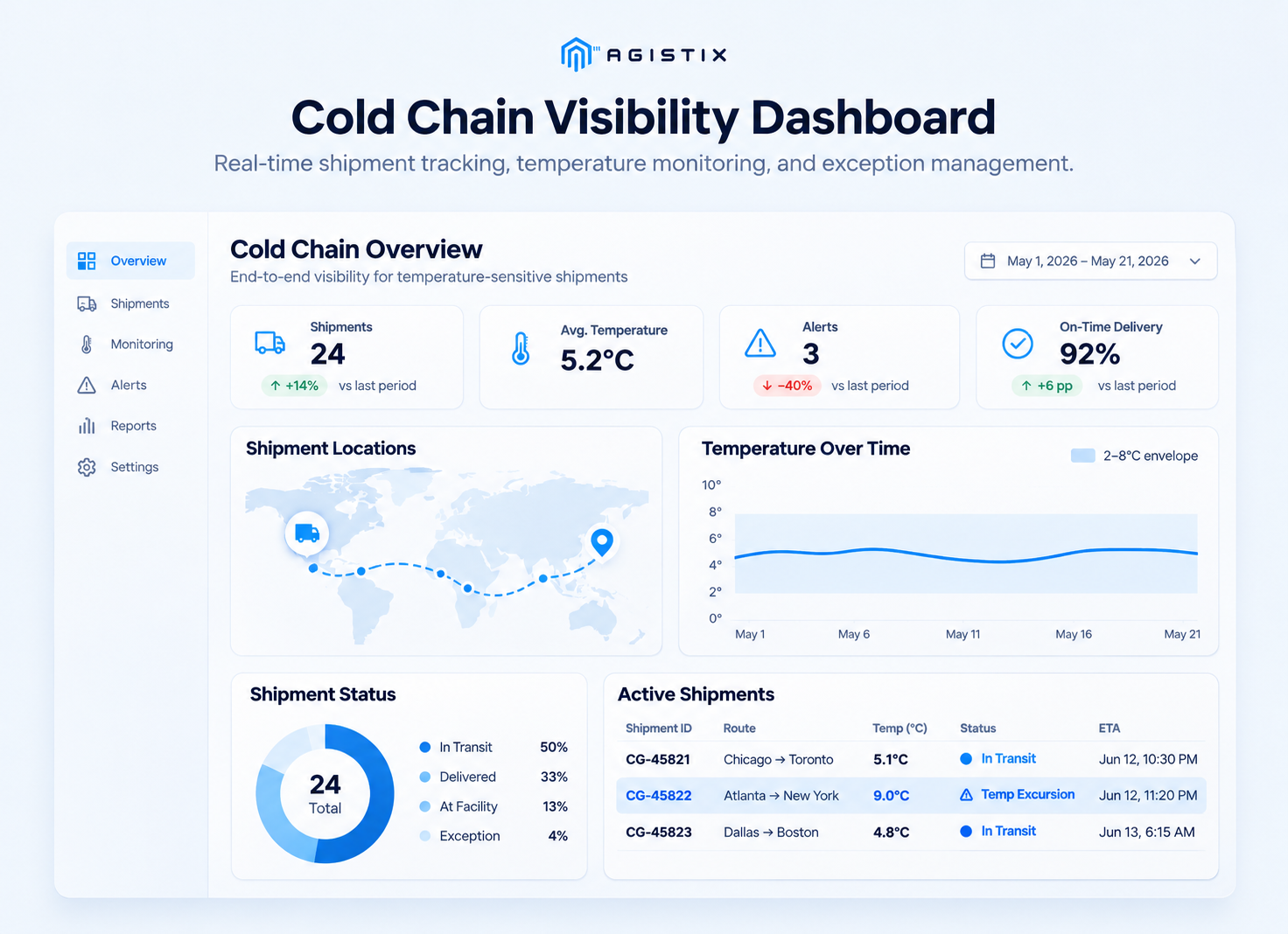
Cold chain temperature monitoring uses connected sensors to report temperature in real time, so logistics teams don’t have to wait until delivery to confirm compliance. Sensor data should feed into the same system the team uses to track freight in transit, creating a single, cohesive shipment record and simplifying required reporting.
Data loggers remain the validated temperature record for many cold-chain shipments, but teams only see their readings after download at delivery. Real-time sensors report during transit, and many companies utilize both so the logger covers any stretch where the live sensor loses signal.
4. Improve Cold Chain Shipment Visibility Across the Journey
Cold chain shipment visibility means seeing temperature data alongside location, milestones, ETA, and dwell time across all carriers to show whether a load is at risk and how much time the team has to take action.
Visibility is key at transfer points because it is often lost there. When a container is transferred from a vessel to a drayage truck, or a carrier is putting pallets down at a cross-dock, there could be hours without data. End-to-end shipment visibility gives the team one source of truth throughout the transfer.
5. Establish Automated Alerts and Escalation Procedures
Critical alerts, such as a sustained temperature deviation or a reefer failure, should be separated from routine status updates so they get attention right away. Each alert and notification should have an owner, an escalation path, and a time frame. For example, if the night dispatcher hasn’t responded to a unit failure in 30 minutes, the issue could escalate to the transportation manager. The response should be clearly defined, whether that’s to intervene, reroute, quarantine, or release with QA sign-off.
6. Maintain Temperature Records and Shipment Traceability
Every shipment needs a complete history, including timestamped temperature readings, the shipment ID, product, route, and milestones, along with any actions taken when alerts were raised. If QA, a customer, or an auditor needs to look up a particular shipment, the team can pull up the full history instantly and be confident that the information is accurate. Data should be stored for as long as required by GDP, the FDA’s Food Safety Modernization Act (FSMA), or the customer contract.
7. Analyze Performance and Continuously Improve Cold Chain Operations
Once individual shipment procedures have been established, teams can look at trends across lanes, carriers, and seasons. A particular lane may perform well in the cooler winter months, but see temperature excursions in the summer. This pattern may only be noticed by looking at historical performance data.
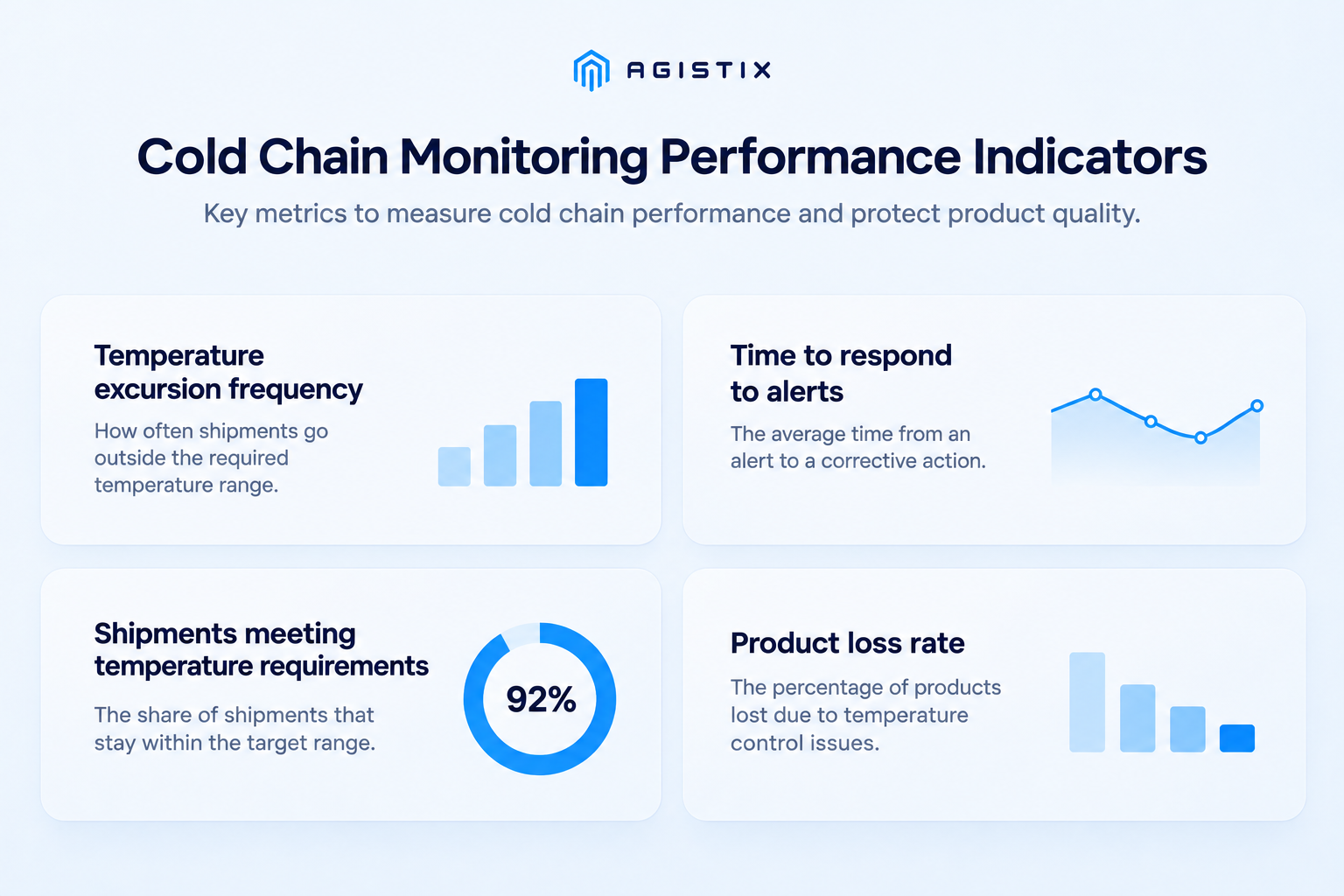
Companies should start by establishing KPIs relevant to their business, which may include:
- Excursion rate (excursions per shipment)
- Average excursion duration
- Percentage of shipments delivered in range
- Time to respond to critical alerts
- Spoilage, rejection, and claims rate
Use analytics results to inform carrier selection, lane planning, and equipment maintenance.
Technologies That Enable Cold Chain Monitoring
Cold chain monitoring works in layers. Devices collect data, a cellular or satellite connection sends it, and logistics systems match it to the right shipment.
- Temperature sensors and data loggers. Sensors report live readings during transit, while data loggers record the full trip for download and review after delivery.
- IoT and GPS tracking devices. Show the condition and location from inside the trailer or container.
- Reefer telematics. Report the reefer’s set temperature, fuel level, and door openings, which can reveal an equipment problem before the product temperature starts to deviate.
- Transportation management systems (TMS). Connected TMSs log each temperature reading in the appropriate shipment record.
- Supply chain visibility platforms. Collect milestone, location, and condition data from all carriers and send an alert when a reading breaches its defined threshold.
- API and EDI integrations. Send and log data between carriers, devices, and internal systems, eliminating manual re-entry.
How up-to-date the data is depends on the devices and integrations in place. The main value comes from connecting shipment and condition data across systems, not from adding more devices.
Common Cold Chain Monitoring Challenges and How to Address Them
There are a few common issues that can occur when monitoring temperature-sensitive freight:
- Fragmented data across carriers and systems. Each carrier provides data in its own format and on its own portal, so no one person sees the whole shipment. Advanced visibility platforms can standardize and normalize fragmented data to ensure consistency across records.
- Connectivity gaps can leave holes in the record. Sensors can occasionally lose signal inside steel containers, at busy ports, and on rural lanes. Data loggers fill in the gaps when needed, but issues often go uncovered too late.
- Alerts with no owner. Unclear ownership can mean exceptions are left in a general queue while the product is at risk. Assigning each alert to an owner based on type and prioritizing it by severity ensures every issue is addressed.
- Inconsistent carrier handling. Carriers follow their own procedures for pre-cooling, setpoint checks, door-open time, and data sharing. Writing cold chain requirements into carrier contracts and routing guides gives the shipper terms to enforce. Those requirements should include continuous temperature recording and access to sensor data.
None of the technology will work without standard processes, trained staff, and partners held to the same requirements.
Connecting Temperature Data to Shipment Decisions
A temperature reading only protects freight when someone sees it in time to act. That means setting ranges and checking carriers before pickup, tying sensor data to location and ETA in transit, and keeping a complete record for QA and auditors after delivery. When any part of that process lives in a separate carrier portal or spreadsheet, excursions surface at the receiving dock instead of on the road.
One Fortune 500 healthcare diagnostics team substantially reduced product spoilage and damage claims after moving its cold chain shipments onto Agistix. The platform brings carrier milestones, location, and available sensor data into each shipment record and routes exceptions to a named owner, with escalation until someone acts. If you’re ready to catch temperature excursions while there’s still time to save the load, schedule a demo of Agistix today.
Frequently Asked Questions
What is the difference between cold chain monitoring and cold chain visibility?
Cold chain monitoring tracks a product’s temperature and humidity, while cold chain visibility adds location, milestones, ETA, and dwell time for the same shipment. Logistics teams need both in one record to determine whether a load is at risk and how much time they have to respond.
Which industries rely most on cold chain monitoring?
Pharmaceuticals, biotech, healthcare diagnostics, and food and beverage rely most heavily on cold chain monitoring. Chemical shippers and life sciences research organizations also use it regularly to monitor sensitive cargo. In regulated industries, the temperature record often decides whether a product can be sold or used at all.
How often should cold chain temperature monitoring record readings?
Many pharmaceutical and food programs record readings every five to 15 minutes. Higher-value or more sensitive products may justify shorter intervals, and the interval should match what your SOPs, customer contracts, and auditors expect.
How does cold chain shipment visibility work across multiple carriers?
A visibility platform pulls tracking events and sensor data from each carrier through APIs, EDI, and device integrations, then standardizes that data into a single shipment record. Without that step, each carrier’s data sits in its own portal and format, and gaps appear at every handoff.
