What Is Freight Management? How to Control Costs & Improve Shipment Performance
Freight management gets harder as companies add carriers, lanes, and shipment volume, and most teams feel that strain through delays and exceptions long before they can name the cause. This article explores what freight management involves, the five problems that most commonly disrupt it, and how visibility and performance data turn a reactive process into one teams can control.
Managing freight across multiple carriers, modes, and systems creates an information problem as much as a logistics one. When shipment data is distributed across various internal systems and partner portals, supply chain teams lose the unified view they need to identify delays early and respond before it impacts downstream production or customer fulfillment. Freight management is the discipline that addresses that problem, coordinating transportation activity, monitoring shipment progress, and maintaining visibility to keep freight moving as planned.
This article covers what freight management involves, where transportation operations typically run into trouble, and how teams can build more consistent execution across carriers and shipment types.
What is Freight Management?
Freight management is the process of coordinating, monitoring, and improving transportation operations from the point of planning through final delivery and performance review. It covers more than moving goods from one place to another. It’s an operational role that determines whether freight moves on schedule, at the right cost, and with enough visibility to catch and address problems before they compound.
Freight management helps supply chain teams answer several important questions:
- Where is each shipment, and is it tracking on schedule?
- Are there delays, exceptions, or service failures that require action?
- Which shipments need intervention right now?
- Are carriers following contracted rates and meeting service expectations?
- What operational patterns are affecting transportation performance over time?
What Does Freight Management Include?
Freight management includes several core activities across the shipment lifecycle, including:
- Freight planning and carrier coordination – Determining shipment requirements, mode, and timing before freight moves, then communicating service expectations to carriers and logistics partners.
- Shipment tracking and status monitoring – Maintaining visibility and real-time tracking to determine whether transit is progressing as planned.
- Pickup and delivery management – Confirming pickups, managing delivery appointments, and capturing final shipment status at destination.
- Exception identification and resolution – Detecting deviations from expected transit and coordinating corrective action with carriers and logistics partners.
- Transportation performance monitoring – Reviewing completed shipments to measure carrier performance, identify recurring service issues, understand actual freight costs against contracted rates, and inform future planning.
When these activities run across disconnected systems, transportation efficiency and visibility inevitably breaks down. Tracking data in a carrier portal, exception alerts in email, and cost data locked in a separate TMS means no one has the full picture without manually pulling it together first.
Freight Management vs. Transportation Management
Freight management and transportation management are often used interchangeably, and for many organizations, the overlap is substantial. Freight management focuses specifically on shipment-level activity: tracking freight in motion, managing exceptions, confirming deliveries, and measuring carrier performance. Transportation management is a broader discipline that extends into network planning, mode strategy, carrier contracting, and rate management.
| Freight Management | Transportation Management |
| Focuses on managing and monitoring freight activity | Broader discipline of transportation planning and execution across the supply chain |
| Often focuses on shipment-level activity and performance | Can include network planning and transportation strategy |
| Tracks shipments, exceptions, deliveries, and carrier activity | Can include routing, scheduling, planning, and execution |
Whether a company draws a distinction between freight and transportation management usually depends on how its logistics department is structured and how many resources they’re able to dedicate.
Why Freight Management Becomes Difficult as Transportation Networks Grow
Freight management gets harder as transportation networks expand, and the difficulty isn’t just about volume. Every carrier relationship, mode, lane, and distribution point adds another layer of data that has to be tracked, reconciled, and acted on. Most companies don’t build that infrastructure in advance – they simply add carriers and partners as the business grows, and visibility gaps accumulate along the way.
The information problem compounds when transportation data lives in multiple places at once. A carrier portal shows status for one lane. A freight forwarder emails updates for another. The TMS holds rate and cost data, but generally only tracks shipments booked within the platform. No single system holds the complete picture, so teams end up reconciling across sources manually and tracking freight in spreadsheets, which slows down exception detection and makes it harder to measure performance consistently across the network.
5 Freight Management Problems That Disrupt Transportation Operations
Fragmented systems and manual processes create the same operational issues across transportation networks of every size.
Limited Visibility Across Shipments
When shipment status requires checking multiple carrier portals or waiting on updates from partners, teams are almost always working with information that’s at least partially out of date. In fact, Tive’s The State of Visibility Report 2025 found that 37% of companies still struggle to monitor shipments in transit. Which means that by the time a delay surfaces, the options for responding to it have already narrowed significantly.
Most teams compensate by assigning someone to manually check status across systems and consolidate updates, which might work until shipment volumes make it unsustainable. At that point, the choice is between investing in dedicated visibility software or accepting that a meaningful percentage of freight will run into problems that go undetected until they’ve already affected delivery.
Reactive Exception Management
Transportation exceptions can be manageable when there’s enough lead time to do something about them. A missed pickup that’s flagged six hours later is a very different problem than one flagged in real time. The same is true for customs holds, unexpected transit delays, and carrier capacity issues. When exception detection depends on manual checks, the lag between an event occurring and a team knowing about it determines what responses are still available.
The downstream effect compounds quickly. A single undetected delay can affect production schedules, customer commitments, and downstream shipments that were planned around an on-time delivery. Teams that operate reactively spend too much time on damage control – time that could be better spent on freight optimization and reducing transportation spend.
Fragmented Transportation Information
When shipment data lives across carrier systems, forwarding platforms, and internal tools, inaccuracy is almost inevitable. Status updates conflict with each other, documentation gaps don’t surface until invoicing, and performance data pulled from multiple sources tells a different story depending on which system you’re looking at. Without a single source of record, teams spend time reconciling information rather than acting on it, and the decisions they make are only as reliable as the transportation data they’re working from.
Poor Coordination Across Transportation Partners
Managing freight across carriers, forwarders, suppliers, and customs brokers means coordinating across organizations that have no shared system and no common view of what’s happening. Each party works from its own data, and the transportation team sits in the middle, fielding updates, relaying information, and manually keeping everyone aligned. That model creates a significant administrative burden and a single point of failure. When something needs to change quickly, the speed of the response depends entirely on how fast information can travel through that chain, and it rarely travels fast enough.
Limited Understanding of Freight Performance
Disconnected systems don’t just make individual shipments harder to manage. They make it nearly impossible to see what’s happening across the network as a whole. Freight cost trends, carrier reliability patterns, and lane-level service issues only become visible when data from multiple sources can be analyzed together over time. Without that consolidated view, freight management stays reactive and anecdotal. Problems get addressed only when they’re loud enough to demand attention, not because the data flagged them early. The result is that the same issues recur, and there’s no reliable basis for making decisions about carriers, lanes, or service levels.
How Freight Management Supports the Shipment Lifecycle
Effective freight management runs from initial planning through post-delivery analysis, and what happens at each stage directly affects the next.
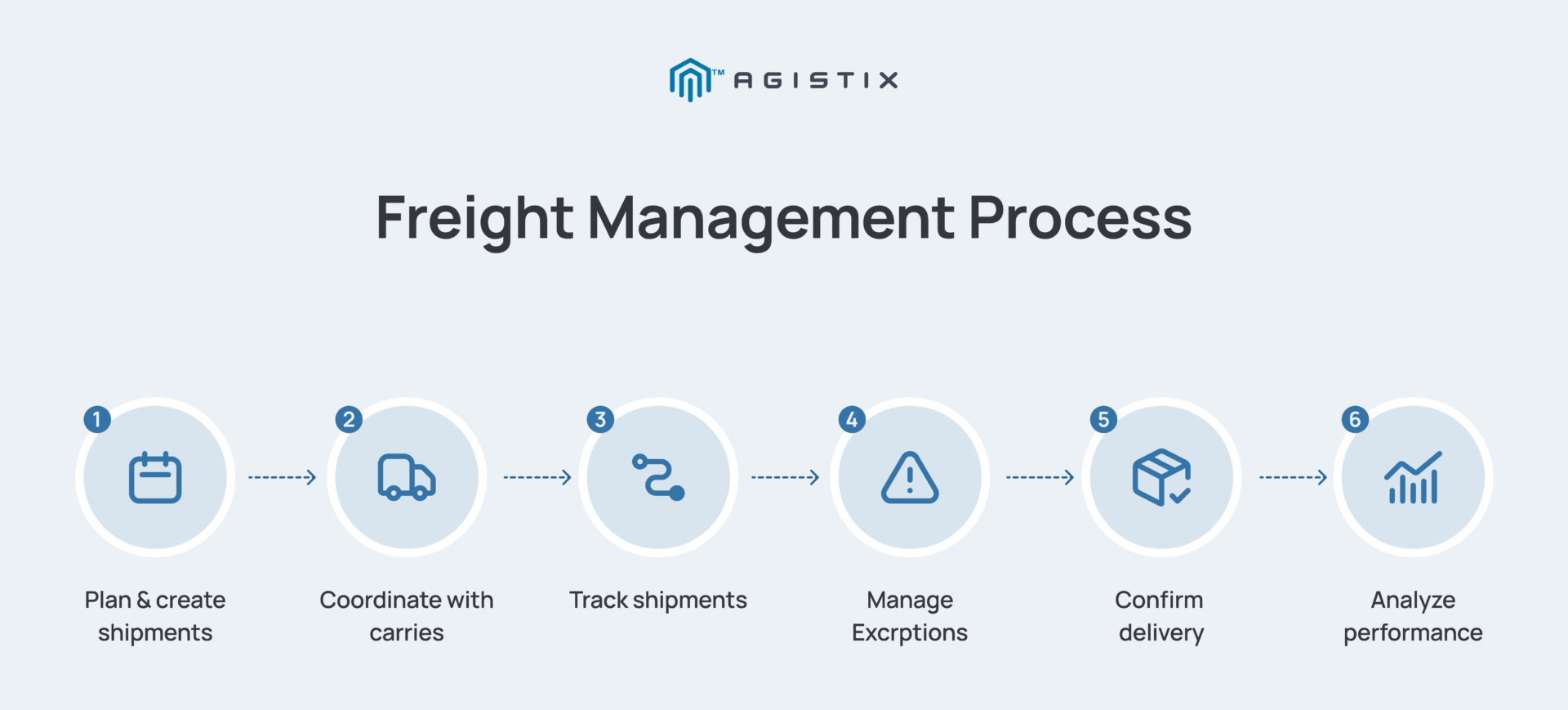
- Plan. Transportation teams determine shipment requirements, timing, and mode, then evaluate carrier options against service needs and cost. Delivery windows, carrier assignments, and service expectations set here carry through every stage that follows.
- Coordinate. After carrier selection, shipment details are communicated to carriers, forwarders, and logistics partners. Accurate, timely information at this stage reduces the risk of pickup failures, documentation errors, and miscommunication that create problems later in transit.
- Monitor. Teams track shipment progress as freight moves, capturing transportation events in real time rather than waiting on periodic status updates. Earlier detection of delays and exceptions means more options for addressing them before they affect delivery.
- Respond. When delays or exceptions occur, teams coordinate corrective action across carriers, forwarders, and logistics partners. Depending on severity, that can mean rerouting freight, escalating with a carrier, or adjusting production and fulfillment schedules to account for a delivery that won’t arrive as planned.
- Deliver. Confirming delivery and capturing final shipment information closes the operational loop on each shipment. Delivery data feeds directly into carrier performance measurement and invoice reconciliation.
- Analyze. Historical shipment data reviewed in aggregate surfaces patterns that real-time monitoring alone never reaches. Supply chain analytics uncover carrier reliability trends, recurring delay patterns, cost variances against contracted rates, and lane-level service issues that only become visible across a larger dataset.
Consistent freight management comes from treating these six stages as one connected operation, not six separate tasks handled by whoever’s available that day. Teams that run it that way can catch problems earlier, spend less time reconciling conflicting information, and walk into the next planning cycle with real data to inform their decisions.
How Transportation Visibility Strengthens Freight Management
Every stage of freight management depends on knowing what’s actually happening to a shipment, not what was planned or expected. Transportation visibility delivers that information. It’s the data that tells a team whether freight is on schedule, whether a carrier is performing the way they were contracted to, and whether something needs attention right now.
That data spans more than location. Shipment status, carrier activity, transportation events, estimated versus actual delivery times, open exceptions, and historical shipment activity all factor into whether a team can manage freight effectively or is just reacting to whatever surfaces first. A shipment marked “in transit” says almost nothing on its own. The same shipment shown against its planned transit time, its carrier’s typical performance on that lane, and its exception history tells a team whether to expect an on-time delivery or start making contingency plans.
That’s the distinction between tracking and visibility. Tracking tells you where something is. Visibility tells you whether it’s on track, and gives teams the context to intervene before a minor delay becomes a missed delivery. Visibility platforms built to pull this data together across carriers, modes, and systems give freight management teams a single view instead of a set of disconnected status checks.
Freight Management KPIs for Monitoring Shipment Performance
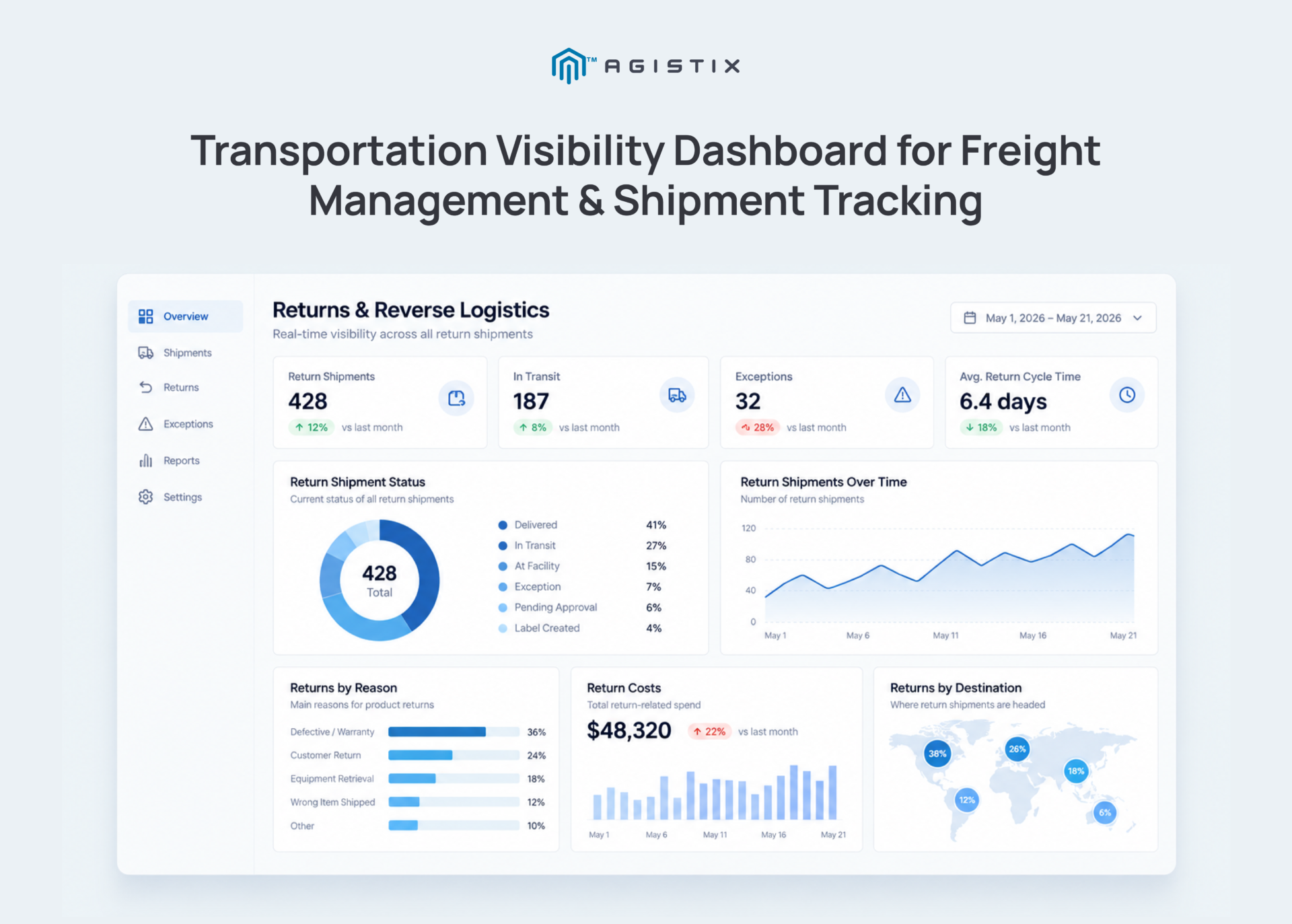
Freight management generates a continuous stream of data, but only some of it is useful for identifying what’s actually driving performance. These supply chain KPIs give logistics teams a consistent way to measure execution and catch problems before they become costly.
- On-time pickup and delivery rate: The clearest signals of whether freight is moving according to plan.
- Transit-time variance: How much actual transit time deviates from expected transit time. High variance makes planning unreliable even when averages look fine.
- Shipment exception rate: The percentage of shipments that experience a delay or deviation from plan. A rising rate on a specific lane or carrier usually points to a fixable cause.
- Tender acceptance rate: How often carriers accept freight at the agreed rate and timing. A declining rate can signal capacity or pricing problems early.
- Carrier service-level performance: Whether or not a carrier is meeting expectations on any given lane or mode.
- Delivery performance by lane: Service performance by origin-destination pair.
Tracked individually, these metrics help identify immediate problems. Tracked over time and across carriers and lanes, they become valuable transportation analytics that shape better carrier selection, more accurate planning, and fewer recurring service failures.
How Technology Supports Modern Freight Management
Most freight transportation problems come down to the same root cause: data scattered across systems that don’t talk to each other. Modern tech solutions address that issue by centralizing shipment information, carrier activity, and exception data into a single place teams can work from.
That centralization shows up in several ways. Shipments are monitored across carriers and providers without someone manually checking separate portals. Transportation updates and exception alerts arrive as they happen instead of surfacing through a follow-up call. Delivery performance and historical shipment activity sit in the same system, so teams can move from tracking a single shipment to analyzing patterns across the network without switching tools.
Technology’s role here is to support the process, not replace the human judgment that drives it. A freight management platform can flag an exception the moment it happens. Deciding how to respond, whether that means rerouting freight, escalating with a carrier, or adjusting a delivery commitment, still comes down to the team managing it.
Freight Management Best Practices for Supply Chain Teams
Freight management gets easier when the same processes apply to every carrier, lane, and shipment. These best practices give supply chain teams a way to run transportation operations consistently and more efficiently, even as networks and volumes grow.
- Centralize and standardize transportation data. Connect carrier and internal data sources into one view, with consistent references and statuses across carriers. Teams working from a single source spend less time reconciling updates and more time acting on them.
- Track every shipment and prioritize exceptions by business impact. Track shipments from pickup to delivery under a defined process, and assign ownership for each exception type in advance. A late shipment that delays production should get attention before one headed to a warehouse with two weeks of stock.
- Monitor historical data to identify recurring issues. Shipment history by lane, carrier, and facility shows where the same problems keep happening. A carrier that regularly misses pickups on one route or a facility with limited receiving hours becomes a specific problem to fix.
- Use advanced analytics to find cost savings. Comparing cost and transit data on each lane shows where a slower mode would still meet the delivery window. Lane volume then shows where smaller shipments could be consolidated into full loads, and the combined cost and service data points to lanes where a different carrier would deliver better results for less.
Turn Freight Data Into Better Decisions with Agistix
Freight management costs supply chain teams more in wasted time than most budgets account for. Every hour spent checking a carrier portal, chasing a status update by email, or reconciling a delivery date across three different systems is an hour not spent on solving the problem at hand or making more strategic moves.
Agistix removes that overhead by putting shipment activity, exceptions, and carrier performance in one place, so teams spend their time managing freight instead of managing data. If you’re ready to see the platform in action, schedule a demo today.
Frequently Asked Questions
What is freight management?
Freight management is how a company keeps control of its shipments once they’re in the hands of carriers and logistics partners. It means knowing where each shipment is, responding when something goes wrong, and reviewing carrier performance and cost after delivery. The goal is to deliver freight on time and catch problems before they reach the customer.
Why is freight management important?
Freight management is important because it gives supply chain teams the visibility and control to catch delays, exceptions, and service failures before they affect customers or downstream operations. Without it, teams rely on manual checks and fragmented updates, and problems get addressed after they’ve already caused damage rather than before.
What does a freight manager do?
A freight manager coordinates shipments across carriers and modes, monitors transit progress, and resolves exceptions as they come up. The role also includes reviewing carrier performance and transportation costs to inform future planning and carrier selection.
How does freight management help reduce shipment delays?
Freight management reduces delays by giving teams earlier visibility into exceptions, so there’s time to act before a minor issue becomes a missed delivery. Consistent monitoring and a defined exception-response process catch problems days or hours earlier than manual status checks typically allow.
What technology is used for freight management?
Freight management relies on tools that consolidate shipment tracking, carrier communication, and exception alerts into a single system, often built on top of or connected to a transportation management system (TMS). Platforms like Agistix pull data from carriers, forwarders, and internal systems into one operational view rather than requiring teams to check each source separately.
