
Transportation Management System (TMS): Top 10 Features for 2026
A Transportation Management System (TMS) is a platform designed to plan, execute, and optimize the physical movement of goods. The most effective TMS features for 2026 include real-time shipment visibility, multimodal route optimization, automated freight auditing, and deep ERP integration. This article takes a deeper look at how leading companies are using these tools to control rising freight costs and improve supply chain resilience through centralized data.
Logistics operations in 2026 face endless pressure from evolving global trade policies, rising fuel costs, and heightening customer demands for immediate updates. Managing these interconnected complexities requires more than old-school spreadsheets and carrier portal log-ins. Shippers, 3PLs, and enterprise logistics teams need a centralized hub to manage freight and maintain control over costs.
A modern TMS platform serves as this hub, integrating supply chain visibility directly into shipment execution workflows. They effectively eliminate data silos and enable the flexibility to pivot when disruptions occur. This guide details the primary functions of a TMS, the problems it solves for modern shippers, and the 10 essential features that define a high-performing system in today’s market.
What Is a Transportation Management System (TMS)?
A transportation management system (TMS) is software that manages the planning, coordination, and execution of freight movements. It serves as the primary interface between a company’s internal orders and its external network of carriers. While an Enterprise Resource Planning (ERP) system manages financial records and a Warehouse Management System (WMS) handles inventory within a facility, the TMS focuses specifically on transporting goods between suppliers, manufacturers, distributors, and end customers.
Core capabilities of a TMS include:
- Planning & Execution: Determining the most efficient and cost-effective way to move an order.
- Carrier Selection: Comparing rates and service levels across a network to find the best provider for a specific lane.
- Freight Cost Optimization: Consolidating shipments and selecting modes to reduce total spend.
- Visibility & Shipment Tracking: Monitoring the progress of freight from the point of origin to the final destination.
- Freight Audit & Payment: Automatically verifying that carrier invoices match quoted rates and contract terms to prevent overpayment and accelerate financial reconciliation.
- Analytics and Reporting: Aggregating historical shipment data to evaluate carrier performance, lane profitability, and overall network efficiency.
The global TMS market is growing as supply chains become increasingly complex. Valued at $18.70 billion in 2025, the market is projected to reach $21.30 billion in 2026 and grow to $44.84 billion by 2034. North America continues to lead this growth, accounting for over 39% of the market share as companies prioritize digital transformation to combat volatility.
What Problems Does a TMS Solve?
Transportation management software eliminates fragmented communication and manual data entry, which cause significant logistics inefficiencies. By centralizing operations, a TMS platform addresses several critical pain points that modern shippers face.
- Lack of Real-Time Shipment Visibility: Without a TMS, companies often rely on manual “track and trace” calls or disparate carrier websites to locate freight. A TMS aggregates this data into a single view, allowing teams to identify delays before they impact production schedules or fulfillment promises.
- Rising Transportation Costs: Geopolitical instability and new trade regulations continue to drive up freight rates. Reports indicate that 97% of shippers expect tariffs to increase transportation costs in 2026. A TMS helps mitigate these increases by providing the data needed to negotiate better contract rates and select the most cost-effective option for every shipment.
- Manual Processes and Human Error: Manual freight auditing and document generation often lead to costly mistakes. An advanced TMS automates the creation of bills of lading, labels, and invoices. This automation speeds up workflows and ensures that freight bills match agreed-upon contract rates.
- Limited Analytics: A lack of quality historical data makes it hard to identify underlying patterns or cost-saving opportunities. Without a centralized system, data is often trapped in spreadsheets, preventing teams from using predictive insights to anticipate lane fluctuations or carrier capacity crunches.
- Carrier Performance Inconsistency: Relying on anecdotal evidence to judge carrier performance can lead to poor freight decisions. A TMS provides objective metrics on on-time performance and tender acceptance, enabling shippers to remove unreliable partners from their network.
What Are the Top 10 Features to Look for in a TMS in 2026?
Modern logistics technology should serve as a strategic asset rather than a simple record-keeping tool. Evaluating a TMS involves looking past basic tendering buttons to find features that drive ROI and operational efficiency.
- Integration with Existing Tech (ERP and WMS)
A TMS should communicate natively with existing tech, like ERP and WMS, to ensure order data is consistent across departments. When a shipment status changes, the TMS pushes updates back to other internal systems, ensuring financial and inventory records are accurate without manual data entry. - Multimodal Transportation Support
Global supply chains require flexibility across parcel, LTL, truckload, ocean, and air. A high-performing TMS optimizes multimodal shipping by allowing you to execute shipments across all modes in one platform. This capability is vital for mode shifting, such as converting multiple LTL shipments into a single multi-stop truckload to reduce costs. - Contract Management and Spot Quotes
A TMS must have the ability to manage complex, multi-year rate contracts while simultaneously providing access to spot market rates. It should allow you to store negotiated rates and automatically trigger a spot auction when contract carriers decline a load, ensuring you always secure the best available market price. - Comprehensive Shipment Tracking
Real-time supply chain visibility is critical for modern logistics. This feature provides continuous updates on shipment status by aggregating data from EDI, API, and GPS sources. It allows teams to manage customer expectations and react to potential delays the moment they occur.
- Exception Management and Alerts
Instead of monitoring every shipment, teams should only focus on the ones that go wrong. Exception management triggers alerts for late pickups, delayed shipments, or missed deliveries, allowing for proactive intervention. - Machine Learning (ML) and Data Insights
Modern TMSs use ML to identify trends in carrier performance and lane pricing. This allows logistics teams to spot patterns that human analysis might miss, like a specific terminal consistently causing delays on Tuesday afternoons, allowing for smarter route planning. - Carrier and 3PL Management
A TMS should act as a scorecard for your partners. It tracks key performance indicators (KPIs) like load acceptance rates, on-time delivery percentages, and claims frequency to help you curate a high-performing carrier network. - Freight Audit and Invoice Reconciliation
This feature automatically compares carrier invoices against your quoted rates. It flags line-item discrepancies, such as unexpected fuel surcharges or accessorial fees, to ensure you only pay what you agreed to. - User-Friendly Dashboard and UX
Logistics teams need an intuitive interface that provides a high-level overview of the entire operation. A well-designed UX allows users to drill down from a global map view into a specific line-item invoice with minimal clicks for maximum efficiency. - Scalability and Cloud-Based Architecture
Cloud-based systems allow for rapid deployment across global sites. They scale automatically as your shipment volume increases, providing the processing power needed for complex optimization without requiring on-site server maintenance or manual software updates.
Basic vs Advanced TMS: What’s the Difference?
Legacy TMS solutions were originally designed for domestic, single-node truckload movements. They essentially functioned as electronic filing cabinets for freight bills. In 2026, these systems are no longer adequate for managing complex global trade. Modern, advanced systems replace manual check calls and static spreadsheets with API-driven data and automated decision-making.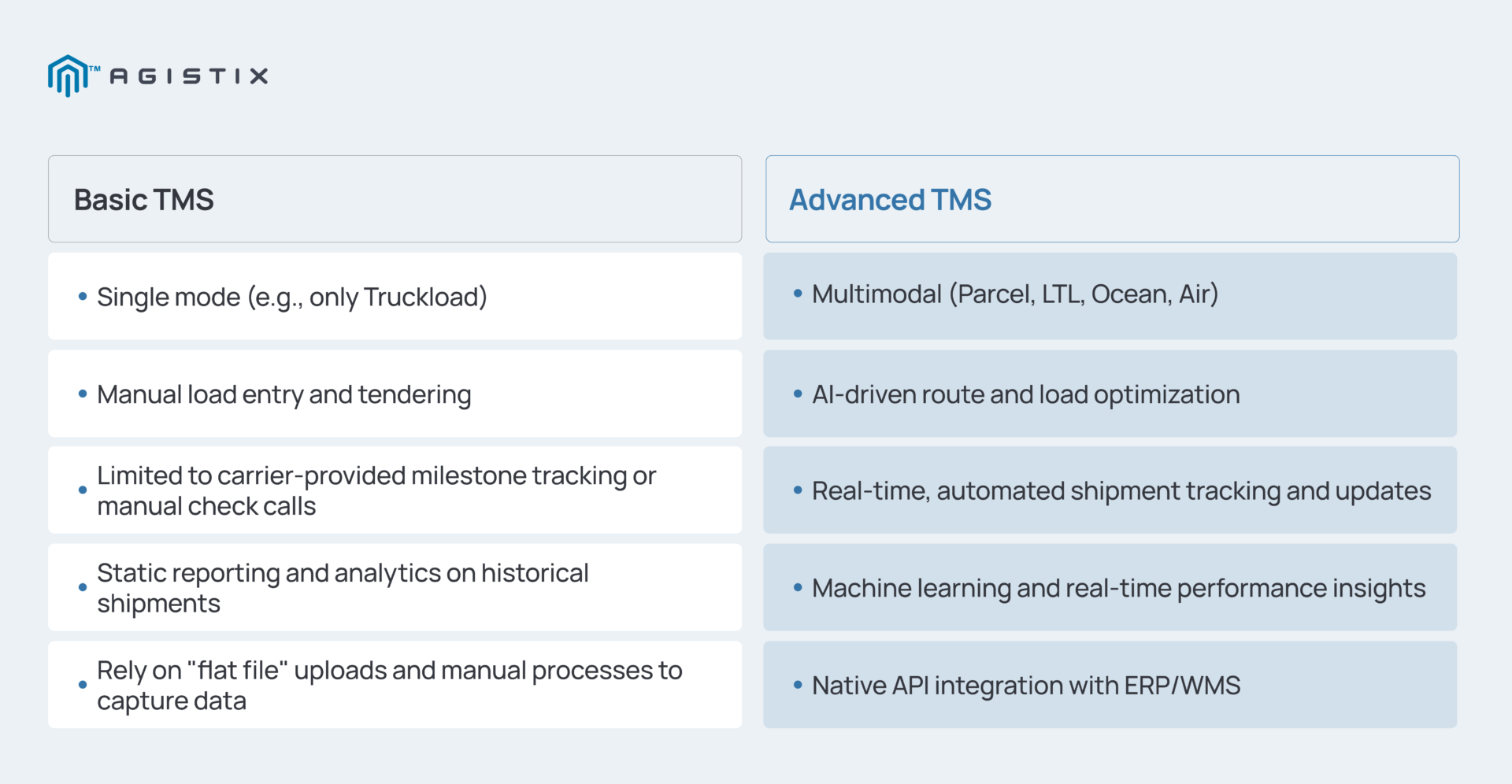
How Does a TMS Improve Supply Chain Performance?
A TMS helps transform logistics into a competitive driver. By eliminating the administrative burden of manual freight management, the software allows teams to focus on higher-value tasks like network strategy and relationship development.
- Direct Freight Savings: Improved route optimization and carrier selection can lead to immediate reductions in transportation spend.
- Administrative Efficiency: Automating the tendering and audit process reduces manual logistics tasks, allowing staff to manage higher shipment volumes without increasing headcount.
- Risk Mitigation: Real-time tracking and exception alerts allow companies to quickly implement contingency plans, like rerouting a shipment or pulling from a different warehouse, when disruptions hit.
- Customer Retention: Providing accurate, real-time tracking data builds trust. It eliminates the friction of “where is my order” (WISMO) inquiries and improves on-time delivery rates.
What Does a Modern TMS Workflow Look Like?
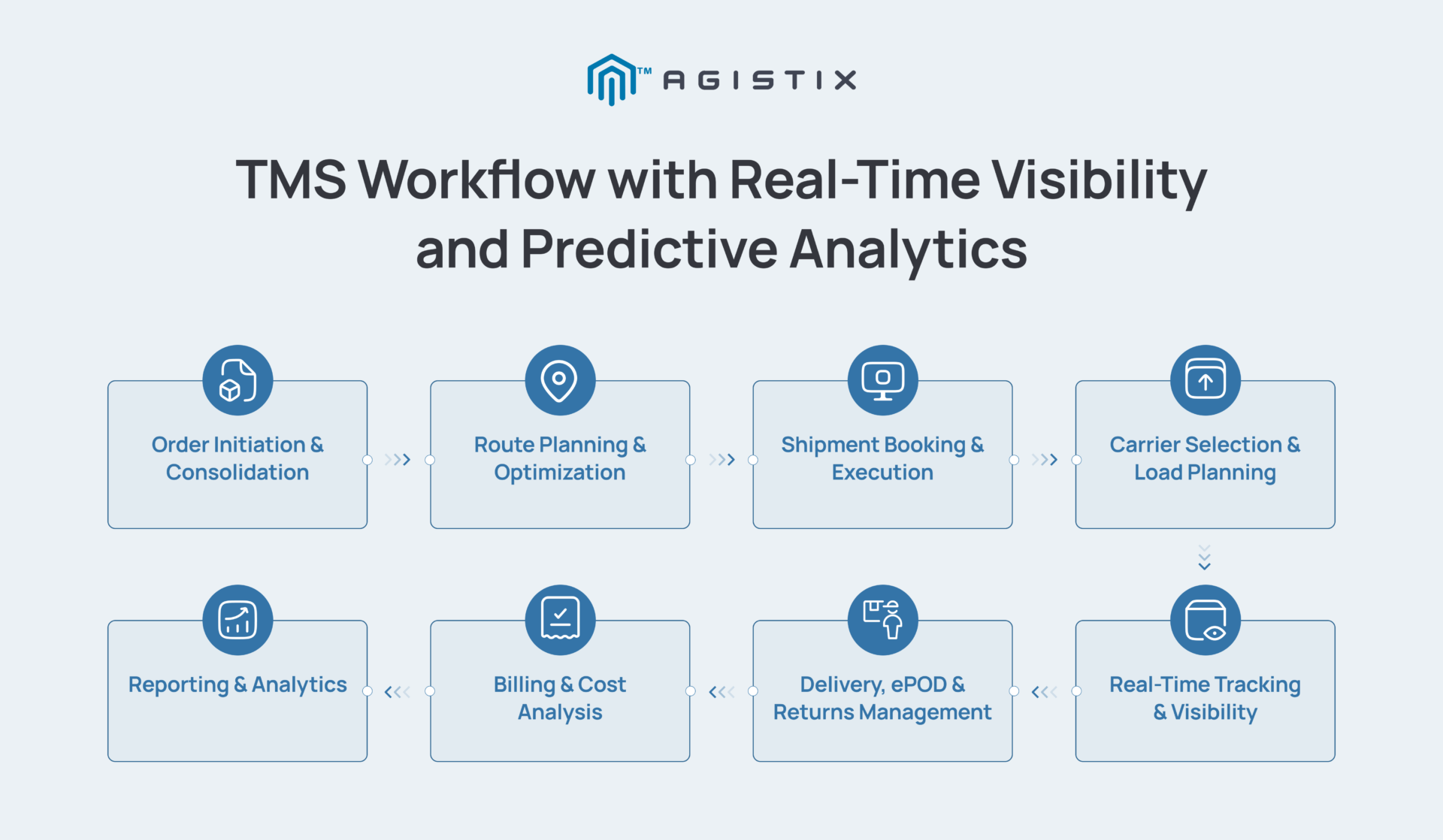
A modern workflow connects every stage of the shipment lifecycle into a continuous loop of data and execution.
- Order Input: Orders flow automatically from the ERP into the TMS once they are cleared for shipping.
- Load Planning: The system compiles shipping options based on your pre-set business rules, comparing contract rates against spot market bids to identify the best value.
- Carrier Assignment: The load is tendered to the selected carrier based on their rate-to-service ratio. If the primary carrier declines, the system automatically cascades the tender to the next best option.
- Real-Time Data Ingestion: The TMS receives continuous updates from external partners via EDI or API. It does not just monitor freight – it ingests and normalizes data from hundreds of different carrier formats into a single view.
- Exception Handling and Alerts: If data shows a shipment is off-track, the system triggers an alert to the logistics team and the customer for faster resolution.
- Freight Audit & Resolution: Upon delivery, the carrier invoice is electronically matched against the original quote. Any discrepancy is flagged for manual review, while matching invoices are cleared for payment.
- Performance Feedback Loop: The final data, including total cost and on-time performance, is fed back into the analytics engine to improve future carrier selection and budget forecasting.
How to Choose the Right Transportation Management System
Selecting a TMS requires an evaluation of both current needs and future growth. Use these steps to guide your selection process.
- Define Business Requirements: Identify the specific modes and regions your business requires for inbound and outbound orders.
- Evaluate Integration Capabilities: Ensure the TMS can connect natively with your existing ERP and WMS to prevent data silos.
- Assess Scalability: Choose a system that can handle sudden spikes in shipment volumes and add new users or locations without performance degradation.
- Check Visibility Features: Ensure the system provides centralized, real-time data by normalizing updates from API and EDI sources for faster decision-making.
- Prioritize User Experience: A system is only effective if your team uses it. Test the interface to ensure it simplifies workflows rather than adding new complications.
Redefine Transportation Management with Agistix
Managing complex global supply chains requires more than a basic tracking tool. Agistix TMS is a robust freight management solution that combines execution with end-to-end visibility to give you total control over your freight operations.
Frequently Asked Questions
What is a transportation management system (TMS) used for?
A TMS is used to centralize and automate the lifecycle of a shipment. This includes:
- Comparing freight rates across different carriers and modes.
- Managing load tendering and documentation like Bills of Lading (BOL) and Proofs of Delivery (POD).
- Tracking shipments in real time and automating exception alerts.
- Auditing freight invoices to ensure billing accuracy.
What are the key features of a TMS?
An advanced TMS should include five essential capabilities:
- Multimodal Support: Handling LTL, Truckload, Ocean, and Air in one place.
- Real-Time Visibility: Direct integration with carrier GPS and telematics.
- Freight Audit: Automatic matching of quotes to invoices.
- Integration: Native connections to ERPs like SAP, Oracle, or NetSuite.
- Analytics: Scorecards to track carrier performance and cost trends.
How does TMS software reduce transportation costs?
A TMS helps reduce costs by enforcing the use of contracted rates, identifying lower-cost shipping modes, and consolidating small shipments into larger, more efficient loads. Additionally, automated audit features prevent overpayment on accessorial fees and surcharges.
What industries benefit from TMS solutions?
Any organization moving significant freight volumes will see an ROI from a TMS, specifically:
- Manufacturing: Coordinating inbound raw materials and outbound finished goods.
- Pharmaceutical & Biotech: Managing temp-controlled logistics and high-stakes compliance.
- Aerospace & Defense: Ensuring international compliance and traceability for high-value contracts.
- Retail & E-commerce: Managing high-velocity parcel and LTL shipments.
- Wholesale Distribution: Streamlining complex multi-stop routes.
Is TMS part of supply chain visibility platforms?
A TMS is an execution-focused tool that generates the data fed into visibility platforms. While many modern TMS platforms include visibility features, they are distinct from ‘visibility-only’ tools because they allow you to actually book and move the freight, not just watch it.
Which integrations to look for with ERP and TMS in freight audit?
Look for two-way API integrations. The ERP should send order details to the TMS, and the TMS should send ‘ready-to-pay’ invoice data back to the ERP’s Accounts Payable module. This ensures your financial records are always in sync with your logistics execution.
