
Air Freight Tracking Best Practices for Faster, More Predictable Deliveries
Air freight carries more than $8 trillion in goods annually, yet many logistics teams still manage visibility through manual checks and disconnected carrier portals. This article covers why real-time tracking has become as important as transit speed, how air freight data flows through the logistics chain, and the best practices for achieving end-to-end shipment visibility.
Air freight moves more than $8 trillion in goods annually and represents roughly 33% of world trade by value, making it an incredibly important part of the global supply chain. Organizations that choose air are paying a premium for speed and reliability, yet they often underestimate how quickly visibility degrades once a shipment is in transit. Between fragmented carrier systems, ground handling operations, and the volume of parties involved in the air cargo journey, end-to-end tracking data is harder to maintain than the mode’s digital connectivity suggests. This article takes a closer look at the challenges of air freight tracking and what it takes to build reliable real-time visibility.
Why Real-Time Air Freight Visibility Matters as Much as Speed
Air cargo rates are among the highest in logistics. When organizations choose air, they’re paying a premium for speed and reliability, which makes unplanned disruptions disproportionately costly.
The problem is often not the delay itself. It’s that a company likely doesn’t know a delay is happening until there’s little left to do about it. Air freight operates in an environment that leaves minimal margin for error. Tight delivery windows, real-time customer expectations, customs complexity at borders, and operational disruptions all reduce the time available to identify and address a problem before it becomes a serious one.
Shippers who treat no news as good news take on risk they often can’t quantify until it’s too late. Air cargo visibility gives logistics teams the ability to communicate with stakeholders and make informed decisions proactively, rather than after the fact.
How Air Freight Tracking Works
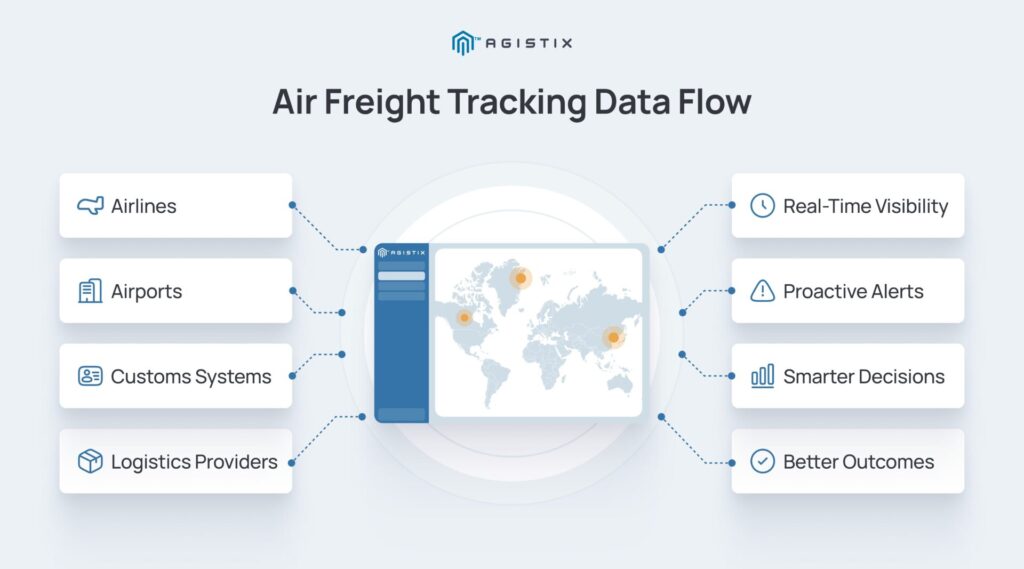
Tracking an air shipment relies on data exchanged between multiple systems as it moves through the logistics chain.
The air waybill (AWB) is the primary document that identifies a shipment and travels with it from origin to destination. Airlines use internal tracking systems to log events against the AWB: acceptance at origin, departure, arrival, and transfer. Freight forwarders manage bookings, documentation, and customs filings, often maintaining separate systems alongside airline data, which creates parallel data streams from the start.
At each airport, ground handling agents log physical cargo events including receipt, storage, loading, and offloading. Customs systems record clearance status at borders. Final-mile carriers track delivery activity at destination.
Every party generates tracking data. The problem is that data rarely moves between these systems automatically or in real time. Modern visibility platforms connect to these sources through API integrations, pulling event data from airlines, forwarders, customs, and ground carriers into a unified shipment record. That integration layer converts fragmented carrier data into actionable tracking intelligence.
The Biggest Challenges in Air Freight Tracking
Managing air cargo tracking across a global supply chain means navigating a fragmented data environment with multiple parties and limited standardization. The most significant challenges include:
- Data Silos and Limited Carrier Visibility: Airlines, freight forwarders, and ground handling agents each maintain separate systems with no native data exchange between them. Logistics teams end up manually checking multiple portals and aggregating status updates, a process that is time-intensive and prone to error.
- Inconsistent or Delayed Tracking Updates: Some carriers batch-update cargo status rather than recording events in real time. A shipment showing “in transit” may have missed a connection hours earlier. Decisions made on stale data carry compounding risk, particularly when downstream operations depend on accurate arrival windows.
- Customs and Border Delays: Documentation errors, regulatory holds, and inspection requirements can extend transit time without advance warning. Because customs systems typically operate outside freight tracking platforms, many shippers learn of a clearance issue well after the expected delivery window has passed.
- Lack of Predictive ETA Information: Standard logistics tracking shows current status, not projected arrival. Knowing a flight has departed does not account for ground processing, customs clearance duration, or final delivery scheduling. Without predictive ETA capability, accurate customer communication and downstream planning both suffer.
- Gaps in Final Mile Ground Visibility: An aircraft arriving on schedule does not confirm a shipment is still tracking for on-time-delivery. Once cargo is offloaded, transportation visibility frequently drops. Local ground carriers and short-haul truckers often operate entirely outside airline and forwarder tracking systems, leaving shippers without reliable data during the stretch customers are most focused on.
7 Air Freight Tracking Best Practices
Effective tracking requires combining the right technology with consistent processes and cross-partner coordination. The following seven practices produce measurable improvement in shipment visibility and delivery predictability.
Centralize Shipment Data in a Single Visibility Platform
The default state for most air freight logistics is fragmented, and the operational costs of disconnected data is substantial. Hours go toward manual status checks, and information doesn’t reach the right people consistently. Teams make calls based on incomplete data and discover too late that a shipment is already off track. Because no single system holds the full picture, there is no reliable way to measure carrier performance, identify delay patterns, or hold partners accountable.
A centralized visibility platform aggregates data from all carriers, forwarders, and logistics partners into a single shipment record. Status updates, milestone events, and exception alerts flow into one system, giving every team member an accurate, current view without requiring them to chase it across portals. For organizations working toward end-to-end supply chain visibility, centralization is where operational control actually starts producing results.
Track Shipments Using Real-Time Milestones
“In transit” is not a useful status. It tells a logistics team almost nothing about where a shipment actually stands or whether it is on schedule. Milestone-level tracking changes that by capturing discrete events throughout the air cargo lifecycle:
- Booking confirmed
- Cargo accepted at origin
- Departed on scheduled flight
- Customs cleared at destination
- Out for final delivery
Each milestone sharpens ETA accuracy, supports customer communication, and creates an audit trail when something goes wrong. When a shipment misses an expected milestone, that gap itself functions as an alert. Real-time milestone data also makes post-shipment performance analysis meaningful and actionable.
Use Predictive ETA Technology
Standard tracking is retrospective. It records what happened, not what is likely to happen next. The gap between those two things is where most operationals get hung up.
Predictive ETA technology estimates delivery timing by drawing on historical transit performance on a given lane, carrier-specific delay rates, customs clearance patterns at destination, real-time flight status, and active exception data. The result is a rolling delivery forecast that adjusts as conditions change.
For logistics teams, the impact is significant. Receiving can be scheduled based on realistic arrival windows rather than optimistic ones, and customer commitments can be made with greater accuracy. When a predictive model flags a likely delay, teams have time to communicate proactively or explore alternatives before a missed delivery creates downstream problems. On international lanes where customs clearance time varies significantly by shipment type and origin country, predictive ETA capabilities are particularly high-value.
Monitor Exceptions Instead of Individual Shipments
A logistics team managing 200 active air shipments cannot realistically check each one hourly. Trying to do so simply creates noise.
Exception-based monitoring inverts that approach. Rather than scanning all active shipments, the system surfaces only those deviating from expected patterns. That includes missed connections, customs holds, flight delays that push delivery past the committed window, and shipments that have not scanned within the expected timeframe. Everything running normally stays out of the queue.
This allows teams to redirect time from routine status confirmation toward shipments where action can actually change outcomes. Response times to genuine exceptions improve because the signal is no longer buried in routine updates.
Improve Carrier and Forwarder Collaboration
Real-time data sharing with carriers and forwarders shortens the gap between a problem occurring and a logistics team knowing about it. When a carrier flags a delay in a shared system rather than an email chain, the update reaches the right people faster and with less information degraded in transit.
Stakeholder collaboration also shapes how issues get resolved. Shared visibility into shipment status means that when a forwarder needs to reroute cargo around a flight cancellation, they work from the same information as the shipper. Fewer confirmation calls, faster decisions, and clearer accountability across parties. The organizations that manage air freight most effectively treat carrier and forwarder data access as an operational requirement. Structured data-sharing agreements and API-level integrations between systems make that coordination consistent rather than situational.
Integrate Tracking Data With Internal Systems
A visibility platform gives logistics teams accurate shipment data, but logistics teams aren’t the only stakeholders who need it. Procurement, finance, warehouse operations, and customer service all make decisions that depend on current freight status, and most of them are working in ERP and TMS systems, not a dedicated tracking portal. Without comprehensive supply chain integration, those teams rely on manual updates from logistics.
Connecting tracking data to ERP and TMS systems eliminates that issue. Shipment milestones and status updates push automatically to the systems where each team already works, so inventory records, delivery scheduling, and cost allocation all reflect current data without requiring someone to manually transfer it.
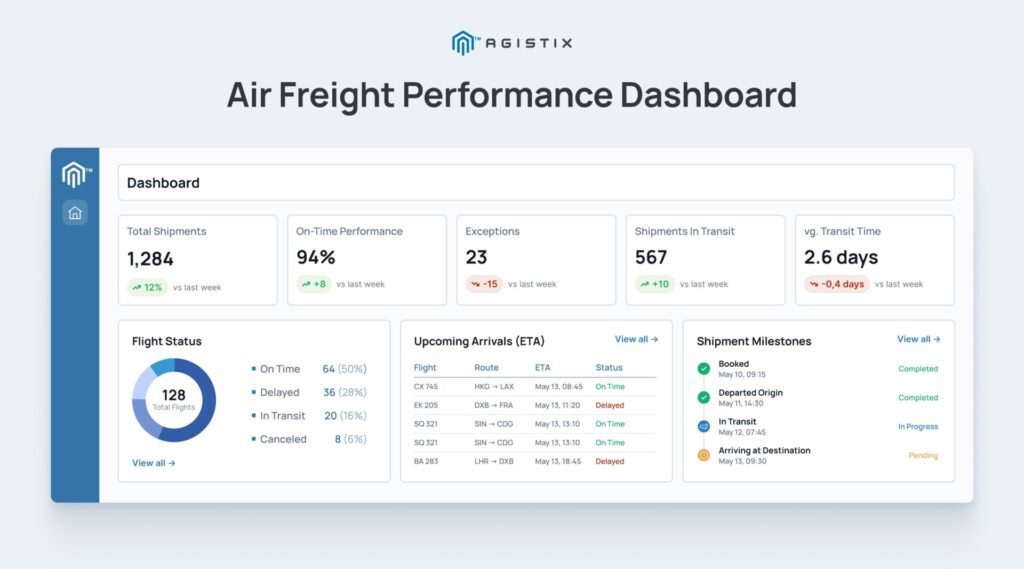
Use Analytics to Identify Performance Trends
Air freight tracking generates a continuous stream of shipment data. Most organizations use it to manage what’s happening in real time, which is valuable. But the same data, analyzed across lanes, carriers, and time periods, reveals structural patterns that individual shipment monitoring never surfaces. Recurring delays on specific lanes, carrier underperformance trends, and documentation issues driving repeated customs holds only become visible in aggregate.
Applying supply chain data analytics to air freight logistics gives teams an evidence base for decisions. Key metrics worth tracking include:
- On-time arrival rate by carrier and lane
- Average transit time by origin-destination pair
- Customs clearance duration by country and commodity type
- Exception frequency and resolution time
- Carrier-specific delay rates over rolling time periods
Carrier performance reports built from this data create accountability in supplier relationships and give procurement teams objective ground for contract negotiations. Route-level delay patterns, once visible in aggregate, can be addressed at the source rather than managed shipment by shipment.
How Air Freight Tracking Technology Is Evolving
The tracking tools available today represent a significant advance over the manual, fragmented processes that characterized the industry a decade ago. Visibility platforms aggregate multi-carrier data and deliver unified shipment records across global networks. API connections between airlines, forwarders, and shippers have replaced many of the manual portal checks that previously consumed logistics team hours. IoT-enabled sensors now extend tracking to physical cargo conditions, monitoring temperature, humidity, and handling impact in real time for high-value or sensitive shipments.
The next phase of development is less about data aggregation and more about intelligence. Several technologies are advancing quickly:
- AI-powered ETA prediction is improving accuracy as models train on larger and more granular datasets. Carrier-specific delay patterns, seasonal lane performance, and customs clearance rates by country and commodity type are all inputs that sharpen delivery forecasting.
- Automated exception management is reducing the manual triage that currently falls to operations teams. Systems are increasingly able to identify at-risk shipments, generate alerts, and suggest remediation steps without human prompting at every stage.
- Digital supply chain control towers are connecting air freight data with surface transport, ocean, and rail visibility in unified platforms. Multimodal transportation visibility allows logistics teams to manage cross-mode shipments from a single operational view, removing the blind spots that appear at mode transitions.
- Predictive customs analytics are emerging as a tool for anticipating clearance delays before shipments enter the customs process, drawing on commodity type, origin country, declared values, and historical clearance performance.
Air freight tracking is becoming a proactive decision-support tool rather than a historical record of events.
Turning Air Freight Data Into Operational Control
Air freight is an investment. The return on it has less to do with which carrier is on the AWB than with how well an organization can see and act on what’s happening across its freight network. High-performing logistics operations have the infrastructure to monitor performance, manage exceptions, and improve based on what the data shows.
Agistix gives logistics teams the tools to build that infrastructure. From real-time shipment tracking and exception management to carrier collaboration and supply chain analytics, the platform connects the people, data, and processes involved in air freight operations into a single, coherent view. If you’re ready to see what Agistix’s visibility, execution, and collaboration capabilities can do for delivery performance and cost control, schedule a demo today.
Frequently Asked Questions
What is air freight tracking?
Air freight tracking monitors a shipment’s location and status from the moment cargo is accepted at origin through final delivery. It captures flight events, ground handling activity, customs clearance, and last-mile delivery as a shipment moves through the logistics chain. Modern visibility platforms consolidate data from airlines, forwarders, and ground carriers into a single, continuously updated record rather than requiring teams to check each source manually.
How does air freight tracking work?
Each party in the air freight chain generates tracking data independently: airlines log flight events, ground handlers record cargo movements, customs systems note clearance status, and delivery carriers update last-mile activity. The challenge is that these systems do not share data natively. Freight tracking platforms connect each source through API integrations and pull event data into a unified shipment record. The AWB number serves as the common identifier that links all events back to a single shipment across every system.
What information can be tracked during air freight shipments?
Booking confirmation, cargo acceptance, flight departure and arrival, connecting transfer events, customs clearance status, ground transport activity, and final delivery confirmation can all be tracked. Advanced platforms go beyond status events to provide predictive ETA updates and exception alerts when a shipment deviates from its expected trajectory. For sensitive cargo, IoT sensors add condition tracking covering temperature, humidity, and physical integrity throughout the journey.
How can businesses improve air freight visibility?
Businesses can improve air freight visibility by focusing on data centralization first. Most visibility problems stem from data being spread across too many disconnected sources, with no single system holding the full picture. Connecting all carriers and forwarders to one visibility platform addresses the root cause. From there, integrating that platform with internal ERP and TMS systems closes the gap between knowing where a shipment is and acting on that information. Exception-based monitoring and predictive ETA tools handle the operational layer on top of that foundation.
What technologies are used for air freight tracking?
Real-time visibility platforms and API integrations with airlines and forwarders form the base for air freight tracking. IoT sensors extend tracking to physical cargo conditions. AI-powered ETA prediction models and automated exception management tools handle the intelligence layer above that. Supply chain control towers bring freight data into a broader multimodal view. The most important factor is not which individual tools an organization selects but whether those tools are connected, share data reliably, and surface actionable information.
