March 17, 2026 - 1 minute read

Supply Chain Trends in 2026: Data Management Strategies for Resilience and Growth
The stability that once defined global trade has been replaced by a state of permanent volatility. While logistics leaders previously focused on recovering from singular shocks, like a pandemic or a specific regional conflict, today’s environment is defined by the compounding nature of risk. Fluctuating tariffs, fractured trade alliances, and increasing climate disasters are now baseline conditions rather than outliers. With 80% of supply chains experiencing at least one major disruption in the past year, the conversation must move past simple crisis management and toward a framework that prioritizes resilience and agility.
This article examines the primary drivers of this volatility and explores how a centralized data strategy provides the structural foundation necessary to maintain performance, even when conditions unexpectedly change.
Why Supply Chain Resilience Is a Strategic Priority in 2026
For better or worse, modern supply chains are currently dictated by geopolitical instability. Many organizations are struggling to navigate a landscape where fluctuating tariffs and regional conflicts can invalidate a sourcing strategy in a matter of days. Recent surveys from Sedgwick show that this economic and political volatility has become the foremost concern for 65% of supply chain leaders, yet a significant preparation gap remains. Despite the persistent nature of these risks, only 3% of companies consider themselves fully prepared for potential disruptions. This lack of readiness leaves most firms in a reactive cycle, unable to pivot before shocks impact their bottom line.
Environmental risks have also shifted from seasonal concerns to year-round operational hurdles. The frequency of billion-dollar climate disasters provides a clear metric for this acceleration: in the 1980s, the U.S. averaged 82 days between these massive disruptions. By 2025, that window shrunk to an average of just 16 days. This collapse in recovery time often means that the tail end of one disruption now overlaps with the beginning of the next.
These pressures are forcing a fundamental trade-off. To remain agile, organizations are prioritizing diversified supplier and carrier networks, even when those choices result in higher upfront costs. Resilience requires more than just a plan for bouncing back from supply chain disruptions – it requires the infrastructure to identify them early and execute alternative plans quickly.
What Is a Resilient Supply Chain in Today’s Market?
While resilience is often used as a catch-all term for general preparedness, in an operational context, it refers to a system’s capacity to absorb shocks and adapt while maintaining profitability and performance. It differs from traditional risk mitigation, which focuses largely on prevention. Resilience assumes that disruption will occur and focuses on the speed and efficacy of the response.
A resilient supply chain in 2026 is defined by several important characteristics:
- Agility and flexibility: The ability to shift sourcing, production, or transportation modes in real time without triggering massive cost spikes or crippling delays.
- Actionable visibility: Moving beyond basic tracking to achieve a 360-degree view of all shipments, carriers, and third-party data. This ensures decisions are based on the current state of the network.
- Proactive preparedness: Utilizing scenario modeling and high-fidelity data to build contingency plans for both predictable shifts and unforeseen black swan events.
- Cross-functional collaboration: Breaking down the silos between procurement, logistics, and finance to ensure that when a disruption occurs, the entire organization responds from a unified data set.
- Technological integration: Implementing systems that automate data collection and alert stakeholders to exceptions, reducing the reliance on manual checks that fail during a crisis.
How Real-Time Visibility Enables Supply Chain Resilience
True resilience demands a shift from static data to dynamic, real-time visibility. While many organizations equate visibility with simple shipment tracking, 2026 standards require a more comprehensive view. Real-time visibility serves as the central nervous system of a resilient supply chain, consolidating disparate data points into a single, actionable 360-degree view of global operations.
Achieving this level of transparency allows shippers to identify operational gaps and reduce spend by identifying and resolving exceptions before they escalate. When data is centralized, it becomes a tool for proactive control. Shippers can monitor inbound, outbound, and third-party shipments across all carriers and modalities, regardless of where those shipments were booked.
A robust visibility infrastructure requires moving away from fragmented carrier portals and manual spreadsheets. A centralized platform harmonizes data from various sources, ensuring that when a delay occurs, the information is processed and flagged immediately. This eliminates the lag that often leads to expensive, reactive shipping decisions. By providing a holistic view of all carrier and partner data, visibility platforms enable the collaboration required to maintain service levels in a volatile market.
Key Supply Chain Trends in 2026
Enterprises are arguably better equipped to handle unpredictability today than they were during the initial disruptions of the early 2020s. This preparedness is the result of a more proactive approach to supply chain resilience and data management. Below are the supply chain industry trends currently shaping the market.
Diversifying Supplier and Carrier Networks
Strategic sourcing has emerged as the primary mechanism for mitigating risk in a fractured trade environment. Organizations are moving away from vendor concentration to ensure that a localized conflict or policy shift doesn’t invalidate their entire logistics strategy. Shippers are increasingly prioritizing regionalization and multi-sourcing to ensure that a disruption in one corridor doesn’t paralyze the entire network. While managing a more diverse group of partners adds complexity, it provides the redundancy necessary to maintain continuity when primary routes are blocked or restricted.
Cost Management and Operational Efficiency
In an environment of fluctuating trade dynamics and cautious consumer spending, closely monitoring and managing costs has become essential. Resilience and efficiency are no longer viewed as opposing goals; instead, organizations are using better data to protect their margins. This involves a granular focus on freight spend, carrier performance, and the minimizing reliance on manual workflows. By automating the auditing and reconciliation of supply chain data, companies can identify hidden costs and ensure that their resilience strategies remain financially sustainable.
AI and Automation
In 2026, the industry has moved past experimental AI pilots and toward agentic systems capable of executing multi-step workflows without constant human intervention. Generative AI is now utilized by 91% of mid-market manufacturers in some capacity, largely to automate data capture from shipping documents and to trigger real-time updates for downstream teams. These tools are increasingly used for predictive analytics, allowing shippers to model the impact of a supplier pivot or tariff change on their landed costs before the event.
However, as these technologies mature, they are being viewed with increasing scrutiny. Executives are moving away from broad AI-first initiatives in favor of rigorous evaluations of efficacy and ROI. There is a growing recognition that sophisticated algorithms cannot compensate for fragmented data or broken processes. For AI to provide a clear return, it must be applied to specific, proven workflows where it can demonstrably reduce manual effort and decision latency.
Data Management and Cybersecurity
As global networks become more interconnected, data management and supply chain cybersecurity have converged into a single strategic priority. Centralizing data is no longer just about visibility; it is about reducing an organization’s attack surface. Recent surveys found that 70% of organizations cite third-party risk as their primary cybersecurity concern, as attackers increasingly target the upstream digital services that link shippers to their carriers and suppliers. A fragmented data environment, where information is scattered across unmanaged spreadsheets and legacy portals, creates vulnerabilities that are difficult to patch or monitor.
A resilient data strategy prioritizes the secure, high-fidelity exchange of information across the entire network. This requires moving toward platforms that offer robust encryption and continuous access monitoring. By centralizing supply chain records, organizations can ensure that their data is not only accessible for operational pivots but also protected by a unified cybersecurity framework. This shift transforms data management from a back-office function into a core component of risk management, ensuring that business continuity isn’t compromised by a breach in the partner ecosystem.
How to Achieve Supply Chain Resilience With Data Centralization
The shift in leadership’s view of the supply chain is reflected in current executive priorities. According to a 2025 survey by The Conference Board, 71% of U.S. CEOs plan to fundamentally alter their supply chains over the next three to five years. This restructuring is no longer a localized logistics initiative, but an enterprise risk strategy. Supply chain management has emerged as a dominant strategic priority for 68% of trade professionals, nearly double the percentage from just one year ago.
Managing supply chain risks requires a departure from fragmented, siloed operations. To build true resilience, organizations must be able to process information at all levels and from multiple sources simultaneously. Data centralization creates a unified architecture that eliminates the information gaps inherent in legacy systems. By consolidating data, companies can reduce manual touches and human error, ensuring that their response to disruption is based on accurate, real-time information.
Resilience in 2026 is driven by this digital infrastructure. Centralizing data allows for a proactive approach to network changes, enabling shippers to:
- Simplify processes: Consolidate inbound and outbound transaction data to identify and remove bottlenecks.
- Improve supplier relationships: Use high-fidelity data to hold partners accountable to performance standards and improve on-time delivery rates.
- Reduce operational costs: Automate routine data reconciliation to lower personnel costs and redirect resources toward higher-value exception management.
- Enhance decision speed: Utilize a single source of truth to coordinate communication between procurement, finance, and logistics teams.
Investing in supply chain resilience solutions is no longer optional for organizations pursuing global growth. It is the only way to transform a reactive, manual operation into an agile network capable of sustaining performance in a volatile market.
Key Challenges in Supply Chain Data Integration
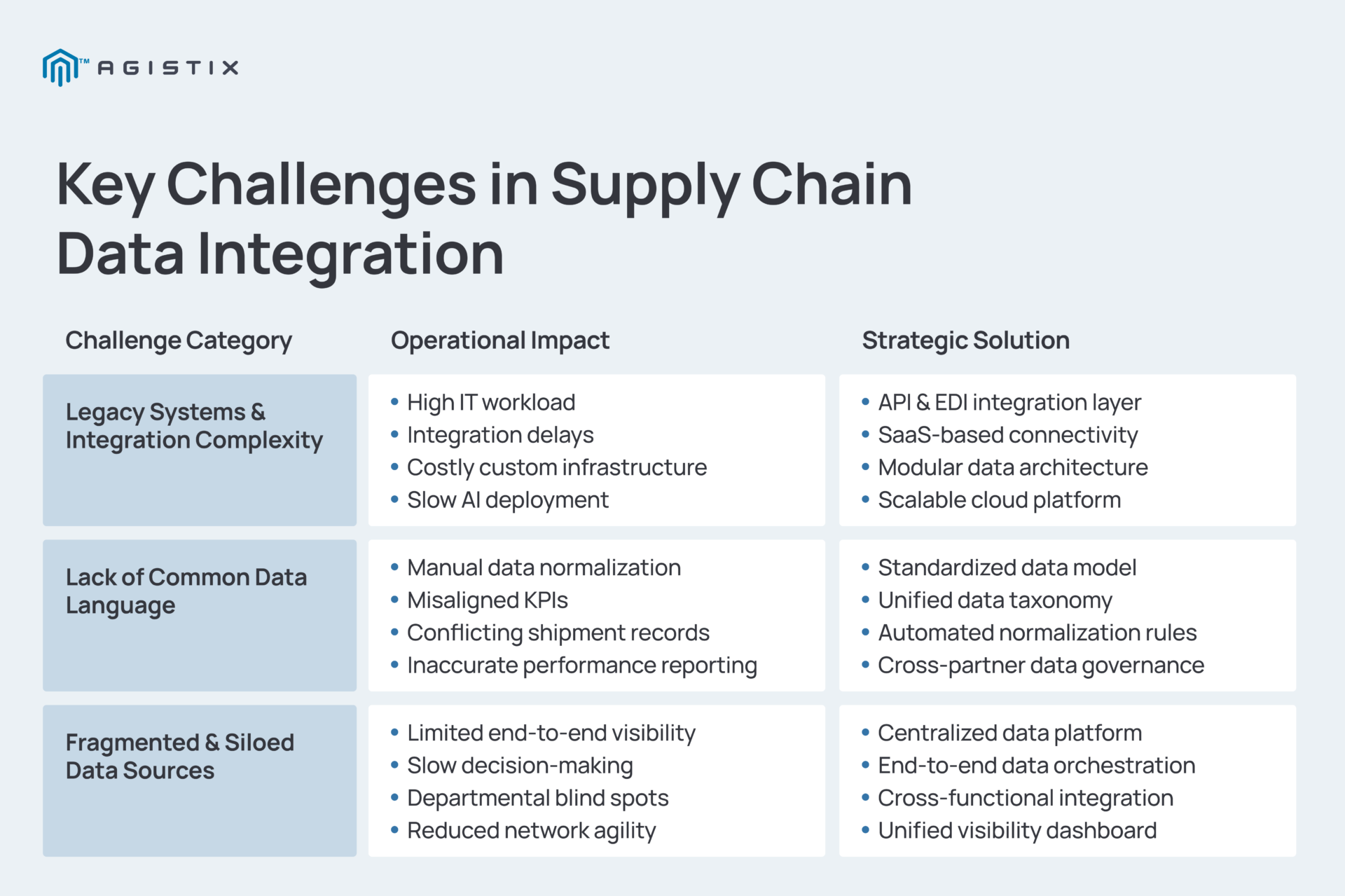
Most organizations invest heavily in data management yet remain dissatisfied with the outcomes. The challenge has intensified in 2026 as leaders attempt to deploy advanced analytics and AI tools that require a foundation of high-fidelity data. Without addressing the underlying integration hurdles, these technologies cannot provide a measurable return.
Legacy Systems and Integration Complexity
The primary barrier to a unified data strategy is the reliance on legacy systems that were never designed for modern interoperability. Gathering, storing, and transporting data across disparate internal systems often consumes excessive IT resources and leads to significant delays. Building a custom infrastructure to bridge these gaps is a high-cost, high-effort undertaking. However, adopting SaaS platforms with diverse integration capabilities that support both APIs and EDI can simplify this task, enabling companies to link their technology stack without an extensive overhaul of their existing systems.
Lack of a Common Data Language
A significant hurdle in data integration is the absence of a standardized language between the many partners involved in moving goods. Shippers, carriers, 3PLs, and suppliers often use different formats, units of measure, and status definitions for the same transaction. This lack of uniformity forces organizations to spend valuable time manually normalizing data to get an accurate view of their operations. Without a common data language, the risk of misinterpretation increases, leading to conflicting records and misaligned KPIs across the supply chain.
Fragmented and Siloed Data Sources
Supply chain data is inherently fragmented, usually developed in isolation to suit the needs of a single department or an individual partner. Unlike a physical product, where every component is designed toward a single result, digital data is often built in silos without regard for how it will be used in broader business processes. A successful data management strategy treats these datasets as core components of the larger supply chain, focusing on the end-to-end flow of information from collection to consumption. Treating data as a competitive advantage allows firms to optimize their global networks and respond to market shifts with greater precision.
What Features Should a Supply Chain Data Platform Include?
A supply chain data management platform provides the foundation for digitization and scalability. By automating the correlation of data streams from partners and public feeds, these platforms eliminate the need for manual status checks and fragmented email reporting. Centralizing this information allows stakeholders to monitor performance in real time, issue proactive alerts, and utilize predictive analytics to inform critical decision-making across the entire network.
- Real-time shipment tracking: Provides live updates across all modes, eliminating the need for manual checks. This ensures data remains current and supports specialized requirements, such as temperature monitoring and automated status alerts.
- End-to-end system integration: Supports a wide range of data interfaces, including EDI, XML, and APIs, to harmonize information from various carriers and technology providers into a single digital supply chain.
- Advanced data analytics: Transforms high-fidelity data into actionable insights for predictive ETAs and cost optimization. Customizable metrics allow organizations to focus on the specific KPIs that drive their operational outcomes.
- Automated alerts and risk notifications: Uses predictive analytics to enable proactive exception management. Configurable alerts via email or SMS allow teams to address disruptions before they impact service levels.
Building a Resilient Supply Chain with Agistix
Agistix helps organizations address modern supply chain challenges through advanced data centralization software. Our primary advantage is a seamless integration process that requires no changes to your established business workflows. Implementation is streamlined, typically delivering measurable results, including reduced labor costs and automated operations, in as little as four weeks.
With decades of industry experience and a collaborative approach, Agistix provides end-to-end visibility into every transaction and shipment. The platform is architected to support evolving data schemas and the complex exchange requirements of any partner network. By deploying our robust visibility platform, you can eliminate operational blind spots and improve order fulfillment without overextending your IT resources.
Gain real-time visibility, centralized data control, and actionable insights to strengthen your supply chain strategy in 2026.



Frequently Asked Questions
- Strategic sourcing and regionalization: Shifting away from vendor concentration to reduce exposure to volatile trade corridors.
- Cost management through automation: Utilizing high-fidelity data to identify hidden expenses and protect margins.
- AI ROI scrutiny: Moving past experimental pilots toward AI solutions with proven efficacy in predictive analytics and data capture.
- Systemic cybersecurity: Treating data security as a core supply chain risk rather than just an IT function.
- Integration layers: Platforms that utilize both APIs and EDI to harmonize data from disparate carriers and 3PLs.
- Cloud infrastructure: Systems that provide the scalability needed to process and store massive volumes of global transaction data.
- IoT sensors: Devices that provide real-time environmental tracking for sensitive freight, such as temperature or location.
- Automated alert systems: Configurable tools that push real-time risk notifications to stakeholders via SMS or email.
