September 15, 2025 - 8 minutes read
Supply Chain Transparency, Traceability, and Visibility: What Is The Difference
Transparency and traceability are rising to the top of supply chain priorities as demand for sustainable products steadily increases. In fact, a 2025 Capgemini survey shows that 64% of all consumers and 73% of Gen Z consumers prefer to purchase from companies with verified sustainability claims. But meeting those expectations means being able to collect and interpret supply chain data that proves how goods are sourced, produced, and delivered.
Terms like transparency, traceability, and visibility get thrown around in the industry, often without a clear distinction. And without a shared understanding, it’s hard to move responsibility and sustainability goals forward. This article takes a closer look at what each concept actually means and how visibility platforms can support smarter, more connected supply chains.
What Is Supply Chain Traceability?
Traceability refers to the ability to track a product’s journey across the supply chain, from raw materials to finished goods. It focuses on identifying exactly where a product came from, how it was made, and who handled it along the way.
This is about more than just monitoring direct Tier 1 suppliers. Effective traceability requires deep integration across the supply chain, connecting data from suppliers, manufacturers, logistics partners, and internal systems into a continuous record of activity. That integration makes it easier to trace products across multiple tiers, including upstream partners (Tiers 2, 3, and beyond). This broader, connected view is critical for compliance and credibility, particularly in industries under pressure to validate sourcing, safety, or sustainability claims.
Traceability helps answer:
- Where did this product originate?
- What raw materials, ingredients, or components were used?
- Who handled or transformed the product at each stage?
- How did it move through the supply chain, and when?
- Can we verify the chain of custody for regulatory or recall purposes?
Traceability is especially vital in sectors like food, pharmaceuticals, agriculture, and medical devices, where product integrity, consumer safety, and regulatory accountability are closely linked.
What Is Supply Chain Transparency?
Transparency is the act of making supply chain information accessible to necessary stakeholders intentionally and consistently. It’s all about deciding what data to share, who needs to see it, and when that information should be available.
For companies under pressure to prove ethical sourcing, environmental responsibility, or regulatory compliance, transparency is no longer optional. Investors want to see supplier accountability. Customers want to know where products come from. Regulators expect evidence, not estimates. Meeting those expectations requires being ready to share reliable data across the supply chain network.
That includes:
- Identifying who needs access: Internal teams, logistics providers, multi-tiered suppliers, regulatory bodies, or customers
- Defining what’s shared: Supplier identities, sourcing locations, ESG performance, product claims, or shipment-level events
- Establishing when it’s shared: In real time, at regular intervals, or when a disruption occurs
Transparency supports faster decision-making, smoother collaboration, and stronger accountability across functions and partners. It also creates space to address exceptions before they escalate — whether that’s a sourcing issue, a missed transit milestone, or a supplier risk that needs immediate attention.
Without transparency, organizations are left to manage expectations reactively with incomplete information. With it, they can demonstrate responsibility, act decisively, and build more resilient supply chains from the inside out.
What Is the Difference Between Supply Chain Transparency and Traceability?
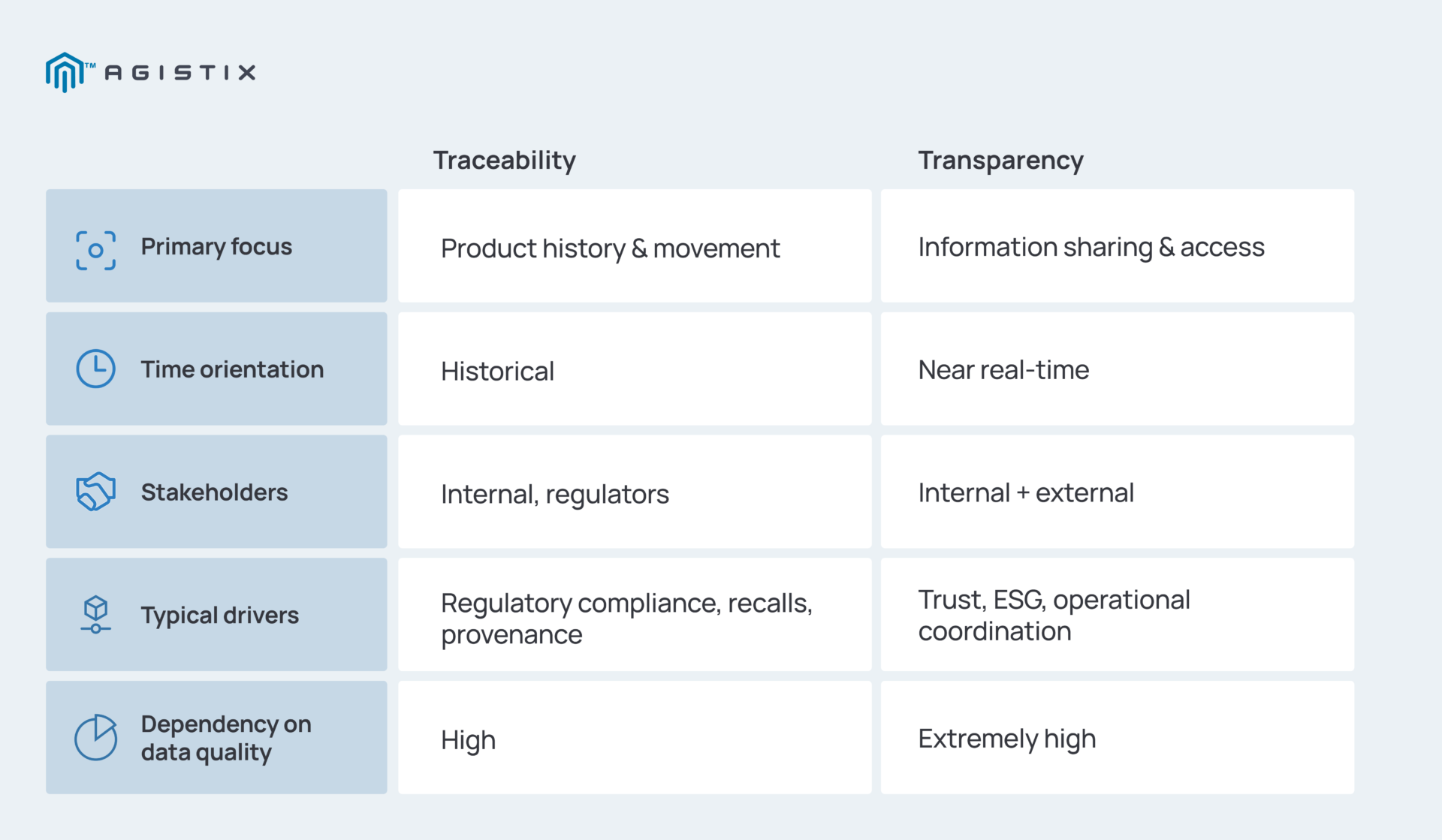
Transparency and traceability serve different purposes, but they’re most effective when approached together. Traceability gives organizations the ability to track what happened. Transparency determines what gets shared, and with whom. One builds a record of activity; the other applies that record in ways that drive trust, accountability, and action. Failing to prioritize both creates gaps in both understanding and execution.
What is Supply Chain Visibility and Where Does It Fit?
Supply chain visibility is the mechanism that makes transparency and traceability possible. It gives organizations access to the data needed to verify activity, share information with stakeholders, and respond to issues quickly and accurately.
That visibility needs to go far beyond location tracking. It includes order and inventory status, carrier and partner updates, documentation, financial transactions, and exceptions — all pulled from systems that often don’t talk to each other. When that data stays fragmented, teams are forced to rely on assumptions or manually track down updates. But when it’s unified in real time, companies can both trace a product’s full journey and provide the information needed to meet rising demands for transparency.
Advanced logistics platforms like Agistix support these efforts by delivering end-to-end visibility across the supply chain — not just for outbound freight, but also inbound and third-party shipments, across all modes and carriers. By connecting data from ERPs, TMSs, carrier systems, and supplier portals, Agistix provides a single source of truth for both executional control and corporate transparency initiatives.
Why Visibility Platforms Are Essential for Transparency and Traceability
Supply chain data rarely lives in one place. Shipment details sit in a TMS, invoices live in the ERP, partner updates arrive via email, and quality documents might never be digitized at all. Without a way to bring that information together, there’s no reliable way to trace product movement or share accurate updates with the people who need them.
Visibility platforms solve that problem by making disconnected data usable. They create a unified view that connects shipments to transactions and performance across regions, freight modes, and supplier tiers.
Capabilities that make this possible include:
- Normalizing data across systems, formats, and supply chain partners
- Linking shipments to transactions, documentation, and financial records
- Detecting exceptions based on real-time, rule-based triggers
- Scaling visibility across regions, business units, and freight modes
- Enabling internal coordination and external data sharing from the same source
Visibility platforms provide organizations with the structure and consistency needed to act on supply chain data in real time. They bring together the pieces that transparency and traceability depend on through systems that connect what’s happening with where and why. That level of integration sets a new operational standard for supply chains built to perform under pressure, prove their claims, and adapt as expectations evolve.
FAQs
1: What data do companies need to prove supply chain transparency to consumers and regulators?
To demonstrate supply chain transparency, companies need access to accurate, verifiable data that shows how products move through the supply chain and who is involved at each stage. That data must be consistent enough to share externally and detailed enough to stand up to scrutiny.
Common data sources include:
- Supplier Profiles: Verified identities, locations, and certifications for Tier 1, 2, and 3 partners.
- Chain of Custody Records: Digital records that prove when and where a product changed ownership.
- Sourcing Credentials: Documentation regarding raw material origins, such as fair trade certifications or conflict-free mineral reports.
- Logistics Milestones: Real-time data on transit times, routes, and carbon emissions for all shipments.
- Compliance Documentation: Safety data sheets, audit results, and quality control certificates that validate product claims.
2: Why is data normalization and centralization critical for visibility and transparency in supply chains?
Supply chain data is notoriously messy because it originates from dozens of different sources, including ERPs, TMSs, carrier portals, and manual spreadsheets. Without normalization and centralization, that data remains inconsistent, incomplete, and difficult to use. Different formats, timestamps, and identifiers make it hard to align events or verify what actually happened.
Normalization standardizes incoming data so it can be compared, correlated, and trusted. Centralization brings that standardized data into a single environment where it can be accessed, monitored, and shared. Together, they create the foundation for reliable visibility, which is essential for both traceability and transparency.
3: What capabilities should companies look for in a supply chain transparency software?
A robust transparency and visibility platform should act as a bridge between disconnected systems, making it easy to share and act on information. When evaluating supply chain transparency software, look for these capabilities:
- System Agnostic: The ability to integrate with any ERP, TMS, or WMS without requiring a total system overhaul.
- Multi-Tier Mapping: Tools that allow you to see beyond direct suppliers into the deeper layers of your supply chain.
- Real-Time Exception Management: Automated alerts that trigger the moment a shipment or supplier falls out of compliance.
- Document Digitization: A central hub for storing and linking digital twins of physical paperwork, like bills of lading or sourcing certificates.
- Scalable Reporting: Dashboards that can quickly export the specific data sets required by different regulators or ESG frameworks.
4: How does supply chain traceability and transparency improve operational performance beyond compliance?
Beyond meeting regulatory or reporting requirements, traceability and transparency improve how supply chains operate day to day. When companies can see and verify what is happening across suppliers, shipments, and transactions, they are better positioned to identify issues early and coordinate responses more effectively across teams and partners.
This level of clarity reduces manual intervention and improves decision-making during disruptions or exceptions. Over time, it leads to more predictable performance, stronger partner accountability, and fewer downstream surprises that impact costs and service levels.
5: How does supply chain transparency support ESG reporting and sustainability goals?
Supply chain transparency provides the data foundation required to support ESG reporting and sustainability initiatives. Many environmental and social metrics depend on understanding supplier practices, sourcing locations, transportation activity, and operational performance across multiple tiers of the supply chain.
With transparent, connected data, companies can validate sustainability claims, track progress against goals, and respond to stakeholder questions with evidence. Transparency also makes it easier to identify risk areas, address noncompliance, and improve reporting accuracy as ESG requirements evolve.

