
Introduction to Building Strong Supplier Relationships
Modern supply chain strategy relies on effective supplier relationship management (SRM) to drive cost efficiency and operational reliability. High levels of market volatility increasingly change how organizations view their upstream partners; in fact, 88% of procurement leaders report that supplier collaboration has become a significantly higher priority over the past two years. This new focus reflects a broader need to move beyond transactional supplier interactions to ensure supply chains can stand up to modern pressures. This article explores the benefits of collaborative partnerships and provides steps for developing strategies to improve and maintain these essential relationships.
| Quick Summary
Supplier relationship management (SRM) shifts the focus from transactional purchasing to strategic partnerships that strengthen supply chain resilience and lower operating costs. By aligning on performance metrics like fulfillment accuracy, freight efficiency, and inventory turnover, organizations can turn vendors into integrated partners. This article outlines a five-step approach to building these relationships, showing how shared data and modern collaboration tools provide the visibility needed to maintain stability in the face of volatility. |
What is Supplier Relationship Management (SRM)?
Supplier relationship management (SRM) is the strategic collaboration and interaction between organizations and their suppliers. SRM categorizes third-party vendors based on their operational impact. Procurement teams use SRM to maximize value through performance analysis and risk mitigation.
Managing supplier relationships extends beyond transactional arrangements to emphasize the need for long-term, symbiotic partnerships. Supplier relationships are vital as they contribute significantly to a company’s overall success and resilience. Open communication, mutual trust, and shared objectives form the foundation for maintaining these critical alliances.
Benefits of Strong Supplier Relationships
Strong supplier relationships foster a sense of shared purpose between an organization and its suppliers. When goals align, both parties work collaboratively toward achieving milestones.
- Improved Quality: Collaborative partnerships encourage a continuous exchange of knowledge. Suppliers engage in product development, which leads to improved quality standards and customer satisfaction.
- Reduced Costs: Robust relationships enable streamlined processes, efficient inventory management, and optimized production cycles. Optimized cycles eliminate unnecessary expenditures and increase financial visibility.
- Increased Innovation: Transparent communication nurtures an environment of innovation. Suppliers share ideas and insights that drive continuous improvements and breakthrough innovations.
- Enhanced Resilience: Strategic partnerships enable faster response times when supply chain disruptions hit. Close collaboration ensures that both parties can anticipate risks and pivot quickly, maintaining continuity amid chaos.
Strategic and intentional partnerships help transform suppliers into integrated stakeholders. Consistent collaboration builds a foundation for predictable growth and supply chain stability.
What Makes Good Supplier Relationships?
Building strong supplier relationships requires several elements that form the foundation for successful partnerships. These components foster supply chain collaboration and mutual growth, ensuring a more resilient ecosystem.
Transparency and Open Communication
Trust, transparency, and open communication are the cornerstones of any strong supplier relationship. Transparency ensures that both parties have access to essential information, fostering a shared understanding of expectations, fulfillment statuses, and even potential issues. Open communication channels enable a free flow of information, allowing for timely issue resolution and improved decision-making. These tenets effectively build trust and strengthen the bond between companies and their suppliers, leading to a more productive and effective partnership.
Shared Goals and Performance Improvement
A crucial element of a strong supplier relationship is aligning goals and objectives. Both organizations and their suppliers must have a clear understanding of their shared purpose and vision. By aligning goals, the supplier becomes an extension of the organization’s mission, investing in the shared success of the supply chain.
Measurement and Constant Improvement Initiatives
Effective supplier relationships thrive when performance measurement and improvement initiatives are in place. Establishing clear metrics for evaluating supplier performance enables both parties to track progress and identify areas for enhancement. Regular performance reviews provide opportunities for constructive feedback and recognition of achievements.
Continuous improvement initiatives encourage collaborative problem-solving and the implementation of best practices. As suppliers and organizations work together to optimize processes, products, and services, the supply chain becomes more competitive and adaptable.
The ROI of Managing Relationships with Suppliers
Effective supplier management delivers measurable financial returns. Organizations that prioritize these relationships move past the unit price to focus on specific supply chain KPIs.
- On-Time In-Full (OTIF) Rates: Proactive data sharing ensures suppliers match production and fulfillment with actual demand, effectively reducing the need for safety stock.
- Freight Spend Ratios: Access to supplier timelines allows for longer lead times for transportation and provides an opportunity to consolidate loads, helping to control freight costs.
- Inventory Turnover: Real-time visibility into replenishment schedules reduces lead-time uncertainty and allows for lower safety stock levels and reduced carrying costs.
- Exception Resolution Time: Stronger communication channels shorten the time required to fix shipping or quality errors, ensuring production and delivery timelines stay on schedule.
Investing in these relationships creates a protective buffer against market volatility. When suppliers act as partners, the resulting efficiency directly supports profitability and the overall health of the enterprise.
5 Steps for Building a Supplier Relationship Strategy
Developing a formal strategy changes supplier management into a business advantage. By implementing structured processes, supply chain teams can ensure consistency across their entire partner network. The following steps provide a roadmap for building and maintaining these critical connections.
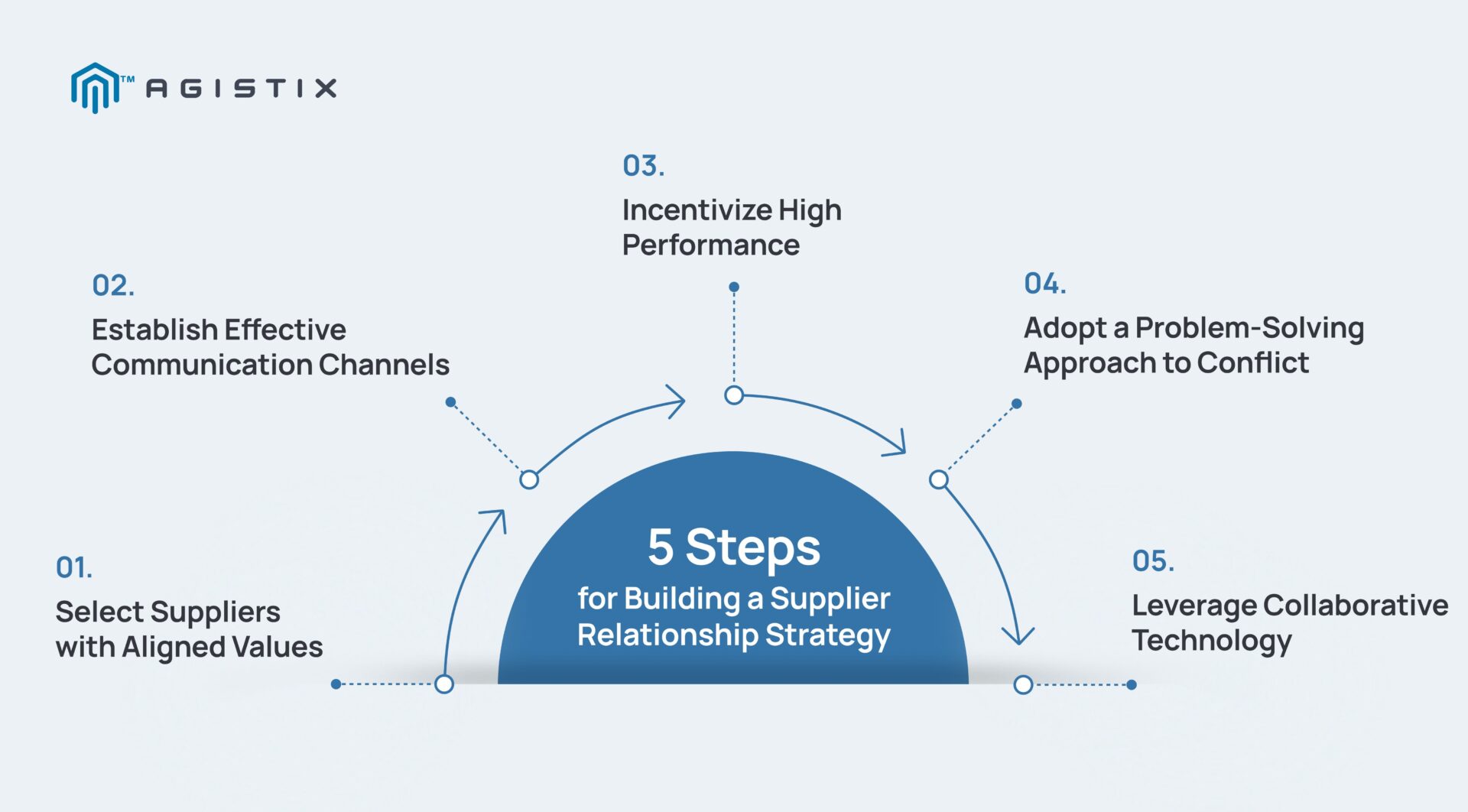
1. Select Suppliers with Aligned Values
Selecting the right suppliers is a key component of successful partnerships. It’s essential to identify suppliers whose values and goals align with the organization’s. Beyond evaluating cost and capabilities, supply chain professionals should prioritize suppliers who share a commitment to quality, sustainability, and ethical practices.
2. Establish Effective Communication Channels
Open and effective communication is vital to building strong supplier relationships, so regular communication channels should be established to facilitate the exchange of information. Supply chain professionals should actively engage suppliers in discussions regarding market trends, customer needs, and emerging challenges. Collaboration should go beyond immediate needs and include joint problem-solving, and continuous improvement efforts.
3. Incentivize High Performance
Recognizing and incentivizing high-performing suppliers is an effective way to strengthen the relationship and foster a sense of partnership. Supply chain professionals can implement incentive programs that reward suppliers for exceptional performance, such as meeting or exceeding quality standards, on-time deliveries, or cost-saving initiatives. Recognition could be a public acknowledgment, an award, or even a long-term contract that solidifies the partnership.
4. Adopt a Problem-Solving Approach to Conflict
In any partnership, conflicts and challenges may arise. Supply chain professionals should approach conflict resolution with a problem-solving mindset rather than a confrontational one. Emphasize open dialog, active listening, and a willingness to address issues collaboratively, focusing on timely resolution of conflicts to prevent the escalation of disputes.
5. Leverage Collaborative Technology
Centralized platforms allow for real-time data sharing and total visibility across the supply chain. Using collaborative technology ensures that all stakeholders work from a single source of truth. Shared data helps teams identify issues early and resolve exceptions before they impact production and delivery.
Future Trends in Supplier Relationship Management
The future of SRM is being shaped by data and the ability to collaborate in real-time.
- AI and Data Analytics for Proactive Insights: AI-driven algorithms can now predict supplier behavior, demand fluctuations, and potential disruptions, empowering organizations to make proactive decisions before a crisis hits.
- Collaborative Ecosystems: The old way of sharing data involved manual portals or clunky EDI. The trend is shifting toward collaborative “Microsites” where stakeholders can easily look up and add information to shipment records during their lifecycle, ensuring total visibility.
- Digital Data Ownership: Organizations are increasingly taking ownership of their supply chain data rather than leaving it siloed within carrier or supplier systems. This ownership is essential for long-term compliance, governance, and measuring true performance.
Improving Supplier Collaboration with Agistix
Building strong relationships is impossible if suppliers are forced to rely on manual processes and fragmented data. Agistix provides the infrastructure to bridge these gaps through collaborative Microsites. These customizable, browser-based applications allow every partner to look up and add information to shipment records throughout their lifecycle, ensuring everyone operates from a single source of truth.
Our robust integration layer supports all forms of data exchange – from modern APIs to legacy EPIs – without disrupting operations or involving heavy IT resources. By leveraging Microsites, Agistix gives your team and your suppliers a shared environment to manage exceptions and improve performance, leading to a more transparent and resilient supply chain.

Frequently Asked Questions
What is the difference between vendor management and supplier relationship management?
Vendor management is primarily a transactional process focused on short-term goals, while supplier relationship management is a strategic approach to long-term value.
- Vendor Management: Concentrates on price, fulfillment, and adherence to specific contract terms. It is often a one-way street where the buyer dictates terms and the vendor executes.
- Supplier Relationship Management: Focuses on mutual growth, risk sharing, and integrated workflows. It treats the supplier as a strategic partner, utilizing collaborative tools to ensure shared visibility.
What are the biggest challenges in supplier relationship management?
Most supplier relationship management hurdles stem from fragmented data and a lack of real-time visibility between partners. Common challenges include:
- Data Sil Silos: Information trapped in disparate systems or spreadsheets prevents a single source of truth.
- Poor Communication: Relying on manual emails or phone calls leads to delayed exception handling.
- Misaligned Incentives: Conflict arises when the buyer’s savings goals clash with the supplier’s operational constraints.
- Resistance to Transparency: Suppliers may be hesitant to share granular data without a secure, controlled environment.
What KPIs should be used to measure supplier performance?
KPIs should go beyond simple delivery dates to provide a comprehensive view of supplier health and reliability. Effective metrics include:
- On-Time In-Full (OTIF): The percentage of orders that arrive at the right time and with the correct quantity.
- Lead Time Variability: Measuring the consistency of the time elapsed between order placement and delivery.
- Quality Defect Rate: The frequency of items that fail to meet technical or safety specifications.
- Responsiveness: How quickly a supplier acknowledges orders or addresses shipping exceptions.
- Cost Variance: The difference between the quoted price and the final landed cost.
How often should supplier performance be reviewed?
Supplier performance should be reviewed through a combination of continuous automated monitoring and scheduled strategic evaluations. While a formal comprehensive review is typically conducted annually, high-stakes partnerships benefit from quarterly business reviews (QBRs).
Daily or weekly performance monitoring via centralized data platforms helps catch minor issues before they escalate into production halts. Suppliers identified as high-risk or those struggling with consistent quality issues should be assessed more frequently and may require formal corrective action plans.
What tools or software help manage supplier relationships?
Effective SRM requires a stack that moves beyond basic spreadsheets to allow for real-time collaboration. Key tools include:
- Collaborative Microsites: Purpose-built environments like those offered by Agistix that allow both parties to view and update shipment data simultaneously.
- Enterprise Resource Planning (ERP): Systems used for core procurement and financial record-keeping.
- Data Integration Layers: Middleware that connects different technical formats (API, EDI, CSV) into a single usable stream.
- Analytics Dashboards: Visualization tools that track KPIs and alert teams to performance trends or potential disruptions.
