December 2, 2025 - 9 minutes read
5 Ways Supply Chain Visibility Software Changes How You Manage Your Supply Chain
Supply chains are under constant pressure to move faster while staying agile in complex environments. But as logistics networks expand across more partners, systems, and modes, visibility gaps become harder to manage and more costly to ignore. According to The State of Visibility 2025 report, 37% of companies still lack visibility to shipments in transit, putting them at increased risk of production shutdowns or fulfillment failures.
Supply chain visibility software gives organizations a way to regain control by consolidating shipment, cost, and operational data into a single view. With timely access to accurate information, logistics teams can respond to issues as they arise, coordinate more effectively across stakeholders, and manage daily execution with greater confidence and consistency.
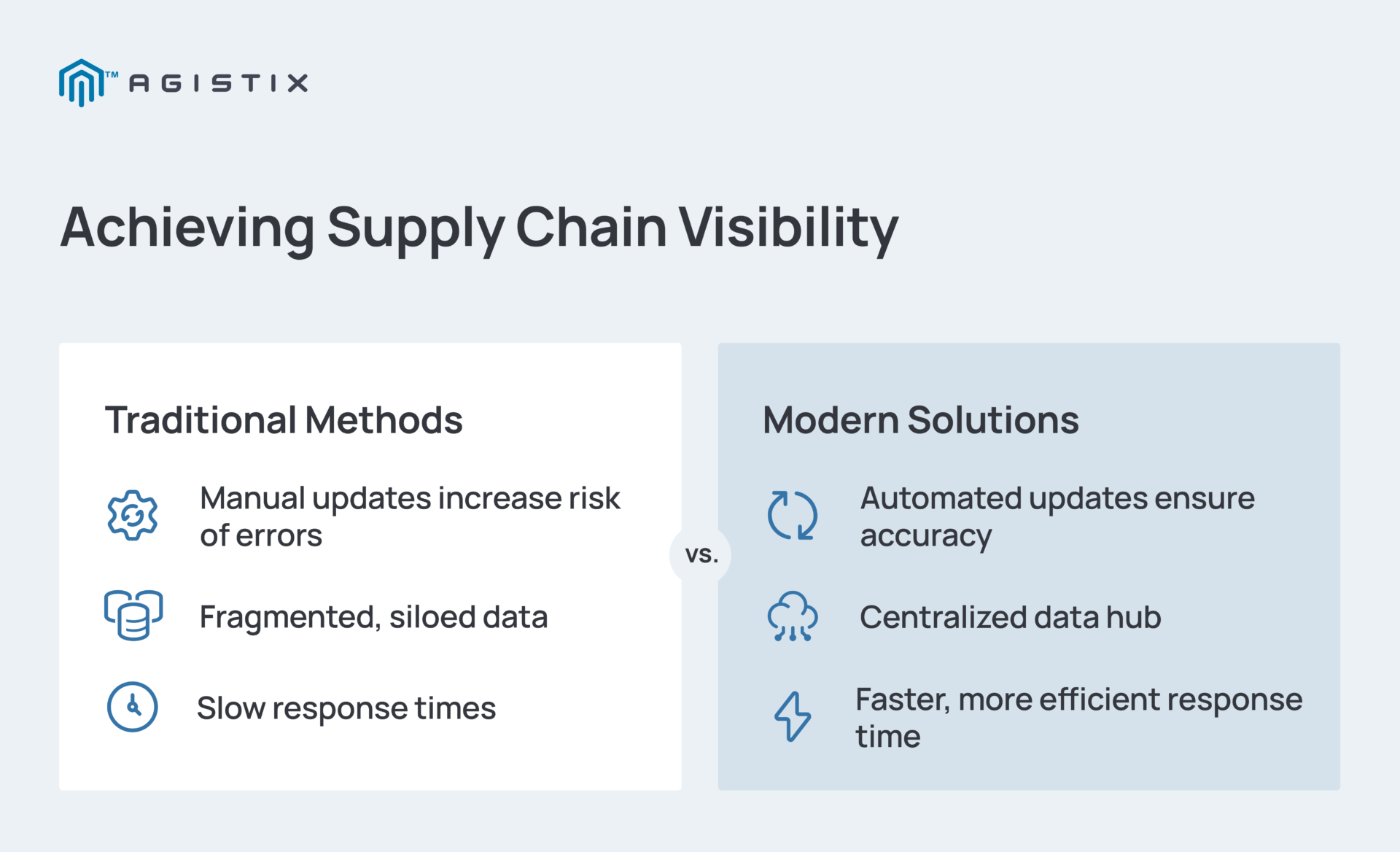
What is Supply Chain Visibility — And Why Traditional Methods Are Not Enough
Supply chain visibility is the ability to monitor goods, data, and activities across the supply chain in real time, from origin through final delivery. True visibility reflects what is actually happening across orders, shipments, documentation, and costs, rather than relying on sporadic manual updates.
Traditional visibility methods struggle to keep pace with modern supply chains. Manual processes and spreadsheets depend on outdated information and require constant monitoring and reconciliation. Data is spread across ERPs, TMSs, carrier portals, and email threads, leaving teams to assemble updates on their own. This fragmented approach slows response times, increases the risk of errors, and limits insight into the root causes of problems.
Modern supply chain visibility tools replace these disconnected workflows and integrate data across systems and partners. By centralizing and standardizing information and providing access through a single platform, companies gain insight into current conditions and the ability to act quickly when disruptions inevitably occur.

Why Real‑Time Visibility Matters in 2026 Supply Chains
Modern supply chains operate across more carriers, modes, and borders than ever before. A single shipment may move between ocean, rail, and truck, all with different compliance requirements and handoffs along the way. In this environment, delayed or incomplete information creates compounding risk. Teams need a real-time visibility platform that reflects current conditions across shipments, documents, and costs, rather than relying on status updates that arrive when it’s too late to act on them.
In the short term, real-time visibility improves day-to-day execution. When data updates continuously, issues surface earlier, and teams can respond before delays escalate. Logistics teams gain faster awareness of missed milestones, documentation gaps, or carrier disruptions, allowing them to adjust routing, communicate with partners, and keep shipments moving. This level of responsiveness reduces avoidable delays and helps stakeholders stay aligned every step of the way.
Explore how Agistix enhances real-time visibility across complex supply chains in our detailed blog post.
Over time, the value of supply chain visibility software extends beyond execution. Consistent access to accurate data supports better planning, stronger risk management, and more informed cost control decisions. Patterns become easier to identify, and organizations can evaluate performance across lanes, partners, and modes with confidence. Instead of reacting to disruption, companies are better equipped to anticipate it and build supply chains that are more resilient and efficient.
Common Supply Chain Visibility Challenges in 2026
Even with the right intent and investment, organizations continue to face practical barriers that limit visibility across their supply chains. Top things that hinder end-to-end visibility include:
1. Legacy Systems and Technology Adoption
Many organizations still rely on legacy systems that are not equipped to support modern supply chain visibility. These platforms typically provide only a partial view of operations, rely on slow manual data entry, and struggle to integrate with other systems. As a result, teams work with incomplete or outdated information, making it nearly impossible to quickly identify and manage exceptions.
While moving to modern supply chain visibility tools is often necessary to stay competitive, technology adoption remains a challenge. PwC’s 2025 Digital Trends in Operations Survey found that  92% of operations and supply chain leaders report that technology investments have not delivered the results they expected, most often due to integration complexity and data quality issues. Without a platform that unifies systems and standardizes data, visibility initiatives struggle to gain traction.
2. Data Silos and Fragmentation
Internal departments such as procurement, manufacturing, logistics, and sales often operate within separate systems, while suppliers and transportation providers rely on their own external platforms. This lack of integration creates fragmented data, making it difficult to maintain a complete view of supply chain activities and to make well-informed decisions. In fact, recent IBM analysis shows that 82% of organizations report that data silos disrupt critical operations, with 68% of their data remaining unanalyzed.
To compensate, teams frequently rely on manual processes to bridge these gaps, pulling information from multiple systems, reconciling discrepancies, and validating updates by hand. This added effort increases the risk of errors and creates significant operational inefficiencies.
3. Lack of Real-Time Operational Insight
Real-time visibility is often framed as shipment tracking, but many organizations still operate with delayed insight across other critical operational data. Outdated systems may provide periodic location updates but fail to surface information on documentation status, compliance requirements, or freight costs.
Without timely access to accurate documents, trade data, and financial details, disruptions compound quickly. Teams may not realize paperwork is missing or costs are increasing until a shipment is already delayed. A real-time visibility platform connects location data with operational context, allowing organizations to manage exceptions, control costs, and maintain compliance before those issues impact service or revenue.
4. Limited Collaboration Across Supply Chain Partners
Global supply chains rely on coordination and communication across stakeholders, often spanning regions and time zones. When information doesn’t flow easily between internal teams and external partners, even minor issues can escalate into larger disruptions.
A delay at a supplier, for instance, may not reach downstream teams in time to adjust production schedules or reroute inventory. Internally, disconnected tools and manual communication can lead to inconsistent order information, delayed responses, and misaligned expectations. Without shared access to timely, reliable data, collaboration becomes reactive, increasing costs and eroding customer confidence.
5. External Disruptions and Unpredictable Risk
External forces continue to place pressure on supply chains and expose gaps in visibility. A 2024 survey by Thomson Reuters found that supply chain leaders note geopolitical instability (19%), supply chain complexity (17%), and regulatory challenges (15%) as the most pressing issues impacting their operations, and the most likely to disrupt the flow of goods. These events are largely outside an organization’s control, but their impact is often magnified by limited insight and delayed information.
Together, these challenges make it difficult to achieve consistent, end-to-end visibility. Addressing them requires modern supply chain visibility software that unifies data, enables collaboration, and delivers instantaneous insight across the entire supply chain.
Key Functionalities of Supply Chain Visibility Software
Supply chain visibility software should provide teams with a clear, reliable view of logistics activity as it happens, without relying on manual workarounds.
- Real-time shipment tracking: Provides continuous visibility into shipment location, status, and estimated arrival times across all modes.
- Data centralization and integration: Aggregates data from ERPs, TMSs, and third-party providers into a single platform.
- Analytics and reporting: Delivers configurable dashboards and reports that surface trends, performance metrics, and risk indicators.
- Collaboration and communication tools: Enables shared access to shipment data, documents, and alerts across internal teams and external partners.
- Data ownership, traceability, and compliance: Maintains a complete, auditable record of shipments, transactions, and supporting documents.
These capabilities form the foundation for more informed, responsive supply chain management. When visibility is built into daily workflows, organizations can move beyond reactive issue response and start proactively managing logistics.
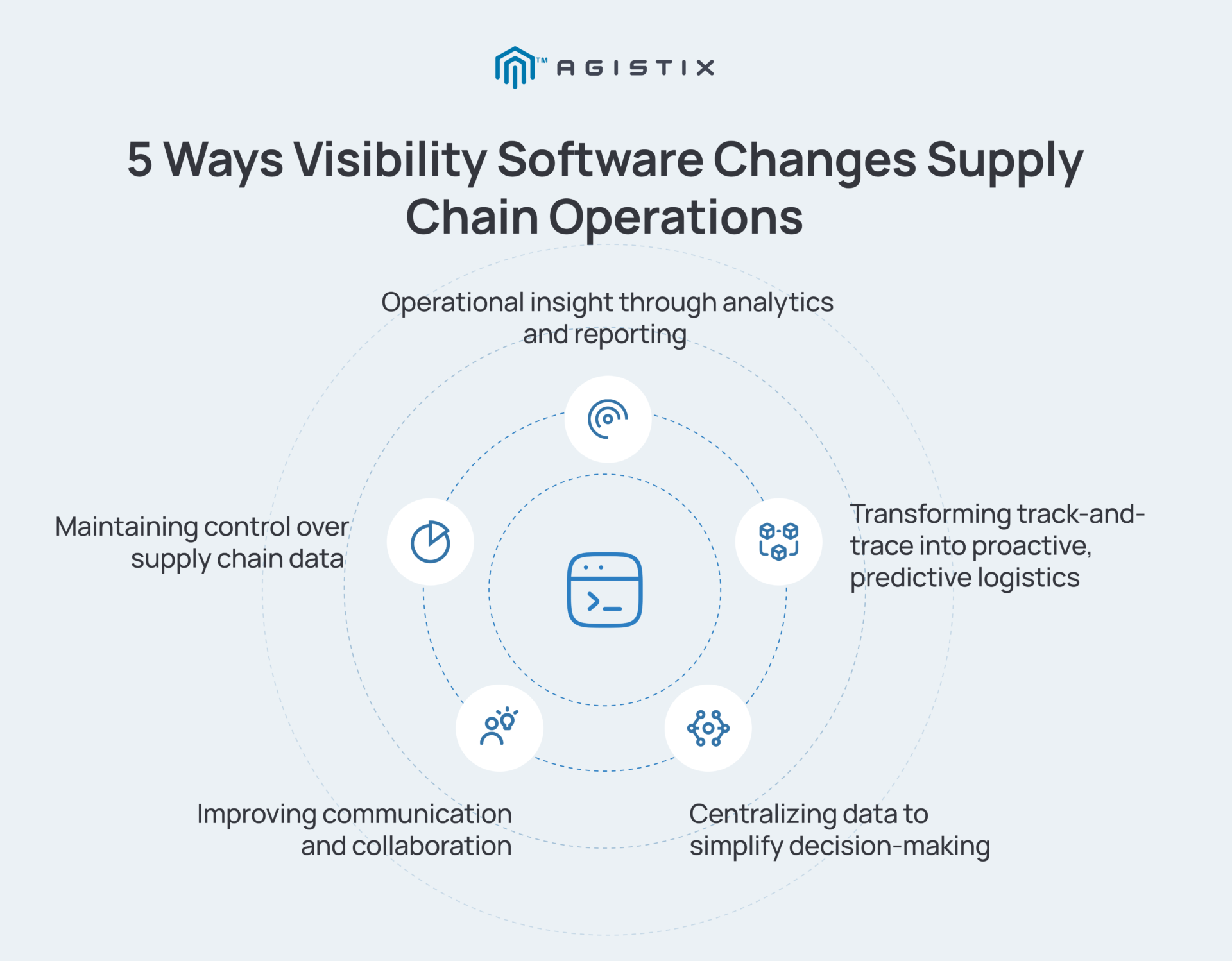
5 Ways Visibility Software Changes Supply Chain Operations
Once visibility is in place, the most significant shift is in how problems surface, how quickly they’re addressed, and how much guesswork is removed from day-to-day logistics management.
Transforming Track-and-Trace Into Proactive, Predictive Logistics
Basic tracking answers where a shipment is. Visibility software answers whether it is at risk.
By combining in-transit movement with transactional and financial data, modern platforms expose problems that traditional tracking misses. Missed milestones, incomplete documentation, unusual cost variances, or repeated carrier delays can all indicate trouble while there’s still an opportunity to address them. Predictive analytics build on this history, allowing teams to anticipate delays and make adjustments while there is still time to act. The focus shifts from monitoring movement to managing outcomes.
Centralizing Data to Simplify Decision-Making
Disconnected systems force teams to rely on partial context. Decisions are made with only part of the picture because the rest of the information lives elsewhere.
Supply chain visibility platforms remove that friction by consolidating shipment activity, transactional records, and supporting documents into a single operational view. Domestic and international movements, booking details, and shipment documentation are no longer separated by system or region. When reliable information is available in full context, teams spend less time validating inputs and more time addressing actual issues.
Improving Communication and Collaboration
Most collaboration issues stem from inadequate access to the right information. When some stakeholders are working from updated data, and others are not, alignment erodes fast.
Visibility platforms create a shared reference point across internal teams and external partners. Shipment status, charges, and supporting documents are visible without requiring emails or multiple follow-ups. This reduces noise across the network and shortens the time between identifying an issue and addressing it.
Maintaining Control Over Supply Chain Data
As supply chains grow more complex, the question of who controls the data becomes harder to answer. Visibility software restores that control by maintaining a complete record of shipment activity, transactions, and documentation in one place.
This traceability supports audits and regulatory requirements without relying on fragmented records or third-party portals. It also gives organizations confidence in the accuracy of their data, which is critical when resolving disputes, validating charges, or reviewing historical performance.
Operational Insight Through Analytics and Reporting
Centralizing all supply chain data in a single platform enables companies to leverage powerful reporting and analytics tools, which help them identify trends and patterns to run more smoothly.
Companies can also use custom KPIs and data visualization tools to easily interpret complex supply chain data and generate reports tailored to their specific needs. Scheduling and automating custom reports ensures that stakeholders receive critical insights in their preferred format. This gives businesses detailed insights from accurate, timely data to drive performance improvements. Integrating data from internal and third-party systems provides a holistic view of logistics operations, enabling proactive monitoring and better response to potential disruptions.
By implementing a comprehensive visibility platform, organizations can unlock the full potential of their supply chains, achieving greater efficiency and cost savings across the network.
Achieve End-to-End Visibility With the Agistix Platform
Agistix enables businesses to take on supply chain challenges with its comprehensive suite of solutions. Agistix Visibility makes end-to-end visibility a reality by monitoring supply chain activities from order to invoice. Agistix TMS optimizes transportation management with advanced features for rating, bidding, and more, streamlining logistics operations and reducing costs. And Agistix Microsites foster easy collaboration across the supply chain network by equipping stakeholders with self-service access to critical data.