
Improving OTIF Performance Through Supply Chain Visibility & Collaboration
Improving OTIF performance requires real-time supply chain visibility and active partner collaboration to eliminate costly delivery failures. This guide identifies common fulfillment gaps and explains how to use integrated data to ensure every order arrives on time and in full. Centralizing communication across the logistics network helps organizations meet strict retailer standards and protect profit margins.
In today’s increasingly competitive global market, retailers and suppliers are constantly under pressure to meet on-time and in-full (OTIF) delivery standards. Falling short can lead to costly chargebacks, lost revenue, and strained customer relationships. Despite this reality, many companies still operate with limited supply chain visibility, disconnected systems, and outdated processes, making it challenging to improve OTIF metrics.
Strong OTIF performance requires two fundamental components: real-time supply chain visibility and collaboration between teams. This article explores how better data and communication can drive improvement and what metrics companies need to track to stay ahead. It also presents Agistix’s solutions for closing visibility gaps, connecting supply chain partners, and optimizing fulfillment.
What is OTIF and Why Does it Matter?
OTIF is a critical supply chain KPI that measures logistics performance. It refers to a supplier’s ability to deliver goods within the requested delivery windows and in full quantities ordered.
Originally introduced by Walmart in 2017, OTIF was designed to hold suppliers accountable for meeting delivery commitments. The initiative inspired the retail industry to adopt similar performance standards for operational efficiency and reliable fulfillment.
A strong OTIF score signals an efficient supply chain, while missed deliveries can result in penalties and substantial margin erosion. Here’s why OTIF performance matters:
- Stronger customer relationships – Reliable, on-time deliveries increase trust and satisfaction, driving repeat business.
- Lower operational costs – Meeting OTIF targets reduces the need for last-minute expedited shipments to resolve late shipments and shortage issues.
- Improved supply chain efficiency – A history of on-time, in-full deliveries strengthens collaboration with suppliers and carriers.
- Fewer disruptions – High OTIF rates prevent delays, inventory shortages, and unnecessary reworks.
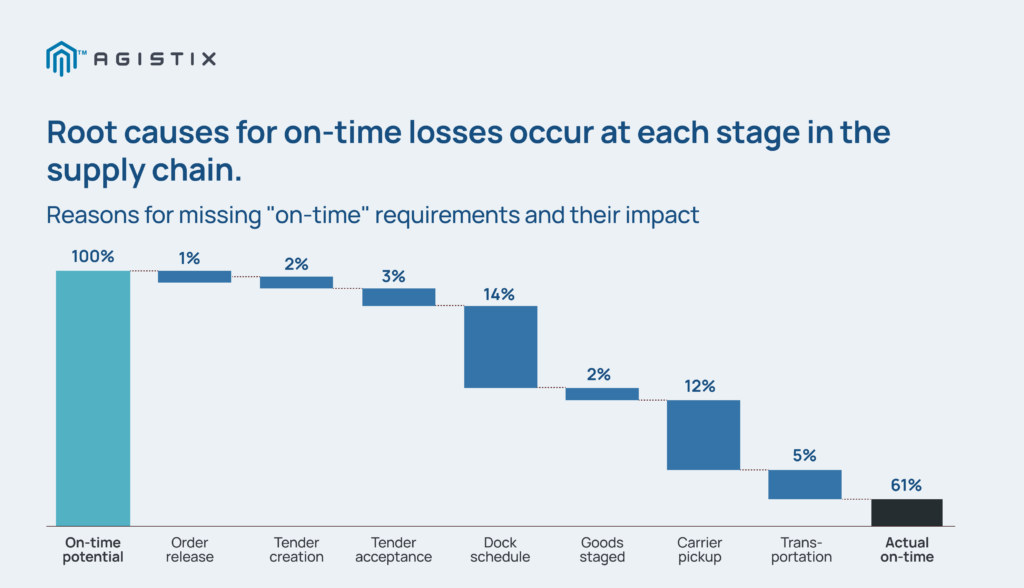
Reliable fulfillment prevents inventory shortages and reduces the need for costly reworks. While transportation delays often receive the blame for missed windows, performance losses occur at almost every stage of the shipment lifecycle. Identifying the specific friction points in the fulfillment process allows logistics teams to make targeted, strategic improvements.
Common Causes of Poor OTIF Performance
Delivery failures often stem from poor internal processes rather than transit issues. Errors at the point of origin frequently delay shipments before they even reach the highway. Most companies struggle with these specific hurdles:
- Clogged docks – When warehouse schedules don’t align with driver arrivals, trailers sit idle and loading takes longer than necessary.
- Late pickups – Drivers who show up past their scheduled time or arrival with the wrong equipment immediately put the delivery behind schedule.
- Slow tendering – Taking too long to offer a load or wait for a carrier to accept it eats into the transit time required for a successful delivery.
- Unprepared orders – If the warehouse doesn’t stage the goods before the truck arrives, the driver waits or leaves empty, resulting in a missed OTIF opportunity.
- Transit disruptions – Unexpected events like weather or road closures still play a role, but they are often the hardest factors to control without real-time data.
The Role of Supply Chain Visibility in OTIF Performance
True supply chain visibility requires a connected ecosystem where critical information flows easily between all stakeholders. This interconnectedness empowers businesses to improve OTIF scores by providing a clear, real-time view of the entire operation. When teams move away from manual tracking and spreadsheets, they gain the speed necessary to keep fulfillment on track.
Real-Time Disruption Detection
Visibility tools act as an early warning system that helps teams spot unforeseen disruptions like port closures, extreme weather, or transit delays. Instead of waiting for a “where is my stuff” call from a customer, shippers use live alerts to address issues proactively. This data allows logistics managers to reroute shipments or switch transportation modes quickly to ensure cargo reaches the destination when it’s due.
Performance Monitoring and Optimization
Supply chain visibility involves much more than just tracking locations on a map. Effective platforms monitor carrier performance, identify which routes consistently cause delays, and track whether drivers follow specific routing guides. This data helps logistics leaders build a more reliable network by selecting the best-performing partners and consolidating shipments to eliminate waste.
Cost Visibility and Control
Visibility platforms provide a granular look at freight costs by comparing expected charges to actual carrier invoices. This transparency helps teams find discrepancies, avoid overpaying for service failures, and uncover specific areas for savings. Having a clear view of financial data provides better budget control and gives shippers the leverage they need during contract negotiations with carriers.
Centralized Data Sharing
Data centralization platforms serve as a single source of truth for suppliers, carriers, and internal teams. This connectivity ensures that everyone sees the same performance metrics and shipment statuses in real time. If a supplier delays production or a carrier rejects a load tender, the visibility platform notifies all parties instantly. This immediate communication allows everyone to adjust their plans and keep the delivery schedule intact.
The Power of Collaboration in Driving OTIF Excellence
Effective collaboration is a key factor in achieving high OTIF performance. In fact, recent surveys show that 56% of manufacturers with excellent supply chain collaboration report supplier on-time delivery of more than 95%. When suppliers, carriers, and retailers work in sync by sharing data, aligning schedules, and proactively addressing disruptions, OTIF targets become far more attainable.
1. Greater Supply Chain Efficiency
Collaborative data sharing streamlines the movement of goods across the entire network. When organizations sync internal systems with supplier and carrier systems, they can eliminate manual check calls and fragmented updates. This coordination allows every partner to optimize their operations based on real-time data from others, reducing the time freight sits idle and ensuring a more efficient flow through the entire supply chain.
2. Better Communication and Transparency
Shared data allows every stakeholder to view shipment status, inventory levels, and demand forecasts whenever they need to. Data sharing and transparency prevents the confusion that often leads to late arrivals or short shipments. When everyone uses the same information, teams can match their efforts to meet specific OTIF requirements rather than working in silos.
3. Increased Predictability and Reliability
Standardizing how partners communicate provides the data needed to hit narrow delivery windows reliably. For example, a global healthcare organization reached 95% on-time performance visibility across their carrier network by integrating partner data and automating workflows. Centralizing communication helps turn erratic arrival times into a predictable schedule, ensuring cargo reaches the destination when the customer expects it.
4. Cost Efficiency
Collaboration cuts costs by removing the uncertainty that drives up expenses. When partners share accurate demand forecasts, they don’t have to hold extra safety stock just to feel secure. These teams can also share resources like backhaul capacity to lower total freight spend without losing speed. Planning ahead eliminates the need for the expensive, last-minute expedited shipping that usually happens when communication falls short.
5. Shared Responsibility
Close coordination between suppliers and carriers creates a culture of accountability. When every party understands their role in the fulfillment cycle, they can engage in collaborative proactive problem-solving. Shared ownership ensures that minor issues do not escalate into delivery failures that trigger retailer penalties.
Practical Steps to Improve OTIF Through Visibility and Collaboration
Improving OTIF performance requires the right combination of tech, process improvement, and strong supply chain partnerships. Here are actionable steps to consistently improve delivery performance and fulfillment reliability.
Step 1: Invest in Visibility Technology
A strong OTIF strategy starts with real-time visibility. Investing in an end-to-end visibility platform enables accurate tracking, data-driven decision-making, and collaboration across the supply chain. The right solution should provide:
- Complete shipment visibility – Track every shipment, across all modes and carriers, from origin to final destination.
- Integrated rating and booking – Centralize multimodal shipment management and carrier selection within a single platform.
- Collaboration tools – Enable self-service access to critical data and simplify communication between stakeholders.
Step 2: Improve Order Fulfillment
Automating key processes, improving warehouse layouts, and refining picking and packing workflows reduce errors and speed up fulfillment. Warehouse automation technologies streamline operations, while predictive analytics improve inventory accuracy and prevent stockouts.
Step 3: Utilize Transportation Management Solutions
A well-integrated transportation management system (TMS) helps optimize shipping routes, minimize delays, and improve cost-effective carrier selection. Performance data ensures reliable carrier choices, while exception management tools help resolve disruptions before they impact OTIF.
Step 4: Foster Collaboration and Communication
Clear communication and data sharing improve coordination between suppliers, carriers, and retailers. Aligned KPIs create accountability, digital collaboration tools enable real-time problem-solving, and strong partnerships drive consistent delivery performance.
Key Metrics to Track for OTIF Success
A widely accepted OTIF benchmark is 95%, meaning 95 out of every 100 orders are shipped complete and on time. In competitive markets, some companies push for even higher standards, aiming for 99% or more. Achieving and maintaining this level of OTIF performance requires tracking the right metrics to identify inefficiencies and make data-driven improvements.
Here are the key KPIs that supply chain professionals rely on:
- On-time delivery rate – Measures the percentage of orders that arrive on or before the promised delivery date.
- Order fill rate – Tracks the ability to fulfill orders completely from available inventory.
- Inventory turnover – Indicates how quickly inventory moves through the supply chain.
- Average delivery time – Calculates the average time it takes for an order to reach the customer.
- Customer order cycle time – Measures the total time from order placement to final delivery.
How to Calculate OTIF
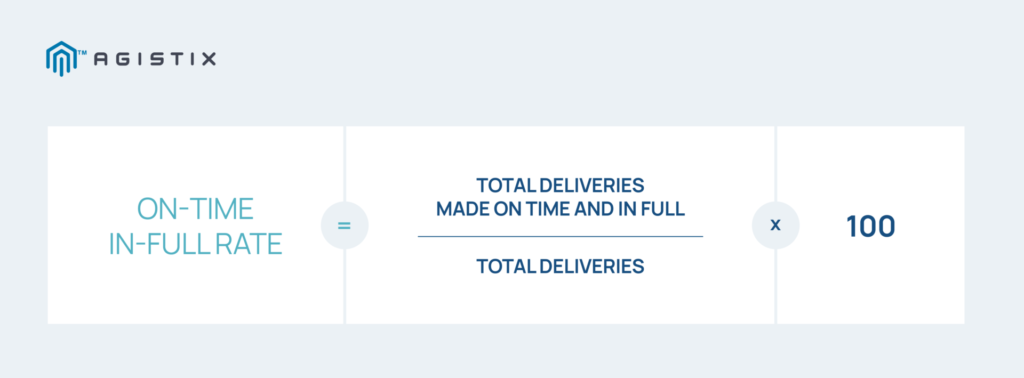
Logistics teams use a straightforward formula to determine their OTIF score. Use the following calculation to measure performance:
- OTIF = (Number of On-Time and In-Full Deliveries / Total Deliveries) × 100
Example: If a company delivers 500 total orders and 475 of those orders arrive both on time and with every item included, the OTIF score is 95%.
- (475 / 500) x 100 = 95%
Improving OTIF Performance with Agistix
Improving OTIF demands real-time visibility, proactive decision-making, and collaboration every step of the way. Agistix gives businesses the tools to take control, providing automated data capture and in-depth analytics to eliminate blind spots and address disruptions before they impact delivery performance.
The Agistix platform includes three solutions that can be used independently or as a comprehensive logistics suite:
- Agistix Visibility – Monitors shipments across all modes and carriers, tracks key performance indicators, and provides a complete view of supply chain operations.
- Agistix TMS – Optimizes route planning, carrier selection, and transportation management to improve delivery efficiency.
- Agistix Microsites – Enables stakeholders to access real-time shipment data through a self-service platform.
OTIF performance is a direct reflection of supply chain efficiency. Agistix delivers the visibility, control, and intelligence businesses need to meet delivery commitments with confidence. Book a demo today to see Agistix in action.
Frequently Asked Questions
What is the formula for OTIF?
The OTIF formula is (Number of On-Time and In-Full Deliveries / Total Deliveries) × 100. This metric measures fulfillment accuracy by dividing perfect orders by the total volume shipped.
For example, if a company ships 1,000 total orders, but 50 arrive late and another 30 arrive with missing items, only 920 orders meet both criteria. Dividing those 920 perfect orders by the 1,000 total shipments results in a 92% OTIF score.
What is the difference between OTIF and OTD?
On-time delivery (OTD) measures only delivery timing, while on-time, in-full (OTIF) measures both timing and order completeness. A shipment meets OTD standards if it arrives on schedule, even if items are missing. The OTIF metric provides a more rigorous performance standard because it requires the supplier to fulfill the exact quantity ordered within the requested delivery window.
How can companies improve OTIF without overhauling their tech stack?
Shippers can use data integration layers to centralize information from existing ERP, WMS, and TMS platforms into one visibility dashboard. Centralized integration removes data silos and manual reporting without the cost of a full system replacement. Connecting carrier APIs directly to these legacy workflows provides the real-time data needed to identify and resolve transit disruptions before they impact delivery windows.
What is a good OTIF score in retail and manufacturing?
A score of 95% is the standard performance benchmark for major retailers and manufacturers. Leading organizations often target 98% or 99% to ensure product availability and avoid compliance fines. Scores below 90% generally signal systemic issues in warehouse staging or carrier reliability that require immediate process adjustments to maintain retailer relationships.
How do retailers calculate OTIF penalties?
Retailers typically charge a percentage of the cost of goods sold (COGS) for every order that fails to meet OTIF requirements. For example, some retailers levy a 3% fine on the value of goods that arrive late or incomplete. Penalty assessments apply to every non-compliant shipment, which directly erodes supplier margins and profitability.
