April 25, 2025 - 6 minutes read

TMS vs Freight Visibility Platform: What’s the Difference?
In logistics, few terms are more overused or misunderstood than “visibility.” It’s often treated as a catch-all, but the reality is more complex. Supply chain visibility means different things depending on who you ask, which system you use, and how your global network operates. And when it comes to choosing technology, the confusion only grows.
Transportation Management Systems (TMS) are commonly associated with visibility, especially around shipment status and carrier updates. But that visibility is often limited to shipments executed through the TMS itself. For many organizations, that leaves significant blind spots in inbound, third-party, and globally sourced shipments, along with missed cost and performance data.
Freight visibility platforms are designed to close those gaps. Unlike a TMS, these systems are designed to centralize data across systems, carriers, and shipment types to provide real-time, order-to-invoice insight into all logistics activity, regardless of who booked the freight or the mode of transportation.
To understand the difference between a TMS vs supply chain visibility platform, it’s important to define what each solution delivers. While they can work together, their roles in modern supply chain management are fundamentally different.
What is a Global Transportation Management System (TMS)? Functions & Limitations
A TMS is software used to plan, execute, and optimize freight movement. These systems are a staple of logistics operations, particularly for organizations managing high volumes of shipments. Depending on the complexity of the supply chain, TMS solutions may vary in scope, but they generally include tools for:
- Booking and managing shipments
- Managing freight rates and contracts
- Tracking cargo status and milestones
- Handling documentation and audit trails
- Procuring and managing carriers
- Planning loads and coordinating dock schedules
- Generating reports and performance data
A TMS is highly effective at managing shipments. It provides visibility into status updates, carrier performance, and delivery timelines, but usually only for freight that moves through the system itself.
Limitations of TMS for Supply Chain Visibility
TMS platforms were built for execution, not end-to-end transparency. While powerful in scope, they fall short in several areas when used as the sole source of visibility:
- Limited Inbound and Third-Party Coverage: Most inbound freight and supplier-booked shipments never pass through the TMS, creating blind spots unless logistics teams manually input data or invest in costly integrations with external systems.
- System Fragmentation: Complex supply chains rarely rely on one system. A TMS doesn’t automatically sync with ERPs, WMSs, or external partner platforms, making it nearly impossible to create a cohesive view of freight activity.
- Data Latency: Even with integrations in place, data flow is often delayed. Status updates and key events may arrive hours or even days after they occur, hindering the ability to address issues quickly and efficiently.
- Gaps in Financial Visibility: Without visibility into all shipments, it’s hard to monitor contract adherence, assessorial fees, or true landed costs, leaving logistics and finance teams to manually reconcile discrepancies once they receive an invoice.
- Basic or Isolated Analytics: TMS reporting is often limited to shipments managed within the platform. Broader performance insights across regions, carriers, or shipment types require significant customization or additional tools.
While a TMS is essential for day-to-day freight management, it isn’t designed to centralize data across systems or deliver holistic supply chain visibility. For organizations managing complex global networks, these limitations can significantly limit responsiveness and cost control.
What Is a Freight Visibility Platform? Features and Capabilities
A freight visibility platform is built to provide a complete view of logistics activity, regardless of how, where, or by whom shipments are booked. Unlike a TMS, which focuses on executing freight movement, a visibility platform connects disparate systems, carriers, and data sources to present a unified, real-time view of supply chain operations.
These platforms ingest and standardize data from multiple partners and systems, including TMS, ERP, WMS, and carrier feeds. This enables centralized visibility into all shipment activity – across modes, regions, and business units – without relying solely on information from the system that executed the freight.
In addition to tracking shipments in transit, visibility platforms surface operational and financial insights that often remain buried in disconnected systems. This includes performance metrics like pickup accuracy, OTIF deliveries, and dwell time, as well as cost drivers such as accessorial fees, rate discrepancies, and non-contracted carrier bookings.
Core capabilities typically include:
- Real-Time Shipment Tracking – Location updates and milestone events from multiple data sources to enable faster exception detection and response.
- Multi-Carrier, Multi-Mode Coverage – Visibility across all transportation modes and carriers, regardless of how freight is booked or who manages it.
- Performance and Cost Analytics – Centralized reporting on carrier performance, rate compliance, and total transportation spend across the entire network.
- Flexible Integration with Existing Systems – APIs, EDI, and other integration tools connect visibility platforms to the systems companies already use, without requiring extensive process changes.
- Exception Management and Alerts – Configurable notifications that help logistics teams proactively address delays, documentation issues, and other exceptions in real time.
In the supply chain visibility vs TMS debate, it’s important to note that a visibility platform is not a replacement for a TMS; rather, it extends beyond it. Aggregating and harmonizing logistics data across partners, systems, and shipment types enables more confident decision-making, faster problem resolution, and clearer accountability across the entire supply chain.
TMS vs Freight Visibility Platform: Which Is Right for Your Business?
Both a TMS and a freight visibility platform play important roles in logistics operations, but they serve different purposes. A TMS is built to execute and manage transportation – especially outbound freight – while a visibility platform focuses on creating a centralized view of all logistics activity.
The right solution depends on a company’s supply chain operations, the systems already in place, and where data gaps may exist. Below is a side-by-side comparison to help clarify the difference between visibility vs TMS functionality: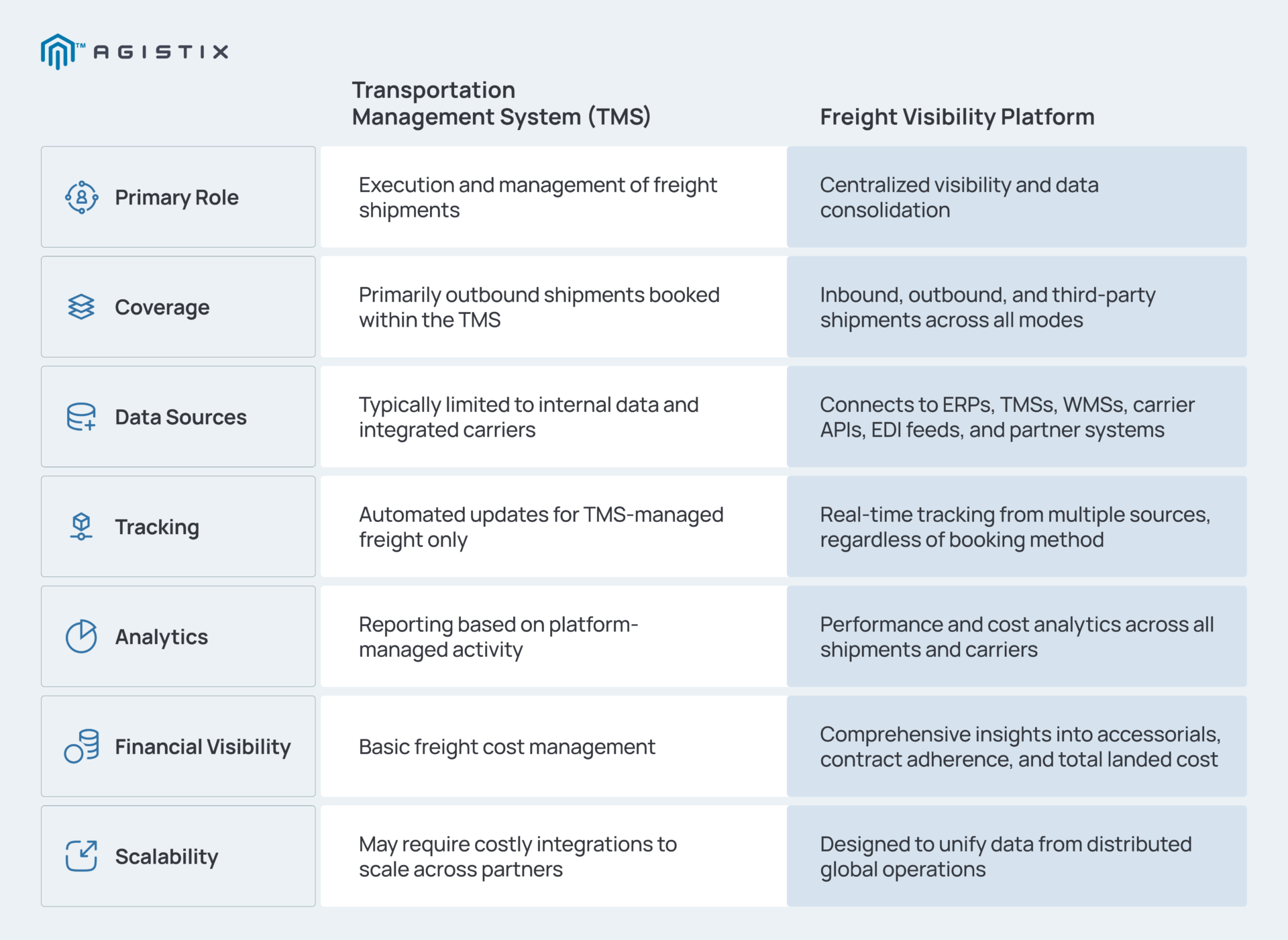 Organizations with straightforward transportation needs and centralized booking may rely primarily on a TMS. But companies operating across multiple modes, regions, or partners often require broader insight into freight activity. In these environments, relying on a TMS alone limits visibility, slows decision-making, and obscures cost drivers.
Visibility platforms provide that missing context. By integrating with existing systems rather than replacing them, companies can improve performance tracking and make better-informed logistics decisions without disrupting core operations.